Address
Building 1, No. 22, Shexi Yongping Road,
Dongguan, Guangdong, China
Work Hours
Monday to Friday: 7AM - 7PM
Weekend: 10AM - 5PM
Address
Building 1, No. 22, Shexi Yongping Road,
Dongguan, Guangdong, China
Work Hours
Monday to Friday: 7AM - 7PM
Weekend: 10AM - 5PM
Box fleet tracking can be as simple as a durable printed ID and a handover sheet, or as involved as RFID at each dock. The useful ... Ask Mingskye for a sample.
Box fleet tracking can be as simple as a durable printed ID and a handover sheet, or as involved as RFID at each dock. The useful output is the same: how many containers are at each location, how long they wait, and which ones keep going missing. Choose the least complex method that produces that data reliably. Check that any label or tag survives the washing process.
This page covers box fleet tracking in six sections: Repair versus grind decisions; Choosing the first route for a pool; Buffer stock for peak weeks; Stack alignment features and interlocking; How a box gets its stiffness from geometry; Empty-container inspection on arrival. Each section answers one practical question and can be read on its own.
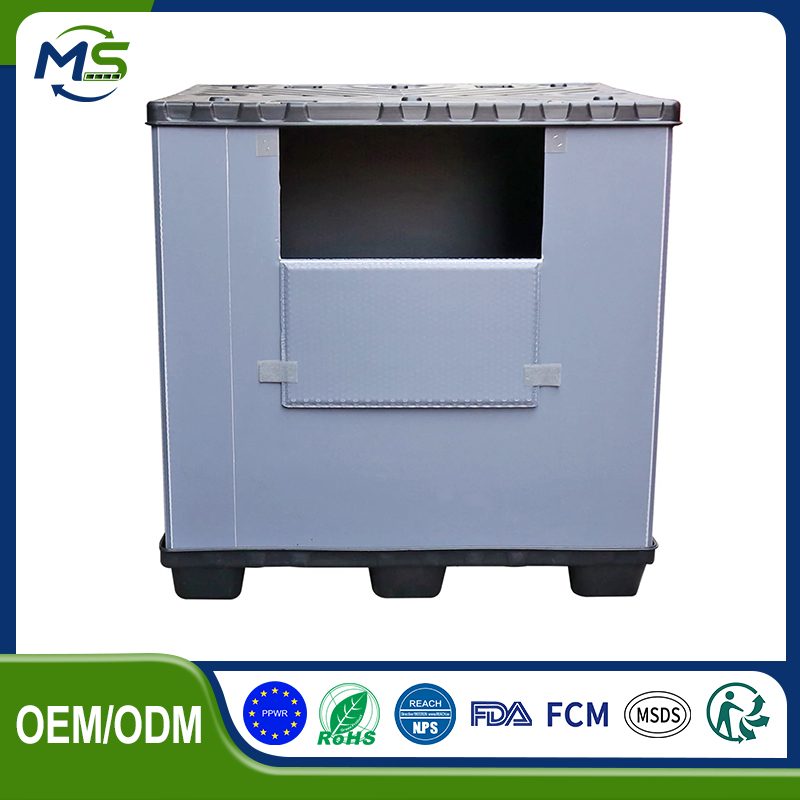
A repair rule protects the load and keeps the replacement budget predictable.
A replaced latch, a re-welded corner or a new label holder can be economical. A crushed core, a split along a fold line, a base that no longer sits flat or persistent contamination usually means grinding.
Record the reason for every retirement. A rising count of split folds points to the folding motion; a rising count of crushed corners points to handling at a specific dock.
The best first route is short, frequent and owned by two sites that already exchange paperwork.
A single part family and a predictable daily or weekly shipment give clean data. Complicating the pilot with mixed parts or a third-party warehouse makes it hard to tell whether a problem comes from the container or the process.
Name the route on the project sheet, together with the number of containers and the expected cycle time. A pilot with a defined boundary produces numbers someone can act on.
For terminology and test-method context see GHG Protocol Corporate Value Chain (Scope 3) Accounting and Reporting Standard. The guidance on this page is practical handling guidance, not a test report or a certificate.
Buffer stock covers a demand peak or a delayed return without stopping the filling line.
It should be sized from observed variability, not from a round percentage. A route with a steady daily shipment needs less cover than one with a large order at the end of each month.
Record where the buffer is stored and who releases it. Stock that exists but cannot be found on a Friday afternoon is not a buffer in practice.
| Operations question | Short answer | Measure to track | In this guide |
|---|---|---|---|
| What should be checked about repair versus grind decisions? | A repair rule protects the load and keeps the replacement budget predictable. | A replaced latch, a re-welded corner or a new label holder can be economical. A … | Section 1 |
| What should be checked about choosing the first route for a … | The best first route is short, frequent and owned by two sites that already exchange paperwork. | A single part family and a predictable daily or weekly shipment give clean data. Complicating … | Section 2 |
| What should be checked about buffer stock for peak weeks? | Buffer stock covers a demand peak or a delayed return without stopping the filling line. | It should be sized from observed variability, not from a round percentage. A route with … | Section 3 |
| What should be checked about stack alignment features and interlocking? | Interlocking features keep a stack square, which is what stops one corner from taking the entire … | A lip, a recessed base or a set of corner locators does the alignment. The … | Section 4 |
Interlocking features keep a stack square, which is what stops one corner from taking the entire upper load.
A lip, a recessed base or a set of corner locators does the alignment. The value is not extra strength but repeatability: every container sits in the same place even when a forklift driver is working quickly at the end of a shift.
Try stacking with a deliberate offset during the trial. A good feature guides the unit back into place; a poor one simply catches on the edge and transfers the shock into the corner joint.
Stiffness in a panel-built container comes mostly from the separation between its skins, not from the amount of resin used.
Spacing two thin faces apart raises the section’s resistance to bending far more efficiently than thickening a single sheet. The cell walls only have to keep that spacing stable under compression, which is why a light container can still feel rigid in the hand.
The practical consequence is a wall that is stiff in bending but vulnerable to a concentrated point load. A forklift tine, a corner strike or a badly placed pallet foot applies exactly the kind of load the geometry is least able to spread.
A short check when empties arrive prevents a damaged unit from entering the next filled cycle.
Count the units against the dispatch note, look for a split fold, a missing lid or a crushed corner, and separate anything that fails. The check takes a moment per pallet and produces the loss and damage figures the programme needs.
Put the reject bay beside the arrival point, not in a distant store. Containers placed near the washing line tend to be quietly put back into service without repair.
A repair rule protects the load and keeps the replacement budget predictable. A replaced latch, a re-welded corner or a new label holder can be economical. A crushed core, a split along a fold …
The best first route is short, frequent and owned by two sites that already exchange paperwork. A single part family and a predictable daily or weekly shipment give clean data. Complicating the pilot with mixed parts or a …
Interlocking features keep a stack square, which is what stops one corner from taking the entire upper load. A lip, a recessed base or a set of corner locators does the alignment. The value is not extra strength but repeatability …
A short check when empties arrive prevents a damaged unit from entering the next filled cycle. Count the units against the dispatch note, look for a split fold, a missing lid or a crushed corner, and separate anything …
References checked by publisher and title on 2026-11-10. Standards and regulations are cited by name only; no performance values are attributed to them. General material and logistics figures in the text are indicative reference values and should be verified against your supplier’s current data sheet and your own trial. Confirm applicability and current versions for your own operation before relying on any of them.
For a quotation, a sample box or help matching a wall thickness and closure to your loading bay and return route on site, contact service@mingplastics.com or WhatsApp +86 189 3887 1524. Include the part dimensions, the load per layer, the destination and the expected cycles per year so the recommended specification can be confirmed before you order.
For box fleet tracking, Measure trips, returns and dwell time per route, and keep the calculation unchanged between reviews. A short check when empties arrive prevents a damaged unit from entering the next filled cycle.


