Address
Building 1, No. 22, Shexi Yongping Road,
Dongguan, Guangdong, China
Work Hours
Monday to Friday: 7AM - 7PM
Weekend: 10AM - 5PM
Address
Building 1, No. 22, Shexi Yongping Road,
Dongguan, Guangdong, China
Work Hours
Monday to Friday: 7AM - 7PM
Weekend: 10AM - 5PM
A reusable box pool is easiest to launch on one stable route with one destination, one part family and a named owner at each end. ... Ask Mingskye for a sample.
A reusable box pool is easiest to launch on one stable route with one destination, one part family and a named owner at each end. Start with enough containers for the full cycle plus a small buffer, then measure returns for a quarter. Add washing and inspection rules before the volume grows. Expanding to a second route too early hides where losses occur and makes the data hard to read.
This page covers reusable box pool in six sections: Open loops and the recycling option; Lids, hinges and latches in one comparison; Condensation after a warm wash; Fleet size from cycle time; Colour and ink in recovered resin; Simple ID and a handover sheet. Each section answers one practical question and can be read on its own.
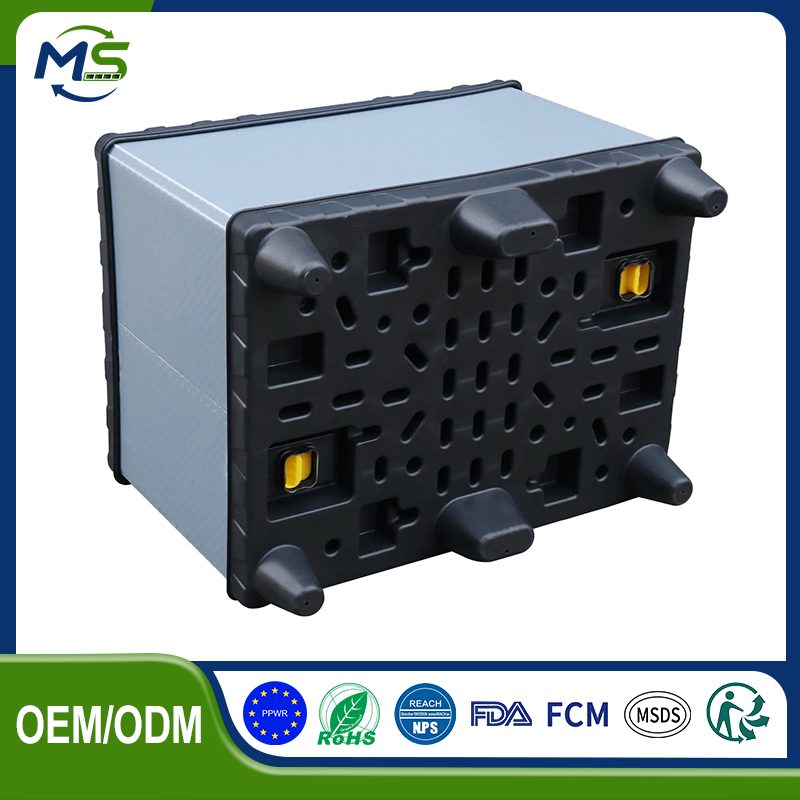
Where a return leg does not exist, a recyclable single-trip package is the more honest comparison.
A reusable container that leaks out of the loop becomes an expensive one-way box. A carton or a single-polymer single-trip design with a documented collection route at the destination does at least have a defined end of life.
Ask what happens to the package at the receiving site. If the answer is a local recycling scheme, record who operates it and what material it accepts.
Closure hardware should be chosen by how often the container is opened, not by how secure it looks on a sample.
A loose lid suits a loop where the box is opened once per trip and stored under cover. A hinged lid suits frequent access but adds a moving part to the wash line. A latch suits a long leg with several handovers, provided someone inspects it each cycle.
List the hardware on the bill of materials and mark which items are removable. That single column decides how much dismantling the recycling route will eventually require.
For terminology and test-method context see GHG Protocol Corporate Value Chain (Scope 3) Accounting and Reporting Standard. The guidance on this page is practical handling guidance, not a test report or a certificate.
A warm wash followed by a cold room leaves free water that a visual check may overlook.
Moisture settles on the coolest surface, which is often the underside of the lid or the base of a folded unit. If the container is closed at that point, the water stays with the load through the next fill.
Allow a cooling step with the lid open before the box enters a chilled store. Note where droplets form on one trial unit and use that spot in the standard drying check.
| Operations question | Short answer | Measure to track | In this guide |
|---|---|---|---|
| What should be checked about open loops and the recycling option? | Where a return leg does not exist, a recyclable single-trip package is the more honest comparison. | A reusable container that leaks out of the loop becomes an expensive one-way box. A … | Section 1 |
| What should be checked about lids, hinges and latches in one … | Closure hardware should be chosen by how often the container is opened, not by how secure … | A loose lid suits a loop where the box is opened once per trip and … | Section 2 |
| What should be checked about condensation after a warm wash? | A warm wash followed by a cold room leaves free water that a visual check may … | Moisture settles on the coolest surface, which is often the underside of the lid or … | Section 3 |
| What should be checked about fleet size from cycle time? | Fleet size follows the full cycle time, including the days when a container is empty and … | Multiply the number of containers dispatched per day by the total days from filling to … | Section 4 |
Fleet size follows the full cycle time, including the days when a container is empty and waiting.
Multiply the number of containers dispatched per day by the total days from filling to clean return, then add a small buffer. The waiting days are as real as the transport days and are usually the ones nobody counted.
Check the result against the slowest destination in the loop. A fleet sized on the average site will run short at the filling point whenever that one plant is busy.
Pigment and printing choices made at the start affect the value of the material at the end.
A dark or heavily printed shell limits the range of products the recovered resin can be used in, while a natural or light shell keeps more options open. Large ink coverage and non-compatible adhesives add further constraints.
Raise the colour decision in the design review, not after the first production run. Changing a shell colour later often means renegotiating the identification scheme as well.
A durable printed number and one line per handover are enough to run a small fleet.
Each container gets a fixed identifier, and each movement records that identifier, the date, the count and a signature. The sheet answers where the boxes are without installing any new system.
Choose a mark that survives the wash line and a pen that works on a damp dock. Stationery details decide whether a simple system actually gets used.
Where a return leg does not exist, a recyclable single-trip package is the more honest comparison. A reusable container that leaks out of the loop becomes an expensive one-way box. A carton or a single-polymer single-trip design with …
Closure hardware should be chosen by how often the container is opened, not by how secure it looks on a sample. A loose lid suits a loop where the box is opened once per trip and stored under cover. A hinged lid suits …
Fleet size follows the full cycle time, including the days when a container is empty and waiting. Multiply the number of containers dispatched per day by the total days from filling to clean return, then add a small buffer …
A durable printed number and one line per handover are enough to run a small fleet. Each container gets a fixed identifier, and each movement records that identifier, the date, the count and a signature. The sheet answers …
References checked by publisher and title on 2026-11-10. Standards and regulations are cited by name only; no performance values are attributed to them. General material and logistics figures in the text are indicative reference values and should be verified against your supplier’s current data sheet and your own trial. Confirm applicability and current versions for your own operation before relying on any of them.
For a quotation, a sample box or help matching a wall thickness and closure to your loading bay and return route on site, contact service@mingplastics.com or WhatsApp +86 189 3887 1524. Include the part dimensions, the load per layer, the destination and the expected cycles per year so the recommended specification can be confirmed before you order.
For reusable box pool, Measure trips, returns and dwell time per route, and keep the calculation unchanged between reviews. A durable printed number and one line per handover are enough to run a small fleet.


