Address
Building 1, No. 22, Shexi Yongping Road,
Dongguan, Guangdong, China
Work Hours
Monday to Friday: 7AM - 7PM
Weekend: 10AM - 5PM
Out-of-square stacks on high-bay racking are an interface problem between a loaded sleeve box and an automated beam position. A ... Ask Mingskye for a sample.
Out-of-square stacks on high-bay racking are an interface problem between a loaded sleeve box and an automated beam position. A wall that bows a little, a lid that overhangs, or a pallet that is not centred can push the unit outside the rack tolerance even when the stack is stable. A PP honeycomb pallet box needs a defined squareness check at the infeed, not just a stack-load figure. Measure the widest point of the loaded unit, set the infeed gauge, and log rejected pallets by cause.
This page covers out-of-square stacks on high-bay racking for High-bay racking in six sections: What an out-of-square stack looks like at the infeed; Why a stable load still fails the rack; Which measurements belong at the infeed; Which box details keep the envelope square; How to validate a change at the infeed; Limits of a container change. The buyer problem is stacked sleeves sit out of square and the rack rejects the pallet. Each section gives one on-site check and one record to keep.
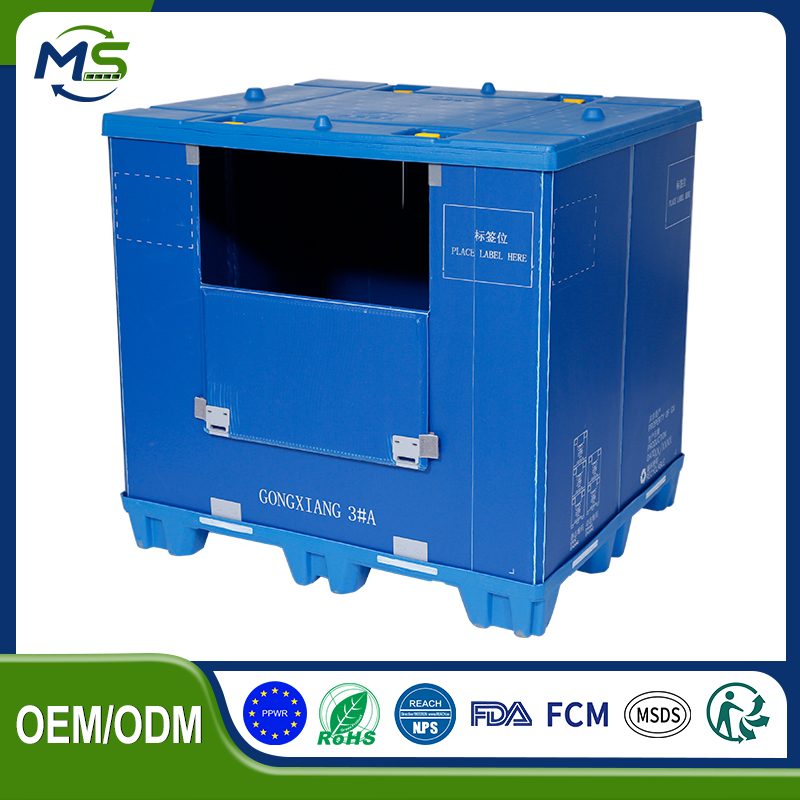
PP honeycomb pallet sleeve box used in high-bay racking – Mingskye reusable transport packaging.
The pallet is stable but the rack infeed rejects it on a clearance or a position check.
An automated high-bay system measures the pallet before it enters a location. A wall that bows outward, a lid that overhangs by a small amount, or a base that is not centred on the pallet can push the unit outside the allowed envelope. The operator sees a rejection message, not a leaning stack.
The same unit can pass a manual aisle and fail the automated infeed. That is why a visual stability check at the loading bay does not predict the rack result.
Rack tolerance is an envelope question, while stack load is a strength question.
A PP honeycomb sleeve box can carry a vertical load well and still grow sideways under that load if the walls are not restrained at the corners. A lid that shifts during braking, a divider pressing on an access door, or a part packed against a wall each add a few millimetres at the widest point. Those millimetres are what the infeed gauge sees.
Pallet position is the second cause. A unit that is square but placed off-centre on the pallet presents the same oversize to a fixed gauge as a bowed wall.
For terminology and test-method context see GS1. The guidance on this page is practical handling guidance, not a test report or a certificate.
Measure the widest point of the loaded unit and the pallet offset, then log rejections by cause.
Take the width and length at the top, middle and bottom of a loaded unit with the lid closed, using a gauge that matches the rack clearance. Note where the maximum occurs, because a bow at mid-height points to a corner restraint issue while an overhang at the top points to the lid. Record the pallet offset from a fixed edge.
Log each rejection against a short cause list: lid, wall, pallet position or load shift. A count without a cause cannot guide a box change.
| Symptom in the loop | Handover cause | Check on the route | Record to keep |
|---|---|---|---|
| What an out-of-square stack looks like at the infeed? | The pallet is stable but the rack infeed rejects it on a clearance or a position … | An automated high-bay system measures the pallet before it enters a location. A wall that … | Section 1 |
| Why a stable load still fails the rack? | Rack tolerance is an envelope question, while stack load is a strength question. | A PP honeycomb sleeve box can carry a vertical load well and still grow sideways … | Section 2 |
| Which measurements belong at the infeed? | Measure the widest point of the loaded unit and the pallet offset, then log rejections by … | Take the width and length at the top, middle and bottom of a loaded unit … | Section 3 |
| Which box details keep the envelope square? | Corner restraint, a located lid and a defined base footprint are the relevant features. | A PP honeycomb pallet box with positively located corners and a lid that seats inside … | Section 4 |
Corner restraint, a located lid and a defined base footprint are the relevant features.
A PP honeycomb pallet box with positively located corners and a lid that seats inside the wall line keeps its width when stacked. A base that locates on the pallet removes the placement variable, and an internal divider that bears on the corner posts rather than on the wall prevents a packed part from pushing the face outward.
Ask for the widest-point measurement on a fully loaded, stacked sample, not on an empty box on a bench. The empty dimension is rarely the one that fails the gauge.
Run a batch of loaded units through the real infeed and compare the rejection count by cause.
Use the same part load, the same pallet type and the same stack height as production. Record the gauge readings before the unit enters the rack, so a rejection can be linked to a measured widest point. Keep the handling route unchanged, because a different fork path can shift the lid.
If the rejection cause changes from wall to pallet position, the box fix worked and the remaining problem is placement. That distinction prevents an unnecessary second specification change.
Rack tolerances and equipment settings belong to the warehouse system, not to the box supplier.
Where the rack clearance is set for a different pallet standard, or where the infeed gauge is out of calibration, a square box will still be rejected. Confirm the rack specification and the sensor setup with the automation provider before changing a container. A box trial on a mis-set system produces a misleading result.
Use the site own tolerance values for the gauge. Test standards are cited here for terminology only, not as a source of a clearance figure.
The pallet is stable but the rack infeed rejects it on a clearance or a position check. An automated high-bay system measures the pallet before it enters a location. A wall that bows outward, a lid that overhangs by …
Rack tolerance is an envelope question, while stack load is a strength question. A PP honeycomb sleeve box can carry a vertical load well and still grow sideways under that load if the walls are …
Corner restraint, a located lid and a defined base footprint are the relevant features. A PP honeycomb pallet box with positively located corners and a lid that seats inside the wall line keeps its width when …
Rack tolerances and equipment settings belong to the warehouse system, not to the box supplier. Where the rack clearance is set for a different pallet standard, or where the infeed gauge is out of calibration, a square …
References checked by publisher and title on 2026-11-24. Standards and regulations are cited by name only; no performance values are attributed to them. General material and logistics figures in the text are indicative reference values and should be verified against your supplier’s current data sheet and your own trial. Confirm applicability and current versions for your own operation before relying on any of them.
For a quotation, a sample box or help matching a wall, closure and pack layout to your own route, contact service@mingplastics.com or WhatsApp +86 189 3887 1524. Include the part or crop, the load per layer, the destination, the dwell time and the expected cycles per year so the recommended specification can be confirmed before you order.
For out-of-square stacks on high-bay racking, Measure the widest point of the loaded unit, set the infeed gauge to it, and log rejections by cause. Rack tolerances and equipment settings belong to the warehouse system, not to the box supplier.
Need a specification sheet, samples or a quotation for PP honeycomb panels, sleeve boxes or cable reels? Our team replies within one business day.
Tel / WhatsApp: +86 189 3887 1524
Email: service@mingplastics.com
WhatsApp: Chat with us