Address
Building 1, No. 22, Shexi Yongping Road,
Dongguan, Guangdong, China
Work Hours
Monday to Friday: 7AM - 7PM
Weekend: 10AM - 5PM
Missing lids and dividers after return trips turn a complete returnable pack into a partial one. The box body comes back, but ... Ask Mingskye for a sample.
Missing lids and dividers after return trips turn a complete returnable pack into a partial one. The box body comes back, but loose accessories are left at a supplier, mixed into another set, or thrown away with the dunnage. Protection then depends on whatever the next loader can find. A PP honeycomb box with a divider set needs the accessory count on the same record as the box count. Attach or captive-fit what can be attached, kit the rest at the return point, and count both at goods-in.
This page covers missing lids and dividers after return trips for Returnable pack accessories in six sections: How missing accessories show up on a return; Why loose parts are lost more often than bodies; Which records make a complete set countable; Which pack features reduce the loss rate; How to run a completeness trial; Limits of accessory controls. The buyer problem is lids and dividers go missing after every return trip. Each section gives one on-site check and one record to keep.
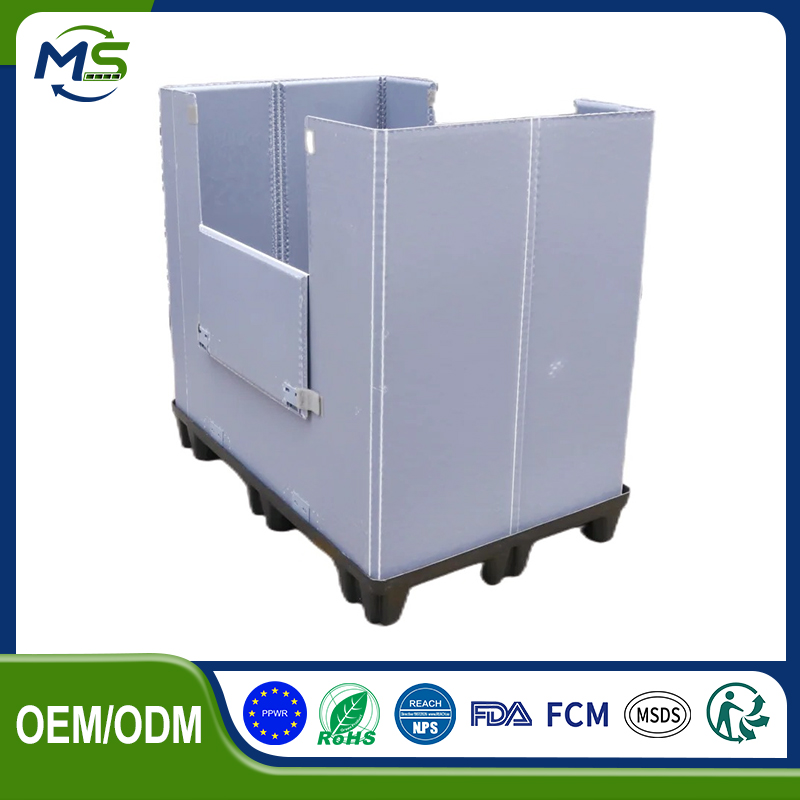
PP honeycomb pallet sleeve box used in returnable pack accessories – Mingskye reusable transport packaging.
The body of the box comes back, but the lid and the divider set do not.
At goods-in the returned unit is counted as one box and put into the empty store. Nobody opens it to check whether the complete set is present. On the next fill the loader finds a missing divider, substitutes a piece of loose sheet or ships the parts without separation, and contact damage appears on arrival.
Because the box body has an identifier and the accessories do not, the loss is invisible in the fleet register. The register says the asset returned.
A loose accessory has no fixed place and no owner at the moment the box is emptied.
A lid or a divider is removed at the receiving line and set aside so the operator can reach the parts. From that moment it is a separate item on a busy bench. It can be swept into waste dunnage, used on another part number or left at a supplier until the next collection.
The return journey adds a second opportunity. If the accessory is not stowed in or on the folded unit before collection, the driver has no way to know it belongs to that box.
For terminology and test-method context see WRAP. The guidance on this page is practical handling guidance, not a test report or a certificate.
Count the box and its accessories together, at despatch and at return, on one record.
Define the set in writing: one body, one lid, one base and a stated number of dividers of a stated type. Put that definition on the pack drawing and on the return note, so a checker at goods-in knows what complete means. Record shortfalls by accessory type rather than as a general shortage.
Where a unit identifier is used, add an accessory state field. A body with an incomplete set should be flagged as unavailable even though the asset itself is present.
| Symptom at the return | Process cause | Check at goods-in | Record to keep |
|---|---|---|---|
| How missing accessories show up on a return? | The body of the box comes back, but the lid and the divider set do not. | At goods-in the returned unit is counted as one box and put into the empty … | Section 1 |
| Why loose parts are lost more often than bodies? | A loose accessory has no fixed place and no owner at the moment the box is … | A lid or a divider is removed at the receiving line and set aside so … | Section 2 |
| Which records make a complete set countable? | Count the box and its accessories together, at despatch and at return, on one record. | Define the set in writing: one body, one lid, one base and a stated number … | Section 3 |
| Which pack features reduce the loss rate? | Captive fittings, a stowage position in the folded unit and a distinguishable accessory design all help. | A hinged or tethered lid cannot be set aside. A divider set that folds into … | Section 4 |
Captive fittings, a stowage position in the folded unit and a distinguishable accessory design all help.
A hinged or tethered lid cannot be set aside. A divider set that folds into a cassette and clips into the folded sleeve has a defined home for the return leg. Where accessories must remain loose, a distinct colour or a printed part number makes them easy to sort from general dunnage at a supplier.
Ask to see the folded unit with the complete set stowed. A design that requires the accessories to travel as a separate parcel simply relocates the loss.
Mark one batch, count the set at despatch and return, and track the shortfall by accessory type.
Use the same supplier and the same route for several cycles. At each return, open the unit and count against the written set definition before it goes into the empty store. Record where a missing part was found, because a divider recovered from a waste skip points to a disposal rule rather than to a design fault.
Compare the substitution rate at the next fill as well. A set that is technically complete but difficult to reassemble will still be improvised on a busy shift.
A pack with many loose variants may be the wrong design for a shared fleet.
Where each part number needs its own divider geometry, a shared box body will always circulate with the wrong set. Dedicated kits, a smaller number of standard layouts or a different container type may be simpler than a tighter counting rule. The decision belongs with the packaging engineer and the part family owner.
Asset registers and identification practice are site systems. Standards are cited by name for terminology; the set definition and the acceptance rule come from your own operation.
The body of the box comes back, but the lid and the divider set do not. At goods-in the returned unit is counted as one box and put into the empty store. Nobody opens it to check whether …
A loose accessory has no fixed place and no owner at the moment the box is emptied. A lid or a divider is removed at the receiving line and set aside so the operator can reach the parts. From …
Captive fittings, a stowage position in the folded unit and a distinguishable accessory design all help. A hinged or tethered lid cannot be set aside. A divider set that folds into a cassette and clips into the folded …
A pack with many loose variants may be the wrong design for a shared fleet. Where each part number needs its own divider geometry, a shared box body will always circulate with the wrong set. Dedicated kits …
References checked by publisher and title on 2026-11-24. Standards and regulations are cited by name only; no performance values are attributed to them. General material and logistics figures in the text are indicative reference values and should be verified against your supplier’s current data sheet and your own trial. Confirm applicability and current versions for your own operation before relying on any of them.
For a quotation, a sample box or help matching a wall, closure and pack layout to your own route, contact service@mingplastics.com or WhatsApp +86 189 3887 1524. Include the part or crop, the load per layer, the destination, the dwell time and the expected cycles per year so the recommended specification can be confirmed before you order.
For missing lids and dividers after return trips, Put the accessory count on the same record as the box count and kit the loose parts at the return point. A pack with many loose variants may be the wrong design for a shared fleet.
Need a specification sheet, samples or a quotation for PP honeycomb panels, sleeve boxes or cable reels? Our team replies within one business day.
Tel / WhatsApp: +86 189 3887 1524
Email: service@mingplastics.com
WhatsApp: Chat with us