Address
Building 1, No. 22, Shexi Yongping Road,
Dongguan, Guangdong, China
Work Hours
Monday to Friday: 7AM - 7PM
Weekend: 10AM - 5PM
Retail backroom empty box handling space is the constraint that breaks a store-level reuse loop. A collapsible PP honeycomb ... Ask Mingskye for a sample.
Retail backroom empty box handling space is the constraint that breaks a store-level reuse loop. A collapsible PP honeycomb sleeve box saves volume only after somebody folds it, and a small backroom has nowhere to stand, fold and stack the flats. Empty units then stay assembled in the aisle until the next collection, which removes the space saving entirely. Agree a fold-at-receipt step, a fixed flat stack location and a collection frequency that matches the store delivery rhythm.
This page covers retail backroom empty box handling space for Retail backroom empties in six sections: How a backroom runs out of space; Why the folded volume saving depends on a process; Which store records make the constraint visible; Which container configuration suits a small backroom; How to trial a fold-at-receipt step; When a collapsible box is the wrong choice. The buyer problem is store backrooms have no floor space to fold and stage empties. Each section gives one on-site check and one record to keep.
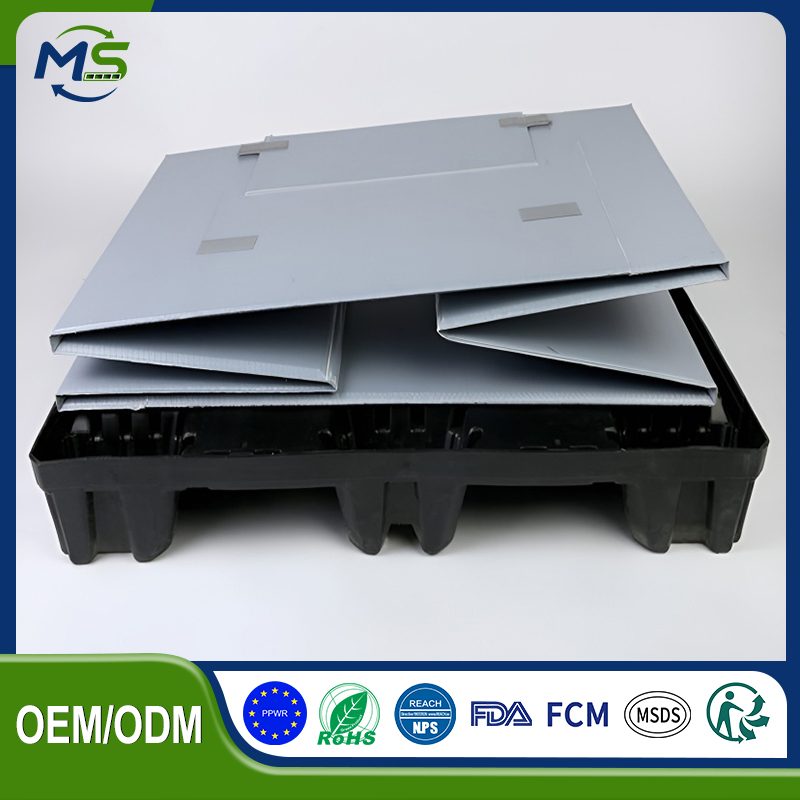
PP honeycomb pallet sleeve box used in retail backroom empties – Mingskye reusable transport packaging.
Empties stay assembled in the aisle because nobody has the floor area to fold them.
A store receives a delivery, unpacks it and has to hold the empty containers until the next collection. Folding a pallet sleeve unit needs a clear patch of floor and somewhere to put the flat. In a small backroom that patch is also the route between the goods-in door and the chiller.
The result is a row of assembled boxes along the wall. The volume saving that justified the collapsible design never appears, and the store team asks for more frequent collections instead.
A collapsible box saves space only after a person folds it in a place where the flat can be stored.
The panel geometry gives a low folded height, but the store receives a full unit at the busiest moment of its day. Folding competes with unpacking, replenishment and customer service. If the step is not assigned to a named person at a named point, it is deferred until the backroom is quiet, which is usually after the collection vehicle has gone.
The collection frequency then sets how many assembled units accumulate. A weekly collection in a store with daily deliveries leaves a large standing queue regardless of the box design.
For terminology and test-method context see WRAP. The guidance on this page is practical handling guidance, not a test report or a certificate.
Record the units received, the units folded, the flat stack count and the collection interval.
A short tally at the goods-in door shows whether the folding step happens at all. Note the time of day it happens, because a step performed two hours after delivery has already consumed the aisle space it was meant to free. Mark the fixed flat stack location on a simple backroom sketch.
Measure the footprint of one assembled unit and one flat unit. Those two local figures are what the store manager needs to decide how many units can be held between collections.
| Symptom at the return | Process cause | Check at goods-in | Record to keep |
|---|---|---|---|
| How a backroom runs out of space? | Empties stay assembled in the aisle because nobody has the floor area to fold them. | A store receives a delivery, unpacks it and has to hold the empty containers until … | Section 1 |
| Why the folded volume saving depends on a process step? | A collapsible box saves space only after a person folds it in a place where the … | The panel geometry gives a low folded height, but the store receives a full unit … | Section 2 |
| Which store records make the constraint visible? | Record the units received, the units folded, the flat stack count and the collection interval. | A short tally at the goods-in door shows whether the folding step happens at all … | Section 3 |
| Which container configuration suits a small backroom? | One-person folding, a stable flat stack and a short fold time are the properties that matter. | A PP honeycomb sleeve box that one person can fold without a tool and without … | Section 4 |
One-person folding, a stable flat stack and a short fold time are the properties that matter.
A PP honeycomb sleeve box that one person can fold without a tool and without clearing a large area fits a store better than a design needing a bench. The folded unit should stack securely at the height a store colleague can lift, with the identifier visible from the aisle. A lid that stays captive avoids a second loose item in a small room.
Check the folded unit against the goods-in door width and the nominated shelf or pallet position. A flat that is thin but wide can still block a narrow corridor.
Fold at the goods-in door on one delivery and compare the aisle footprint with a normal day.
Assign the step to one named colleague, give one fixed flat stack location, and keep the collection timetable unchanged. Photograph the aisle at the same time on a baseline day and a trial day, and record how long the folding step took. If the folding time is unacceptable at the peak, move the step to a quieter point rather than abandoning it.
Repeat across several deliveries. A single quiet Tuesday is not representative of a store receiving a full mixed load on a Friday morning.
A store with no folding point and no consolidation space may be better served by a nestable tote.
If the backroom can only hold a stack of assembled units, a nestable container gives a volume saving without requiring a folding action. That is a different packaging decision, and it should be taken with the store operations team rather than imposed from the distribution centre. A collapsible box that is never folded is simply a rigid box with more parts.
Waste prevention and reuse targets are cited by name for context. The operating rule for a store comes from its own space, delivery rhythm and collection contract.
Empties stay assembled in the aisle because nobody has the floor area to fold them. A store receives a delivery, unpacks it and has to hold the empty containers until the next collection. Folding a pallet sleeve …
A collapsible box saves space only after a person folds it in a place where the flat can be stored. The panel geometry gives a low folded height, but the store receives a full unit at the busiest moment of its day …
One-person folding, a stable flat stack and a short fold time are the properties that matter. A PP honeycomb sleeve box that one person can fold without a tool and without clearing a large area fits a store …
A store with no folding point and no consolidation space may be better served by a nestable tote. If the backroom can only hold a stack of assembled units, a nestable container gives a volume saving without requiring a folding …
References checked by publisher and title on 2026-11-24. Standards and regulations are cited by name only; no performance values are attributed to them. General material and logistics figures in the text are indicative reference values and should be verified against your supplier’s current data sheet and your own trial. Confirm applicability and current versions for your own operation before relying on any of them.
For a quotation, a sample box or help matching a wall, closure and pack layout to your own route, contact service@mingplastics.com or WhatsApp +86 189 3887 1524. Include the part or crop, the load per layer, the destination, the dwell time and the expected cycles per year so the recommended specification can be confirmed before you order.
For retail backroom empty box handling space, Set a fold-at-receipt step and one flat stack location, then match the collection frequency to the delivery rhythm. A store with no folding point and no consolidation space may be better served by a nestable tote.
Need a specification sheet, samples or a quotation for PP honeycomb panels, sleeve boxes or cable reels? Our team replies within one business day.
Tel / WhatsApp: +86 189 3887 1524
Email: service@mingplastics.com
WhatsApp: Chat with us