Address
Building 1, No. 22, Shexi Yongping Road,
Dongguan, Guangdong, China
Work Hours
Monday to Friday: 7AM - 7PM
Weekend: 10AM - 5PM
Container rain in export pallet box loads is condensation from the container atmosphere, not a leaking roof. Warm humid air, a ... Ask Mingskye for a sample.
Container rain in export pallet box loads is condensation from the container atmosphere, not a leaking roof. Warm humid air, a cool cargo surface and a long sea leg put water onto the top of the stow, where paper dunnage and cartons lose strength first. A PP honeycomb export box resists the moisture itself, but the load still needs a dry stow, a desiccant plan and a non-paper contact layer. Record container dryness at stuffing and photograph the top layer at destuffing.
This page covers container rain in export pallet box loads for Ocean export container in six sections: What container rain damage looks like at destuffing; Why a sealed container still produces water; Which checks to record at stuffing and destuffing; Where a PP honeycomb export box helps; How to run a shipment trial; Limits and commercial boundaries. The buyer problem is container rain stains contents and weakens paper-based dunnage. Each section gives one on-site check and one record to keep.
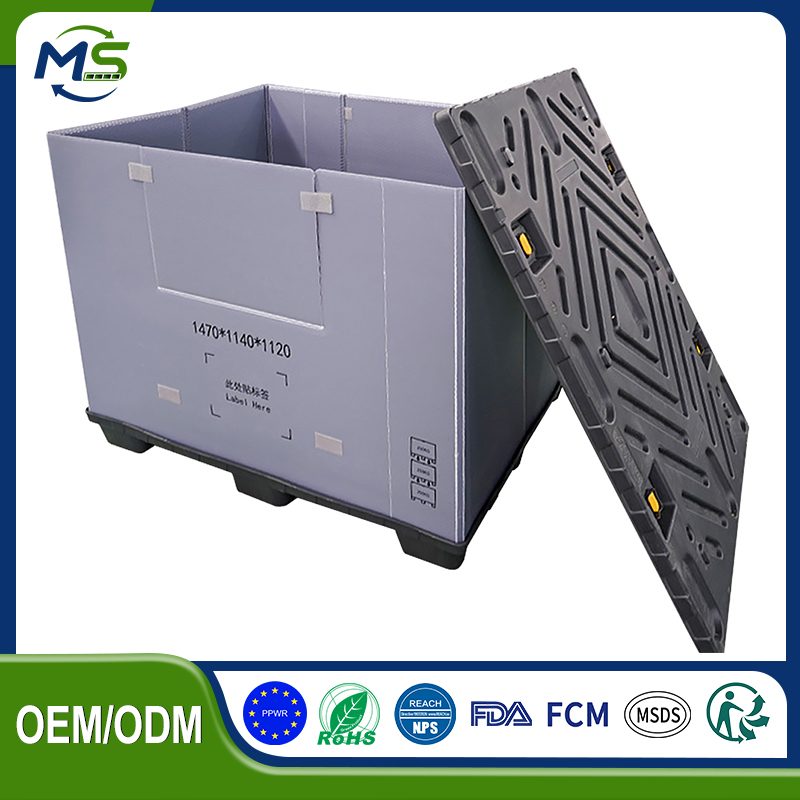
PP honeycomb pallet sleeve box used in ocean export container – Mingskye reusable transport packaging.
The top layer of the stow is wet and stained while the lower pallets are dry.
The container doors open to a damp smell. Water marks run down the inside of the top layer, carton corners have softened and any paper-based dunnage has lost its shape. Metal or painted parts show water staining where the condensate dripped, even though no external leak is visible.
The pattern is characteristic: damage concentrated near the roof and the doors, with the centre of the lower stow unaffected. A roof leak would follow a different path and usually shows a local entry point.
Humid air, a temperature swing and a long voyage create condensation inside a closed box.
Container air, pallets and dunnage all carry moisture at stuffing. As the container passes through warmer and cooler conditions, the steel roof radiates heat and the air near it reaches its dew point. Water forms on the cool surface and drips onto the top of the cargo. The mechanism repeats over many day-night cycles.
Wooden pallets and fibre-based dunnage add moisture to that air. A load that is dry at stuffing can still create its own humid atmosphere over a long sea leg.
For terminology and test-method context see International Chamber of Commerce. The guidance on this page is practical handling guidance, not a test report or a certificate.
Record container dryness, dunnage moisture, the desiccant plan and the top-layer condition at both ends.
At stuffing, inspect the container interior for standing water, damp flooring and a damaged door seal, and note the condition of wooden pallets before they are loaded. Record how many desiccant units were used and where they were placed. Photograph the top layer before the doors close.
Repeat the same photograph set at destuffing, before anything is unloaded. Matching images make a claim about when the wetting occurred much easier to resolve with the carrier or the insurer.
| Symptom at destuffing | Carriage cause | Check at stuffing | Record to keep |
|---|---|---|---|
| What container rain damage looks like at destuffing? | The top layer of the stow is wet and stained while the lower pallets are dry. | The container doors open to a damp smell. Water marks run down the inside of … | Section 1 |
| Why a sealed container still produces water? | Humid air, a temperature swing and a long voyage create condensation inside a closed box. | Container air, pallets and dunnage all carry moisture at stuffing. As the container passes through … | Section 2 |
| Which checks to record at stuffing and destuffing? | Record container dryness, dunnage moisture, the desiccant plan and the top-layer condition at both ends. | At stuffing, inspect the container interior for standing water, damp flooring and a damaged door … | Section 3 |
| What should be checked about where a PP honeycomb export box helps? | A non-absorbent box wall and a non-paper contact layer remove the material that softens first. | A PP honeycomb pallet box does not absorb condensate the way carton board does, so … | Section 4 |
A non-absorbent box wall and a non-paper contact layer remove the material that softens first.
A PP honeycomb pallet box does not absorb condensate the way carton board does, so the container itself keeps its shape and its stack performance. The load still needs protection: replace paper dunnage and cardboard interleaves in the top layer with a non-absorbent contact layer, and keep a clear gap under the roof so drips do not pool on the cargo.
The box is one part of a moisture plan, not a substitute for dry container selection or a desiccant strategy. Ask the supplier how the closed unit behaves when a lid is fitted, because a sealed lid can trap water on top of the load.
Compare one instrumented container with a normal one on the same route and service.
Place a simple humidity indicator near the top of the stow and photograph it at destuffing alongside the top layer. Keep the route, the season and the packing method as close as possible between the two shipments, because a winter and a summer voyage are not comparable. Record the desiccant plan for both.
Judge the result on the condition of the top layer and the dunnage, not on the absence of visible water on the box walls. A plastic wall can look dry while paper dunnage beneath it has failed.
Condensation is a carriage condition, and the packaging decision cannot settle liability for it.
Container selection, desiccant quantity, ventilation and stowage are agreed between the shipper, the carrier and, where relevant, the insurer. Incoterms determine who arranges and pays for those steps, and the contract should say who records the stuffing condition. A box specification cannot answer those questions.
Cite trade and customs rules by name for terminology only, and confirm the current versions and the agreed contract terms for your own shipment.
The top layer of the stow is wet and stained while the lower pallets are dry. The container doors open to a damp smell. Water marks run down the inside of the top layer, carton corners have softened …
Humid air, a temperature swing and a long voyage create condensation inside a closed box. Container air, pallets and dunnage all carry moisture at stuffing. As the container passes through warmer and cooler conditions, the steel roof …
A non-absorbent box wall and a non-paper contact layer remove the material that softens first. A PP honeycomb pallet box does not absorb condensate the way carton board does, so the container itself keeps its shape and …
Condensation is a carriage condition, and the packaging decision cannot settle liability for it. Container selection, desiccant quantity, ventilation and stowage are agreed between the shipper, the carrier and, where relevant, the insurer. Incoterms determine who …
References checked by publisher and title on 2026-11-24. Standards and regulations are cited by name only; no performance values are attributed to them. General material and logistics figures in the text are indicative reference values and should be verified against your supplier’s current data sheet and your own trial. Confirm applicability and current versions for your own operation before relying on any of them.
For a quotation, a sample box or help matching a wall, closure and pack layout to your own route, contact service@mingplastics.com or WhatsApp +86 189 3887 1524. Include the part or crop, the load per layer, the destination, the dwell time and the expected cycles per year so the recommended specification can be confirmed before you order.
For container rain in export pallet box loads, Check container dryness at stuffing, use a non-paper contact layer, and photograph the top layer at destuffing. Condensation is a carriage condition, and the packaging decision cannot settle liability for it.
Need a specification sheet, samples or a quotation for PP honeycomb panels, sleeve boxes or cable reels? Our team replies within one business day.
Tel / WhatsApp: +86 189 3887 1524
Email: service@mingplastics.com
WhatsApp: Chat with us