Address
Building 1, No. 22, Shexi Yongping Road,
Dongguan, Guangdong, China
Work Hours
Monday to Friday: 7AM - 7PM
Weekend: 10AM - 5PM
Address
Building 1, No. 22, Shexi Yongping Road,
Dongguan, Guangdong, China
Work Hours
Monday to Friday: 7AM - 7PM
Weekend: 10AM - 5PM
Escalator works expose a floor edge and route heavy components publicly. This guide covers thickness from 2 mm to 12 mm, edge safety and a trial plan.
Escalator works create a large opening in a finished floor and route heavy components through public areas. The surrounding floor and the opening edge are both at risk. This article looks at protecting floors around escalator installation and refurbishment. The focus is opening edges, component routes and public safety around the void.
An escalator opening exposes a floor edge that is easily chipped, while components are wheeled through public areas to reach it. Both need protection, and they need different details.
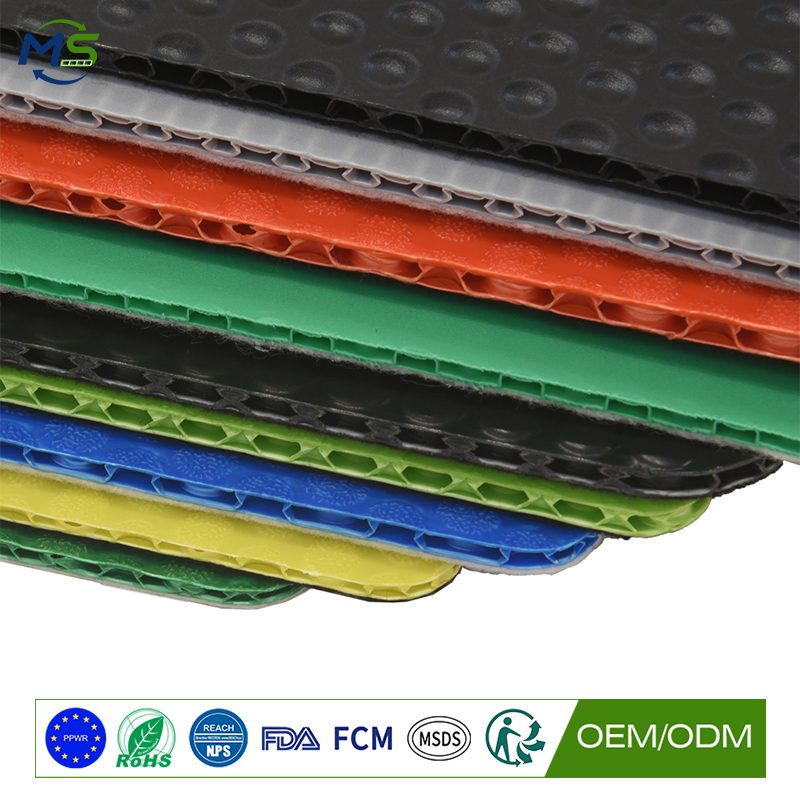
A rigid PP honeycomb protection board protects the surrounding floor from component loads and can be cut to protect the opening edge.
Because the panels are light, they can be placed around an opening without adding load to the structure.
Escalator work involves heavy components and trolleys, so the middle to upper part of the 2 mm to 12 mm range is typical for routes.
For pedestrian diversions around the works a mid thickness is enough. Where components and trolleys cross the floor, thicker boards protect against concentrated loads.
| Board group | Typical thickness | Where it earns its place | Watch-outs |
|---|---|---|---|
| Light-duty panel | 2-3 mm | Pedestrian diversions around the works | Not for component routes |
| General concourse panel | 4-6 mm | Surrounding floors under works traffic | Mark and protect the opening edge |
| Heavy-duty panel | 8-10 mm | Component trolley routes and set-down | Check floor tolerance |
| Maximum protection | 12 mm | Heaviest escalator components | Confirm floor capacity |
Protect and mark the opening edge clearly: it is both a damage risk and a public safety issue in a concourse or mall.
Keep pedestrian diversions complete, flat and finished, because the public will use them while works continue.
Plan component routes outside public hours where possible, and inspect before the space opens each day.
Plywood is the usual choice around openings but is heavy to carry into a concourse and absorbs water from cleaning.
Sheeting slides under trolley wheels and traps moisture, and it is a trip hazard around an opening.
Matting works for pedestrian areas but not for component loads. A PP honeycomb board handles both and is light enough to place around a void.
Protect the surrounding floor and one opening edge, leaving a comparable area on the current method. Inspect before public opening each day.
Run a trolley test along the component route, then lift and check the floor.
Record edge condition and diversion safety, because around an escalator void both matter.
State the floor finish, the component weights, the opening dimensions and whether the public is present. Ask for the recommended thickness and fire performance.
Ask for guidance on opening edge protection and on pedestrian diversions, plus custom sizes for the surrounding floor grid.
For a quotation or sample panel, contact service@mingplastics.com or WhatsApp +86 189 3887 1524. Include the surface type, floor area, trades on site and expected duration so the recommended thickness, facing and fire performance can be confirmed before you order.
Around escalator works, protect both the component route and the opening edge, keep pedestrian diversions flat and finished, and inspect before public opening.


