Address
Building 1, No. 22, Shexi Yongping Road,
Dongguan, Guangdong, China
Work Hours
Monday to Friday: 7AM - 7PM
Weekend: 10AM - 5PM
Address
Building 1, No. 22, Shexi Yongping Road,
Dongguan, Guangdong, China
Work Hours
Monday to Friday: 7AM - 7PM
Weekend: 10AM - 5PM
Loading bays concentrate delivery impacts at the threshold. This guide covers thickness from 2 mm to 12 mm, transitions, continuous routes and a bay trial plan.
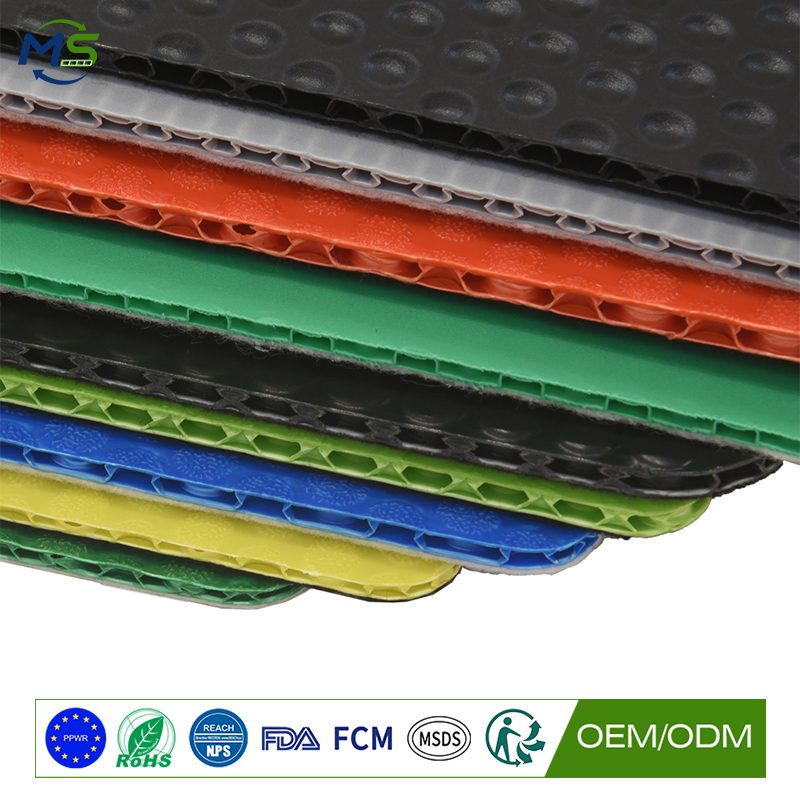
The loading bay concentrates every delivery into one place: pallet trucks, cages, roll cages and set-down impacts, all on a surface that is often the transition between external and internal finishes. This article looks at protecting loading bays during fit-out and operation. The focus is impact at the threshold, continuous routes and working around deliveries.
Deliveries are set down, dragged and wheeled, often at speed and usually at the threshold where the external surface meets the internal finish. That transition is where surfaces fail.
A rigid PP honeycomb protection board spreads set-down impacts and wheel loads, and it stays in place instead of being pushed ahead of a wheel like a sheet.
Because the panels do not absorb water, they suit a bay that is open to weather at one end.
Loading bays carry pallet trucks and cages with real loads, so the middle to upper part of the 2 mm to 12 mm range is appropriate.
For pedestrian movement through the bay a mid thickness is enough. Where palletised deliveries are set down and wheeled, thicker boards protect both the surface and the threshold detail.
| Board group | Typical thickness | Where it earns its place | Watch-outs |
|---|---|---|---|
| Light-duty panel | 2-3 mm | Pedestrian movement through the bay | Fails under pallet trucks and cages |
| General bay panel | 4-6 mm | Loading bays with regular pallet truck traffic | Build a transition at the threshold |
| Heavy-duty panel | 8-10 mm | Palletised set-down and roll cage routes | Check coating and surface tolerance |
| Maximum protection | 12 mm | Heavy plant deliveries through the bay | Confirm the slab can take the load |
Build a transition at the threshold rather than letting wheels drop over an edge, because that impact is what cracks tiles and damages coatings.
Make the protected route continuous from the vehicle to the lift or store, so loads are never set down on an unprotected surface mid-route.
Tape seams in the direction of travel so wheels ride onto joints rather than catching them, and inspect at the end of each delivery window.
Steel plate handles the loads but is heavy and slow, and its edges can be a trip hazard in a busy bay.
Plywood works but crushes at the threshold, absorbs water at the external end and needs replacing through a long programme.
Rubber matting is durable but heavy and usually fixed. A PP honeycomb board gives spreading at a weight that can be placed and lifted around delivery windows.
Protect the bay route and leave a comparable route on the current method. Inspect after each delivery window, focusing on the threshold.
Run a set-down test with a loaded pallet at the threshold, then lift and inspect the surface and the threshold detail.
Record whether the route stayed continuous and whether seams held, because in a bay those two things determine the outcome.
State the surface type, the threshold detail, the delivery loads and whether the bay is exposed to weather. Ask for the recommended thickness for set-down impacts and wheel loads.
Ask for guidance on threshold transitions and on taping seams for continuous routes, plus custom sizes for standard bay dimensions.
For a quotation or sample panel, contact service@mingplastics.com or WhatsApp +86 189 3887 1524. Include the surface type, floor area, trades on site and expected duration so the recommended thickness, facing and fire performance can be confirmed before you order.
Protect the threshold as carefully as the route, build transitions instead of dropping wheels over edges, and keep the protected route continuous from vehicle to store.


