Address
Building 1, No. 22, Shexi Yongping Road,
Dongguan, Guangdong, China
Work Hours
Monday to Friday: 7AM - 7PM
Weekend: 10AM - 5PM
Address
Building 1, No. 22, Shexi Yongping Road,
Dongguan, Guangdong, China
Work Hours
Monday to Friday: 7AM - 7PM
Weekend: 10AM - 5PM
Laminate and LVT fail at click seams and thin wear layers. This guide covers thickness from 2 mm to 12 mm, expansion gaps, moisture checks and a floating-floor trial plan.
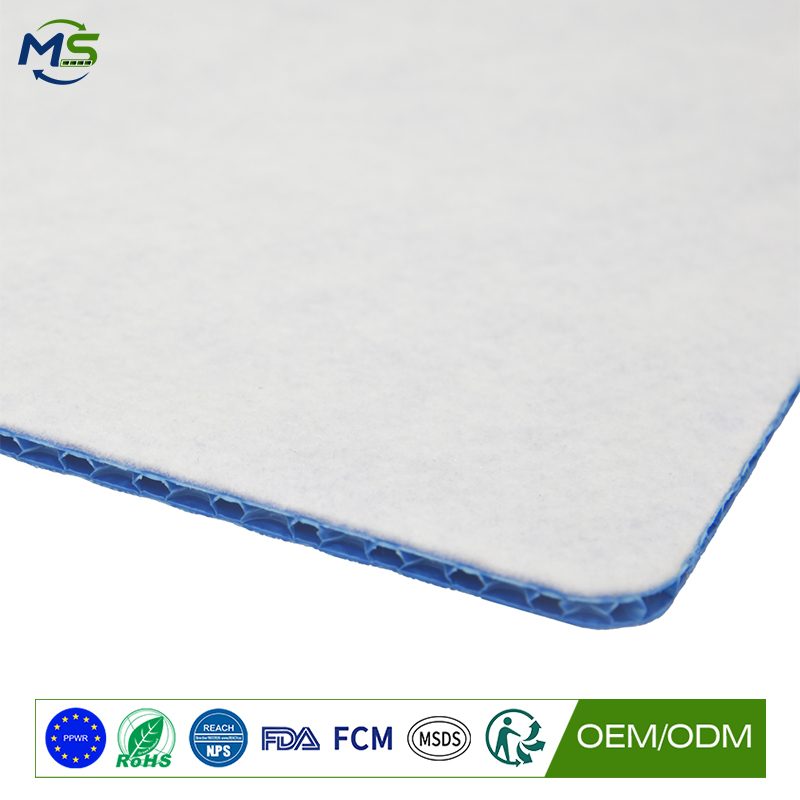
Laminate and luxury vinyl tile are floating floors, which means their weak points are the click seams, the thin wear layer and the substrate beneath. Heavy point loads and trapped moisture cause seam peaking and edge lifting that cannot be repaired without taking the floor up. This article looks at protecting floating floors during fit-out. The focus is load spreading over a flexible substrate, moisture control and protecting a thin wear layer.
A bonded tile fails by cracking; a floating floor fails by moving. Click joints open under concentrated load, edges lift where moisture reaches them, and the thin wear layer marks under abrasion. Protection has to address movement and moisture, not just impact.
That makes rigidity valuable: a board that spreads load over a larger area reduces the stress on individual click joints. A PP honeycomb protection board does that while staying light enough not to compress the floor itself.
Because the panels do not absorb water, they do not hold moisture against vinyl or laminate, which is where edge lifting usually starts.
Floating floors are usually in residential, hospitality and office fit-out where loads are moderate, so the middle of the 2 mm to 12 mm range is often right. Specify for the heaviest realistic crossing rather than the average.
For decorating and light trades a mid thickness is enough. Where furniture, appliances or trolleys will cross the floor, thicker boards protect the click joints from the concentrated loads that cause peaking.
| Board group | Typical thickness | Where it earns its place | Watch-outs |
|---|---|---|---|
| Light-duty panel | 2-3 mm | Decorating only, light foot traffic on LVT | Insufficient under furniture or trolleys |
| General floor panel | 4-6 mm | Laminate and LVT under normal fit-out traffic | Keep clear of expansion gaps; tape seams |
| Heavy-duty panel | 8-10 mm | Appliance and furniture moves over floating floors | Heavier panels; plan handling |
| Maximum protection | 12 mm | Repeated heavy crossings, long programmes | Beyond what light fit-out requires |
Floating floors need expansion gaps at the perimeter, and protection should never be forced into those gaps. Keep panels back from the edge or finish them so the gap stays functional.
Where wet trades are still running, lift panels periodically and dry both the underside and the floor. Vinyl especially should not sit under trapped moisture for long periods.
Use a soft facing against the wear layer. The wear layer on LVT is thin, and the facing is what prevents it from being abraded by routine site traffic.
Paper and foam are cheap but slide and tear, and on a floating floor sliding is the problem: movement drags grit across a thin wear layer and stresses the click joints.
Plywood is rigid but heavy, and its weight on a floating floor can itself be an issue over a flexible substrate. It also absorbs water at the edges.
A PP honeycomb board gives rigidity without weight, which is exactly what a floating floor needs. It is also wipe-clean and re-usable across repeated fit-out phases.
Protect one room with the board and leave a comparable room on the current method. Inspect seams, edges and the wear layer at fixed intervals, using the same lighting and viewing angle.
Run a moisture check: after wet trades or cleaning, lift a panel and feel both surfaces. Any dampness means the inspection schedule needs to be shorter.
Record re-lay frequency and any seam movement, because on a floating floor seam peaking is the failure that costs the most to put right.
State the floor type, the wear layer, the substrate, the trades and whether moisture will be present. Ask for the recommended thickness, facing, panel size and fire performance.
Ask for guidance on perimeter detailing so expansion gaps stay functional, and on seams and cutting. Custom sizes reduce waste where rooms repeat.
For a quotation or sample panel, contact service@mingplastics.com or WhatsApp +86 189 3887 1524. Include the surface type, floor area, trades on site and expected duration so the recommended thickness, facing and fire performance can be confirmed before you order.
Floating floors need rigidity without weight, plus moisture control. Specify a mid-to-heavy board for the heaviest crossing, keep expansion gaps clear, and inspect for damp.


