Address
Building 1, No. 22, Shexi Yongping Road,
Dongguan, Guangdong, China
Work Hours
Monday to Friday: 7AM - 7PM
Weekend: 10AM - 5PM
Address
Building 1, No. 22, Shexi Yongping Road,
Dongguan, Guangdong, China
Work Hours
Monday to Friday: 7AM - 7PM
Weekend: 10AM - 5PM
Most questions about temporary floor protection reduce to four decisions: what load the panel must carry, what the surface ... Ask Mingskye for a sample.
Most questions about temporary floor protection reduce to four decisions: what load the panel must carry, what the surface underneath can tolerate, how long the protection stays down, and whether it will be used again. Answer those four in that order and the choice of thickness, facing, seam method and format follows. The rest is documentation, inspection and a clear handover record.
This page covers temporary floor protection FAQ in six sections: How to work out the load your protection; How to specify the facing for the floor; Specifying for repeat use rather than single use; Why the substrate condition matters more than the; Preparing the floor before any panel is laid; What a warranty should and should not cover. Each section answers one practical question and can be read on its own.
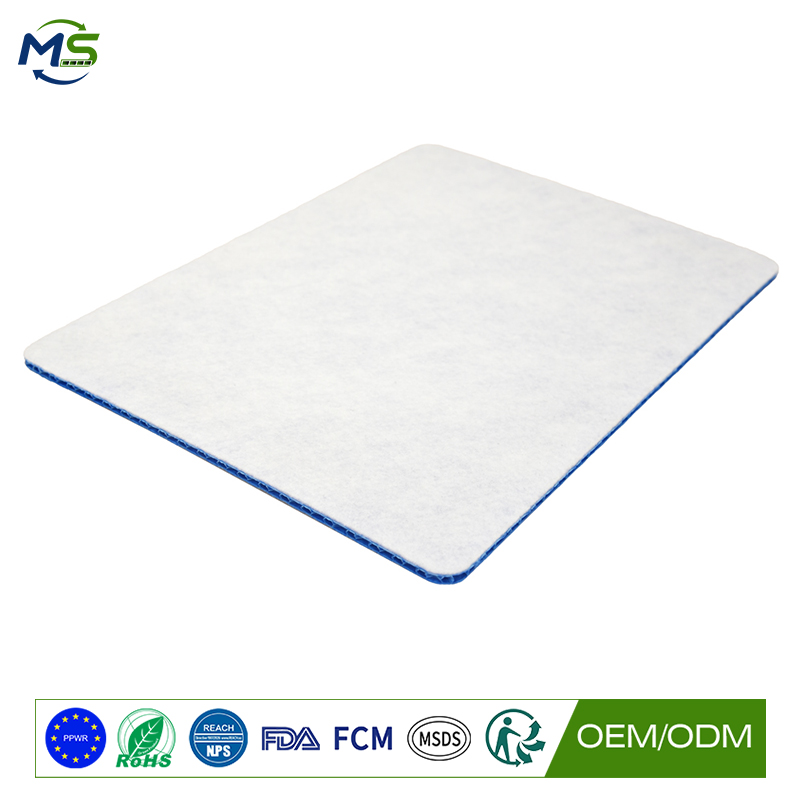
Start by listing the heaviest thing that will cross the protected area and the heaviest thing that will stand on it, then convert those into an equivalent uniform load.
Two different load types appear on almost every site. Moving loads include trolleys, pallet trucks, site workers walking in a line and material on a trolley; standing loads include scaffold base plates, tool cases, stacked material and equipment stands. Standing loads are almost always more damaging because they act in one place for a long time.
The conversion is straightforward. Take the heaviest standing load, divide it by the area of the footprint in square metres, and that gives the peak pressure. Add a safety factor of at least two to cover dynamic effects, because a load dropped or rolled into position briefly exceeds its static weight. The result is the design load per square metre to specify against.
Write the calculation down and send it with the enquiry. A supplier who can see the load calculation will recommend a board on the basis of it, and will tell you when the requirement is beyond a standard product. A supplier given only a thickness will give you a board at that thickness and leave the responsibility with you.
Match the facing to the sensitivity of the substrate and to the conditions, rather than choosing a standard facing and hoping it is adequate.
The decision is straightforward for sensitive finishes. Hardwood, polished stone, marble, high-gloss epoxy and specialist coatings need a soft, non-abrasive facing, because even a trapped particle of grit under a hard film will scratch when traffic passes over it.
For ordinary screed or concrete that will be covered later, a smooth film facing is usually sufficient and is easier to clean. For a board used as a temporary working platform in a wet area, a facing that can be washed and dried is more useful than one chosen for grip.
Where the board sits directly on a finished floor and is likely to stay there for months, the facing decision matters most because it is the only layer between the traffic and the substrate. A felt facing in that position is a small cost relative to a damaged floor.
For terminology and test-method context see GHG Protocol Corporate Value Chain (Scope 3) Accounting and Reporting Standard. The guidance on this page is practical site guidance, not a test report or a certificate.
If a board will be lifted and moved more than a handful of times, the specification should prioritise handling and cleanability over the lowest purchase price.
A board used once can be a low-cost disposable item. A board used eight or ten times is a tool, and a tool has different requirements: it must survive being dragged, washed, stacked and dropped, and it must still be recognisable as fit for purpose after all of that.
Edges are usually the first thing to fail on a board that is moved repeatedly. An edge protection strip or a board with a closed edge profile will outlast an open-cell edge by a wide margin in a reuse programme.
It also helps to plan the reuse programme before ordering. Decide the number of movement cycles expected, the cleaning method available on site, and where panels are stored between phases, then specify a grade and a format that will survive that cycle with the face intact.
| Decision question | Short answer | Checklist line | In this guide |
|---|---|---|---|
| How to work out the load your protection has to carry? | Start by listing the heaviest thing that will cross the protected area and the heaviest thing … | Two different load types appear on almost every site. Moving loads include trolleys, pallet trucks … | Section 1 |
| How to specify the facing for the floor underneath? | Match the facing to the sensitivity of the substrate and to the conditions, rather than choosing … | The decision is straightforward for sensitive finishes. Hardwood, polished stone, marble, high-gloss epoxy and specialist … | Section 2 |
| What should be checked about specifying for repeat use rather than … | If a board will be lifted and moved more than a handful of times, the specification … | A board used once can be a low-cost disposable item. A board used eight or … | Section 3 |
| Why the substrate condition matters more than the panel? | A panel laid on an uneven, dusty or damp floor will behave differently from the same … | Dust and debris under a panel are the most common cause of scratching. A single … | Section 4 |
A panel laid on an uneven, dusty or damp floor will behave differently from the same panel laid on a prepared one, and no amount of panel specification fixes the substrate.
Dust and debris under a panel are the most common cause of scratching. A single particle of grit trapped between the board and a hardwood floor is enough to produce a visible scratch when a trolley crosses it, and the damage cannot be undone without resanding or refinishing.
An uneven floor introduces high spots that concentrate the load onto individual core cells, which is precisely the failure mode the panel was chosen to avoid. Sharp edges in a screed can also cut into the facing and puncture the board.
A damp floor is a separate issue, because a sealed panel traps the moisture and can cause the screed or the adhesive beneath to deteriorate. Preparing the substrate means sweeping, checking for sharp edges, confirming dryness and, where the panel needs to sit for a long period, laying a breathable separation layer.
Preparation takes less time than the delay caused by laying panels on a floor that was not ready, and it is the step that protects the substrate as much as the panel does.
The sequence is simple: remove debris, sweep, inspect for sharp edges or laitance, confirm the floor is dry where that matters, and only then start laying. A vacuum rather than a broom leaves less fine grit behind, and fine grit is what causes the scratches.
On a screed, the surface must be hard enough to take the load and free of loose material. Newly screeded floors need curing time before they are loaded, and covering a green screed with an impervious panel traps moisture and weakens it underneath.
Mark the layout before laying. Setting out the panel grid on the floor first avoids the situation where panels are cut short at the end of a run and a mismatched strip is left along a wall, which is both a visual problem and a weak point in the coverage.
A meaningful warranty covers the product against manufacturing failure and the performance claims made about it, and it says how long it applies and how it is claimed against.
What it should cover: the stated load capacity at the stated deflection for the stated product, and any manufacturing defect such as a delamination or a defective core. What it should not cover is damage from a load beyond the rating, from misuse, from improper storage or from a third party’s installation.
The period matters. A warranty period measured in months is of little use to a fleet that is expected to survive several projects, so a longer period tied to the cycle count is more meaningful than a short period tied to the calendar.
The claim process matters as much as the period. A warranty that requires the panel to be returned to the factory, at the customer’s cost, for a two hundred kilogram pallet of boards is a warranty that will not be used, and therefore is effectively absent.
Start by listing the heaviest thing that will cross the protected area and the heaviest thing that will stand on it, then convert those into an equivalent uniform load. Two different load types appear on almost every site. Moving loads include trolleys, pallet trucks, site workers walking in a line and …
Match the facing to the sensitivity of the substrate and to the conditions, rather than choosing a standard facing and hoping it is adequate. The decision is straightforward for sensitive finishes. Hardwood, polished stone, marble, high-gloss epoxy and specialist coatings need a soft, non-abrasive facing, because …
A panel laid on an uneven, dusty or damp floor will behave differently from the same panel laid on a prepared one, and no amount of panel specification fixes the substrate. Dust and debris under a panel are the most common cause of scratching. A single particle of grit trapped between the board …
A meaningful warranty covers the product against manufacturing failure and the performance claims made about it, and it says how long it applies and how it is claimed against. What it should cover: the stated load capacity at the stated deflection for the stated product, and any manufacturing defect such as …
References checked by publisher and title on 2026-11-06. Standards and regulations are cited by name only; no performance values are attributed to them. General material-property figures in the text are indicative reference values for polypropylene and should be verified against your supplier’s current data sheet. Confirm applicability and current versions for your own project before relying on any of them.
For a quotation, a sample panel or help matching a thickness and facing to your site conditions, contact service@mingplastics.com or WhatsApp +86 189 3887 1524. Include the surface type, floor area, the trades working overhead and the expected duration so the recommended specification can be confirmed before you order.
For temporary floor protection FAQ, Reduce the decision to a single comparison sheet and name the person who signs it off. A meaningful warranty covers the product against manufacturing failure and the performance claims made about it, and it says how long it applies and how it is claimed …


