Address
Building 1, No. 22, Shexi Yongping Road,
Dongguan, Guangdong, China
Work Hours
Monday to Friday: 7AM - 7PM
Weekend: 10AM - 5PM
Address
Building 1, No. 22, Shexi Yongping Road,
Dongguan, Guangdong, China
Work Hours
Monday to Friday: 7AM - 7PM
Weekend: 10AM - 5PM
Panel life is decided at the bond line. The face skins carry the surface load and the core holds them apart, so a bond that fails ... Ask Mingskye for a sample.
Panel life is decided at the bond line. The face skins carry the surface load and the core holds them apart, so a bond that fails lets the skins peel away and the panel loses stiffness even when the plastic itself is undamaged. The facing also decides whether the panel protects a polished floor or marks it, and whether it survives cleaning between uses.
This page covers protection panel facings in six sections: How the face sheets and core are bonded; Facing and surface finish options; Colour coding and why it is useful on; Recycled content and why single-polymer construction matters; Moisture behaviour in wet and humid conditions; UV stability and how long a panel can. Each section answers one practical question and can be read on its own.
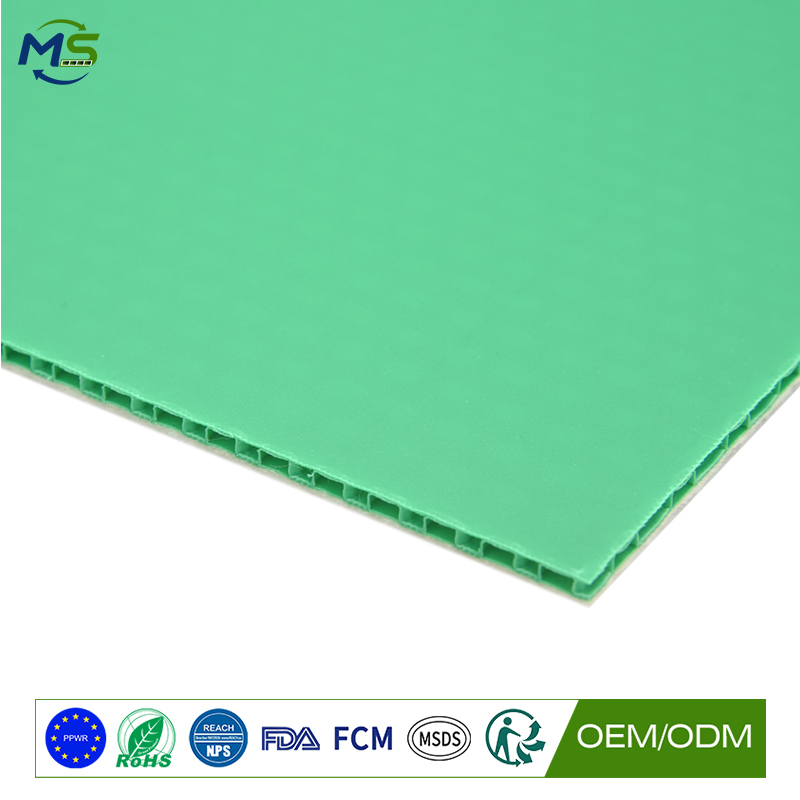
The bond between the polypropylene faces and the honeycomb core determines whether a board delaminates, and most reputable manufacturers achieve it with heat and pressure rather than adhesive alone.
Because polypropylene is a thermoplastic, it can be welded. The standard process heats the extruded core and presses the face sheet against it so the two surfaces fuse. A welded bond is stronger than an adhesive bond and does not carry the same risk of the adhesive creeping under sustained heat.
The alternative route uses a polyurethane or epoxy-based adhesive and gives good results, but the bond line becomes the weakest point when the board is exposed to water, heat cycling or solvent contamination. Boards marketed for outdoor or chemical environments are worth checking for a welded bond rather than an adhesive one.
A simple way to judge bond quality without a laboratory is to look at the edge of a cut-off piece. A fused bond shows a continuous melted transition between the skin and the core wall, while an adhesive bond shows a sharp line and often a visible bead of glue.
The facing determines how the board interacts with the floor it protects, and it is the single specification that most changes the behaviour of an otherwise identical panel.
A polypropylene film facing is smooth, low friction and easy to wipe clean. It does not grip, so it relies on the weight of the panel and on taped seams to stay in place, and it marks the floor if grit is trapped underneath it.
A felt or non-woven facing is soft and grippy. It holds position on its own weight, cushions the contact line, and will not scratch a floor even when there is dust on the surface. It is the usual choice on hardwood, stone and finished screeds.
Paper and kraft facings are used where the board will be handled rather than walked on, for example as a protective layer between stacked components. They are cheap and disposable, but they are not suited to wet conditions and they do not survive repeated washing.
For terminology and test-method context see ISO standards catalogue. The guidance on this page is practical site guidance, not a test report or a certificate.
Colour coding on protection boards is not decorative; it is a communication system that tells crews what a panel is for and how it should be treated.
The common convention is that one colour marks material that protects a finished surface, another marks material rated for traffic, and a third marks material intended for use in a wet area or as a temporary working platform. Once the colours are known, a crew can make the right decision without stopping to read a label.
The secondary benefit is accountability. When a panel is clearly colour-marked and clearly labelled with its intended use, it is far easier to see when someone has used the wrong product. That matters on sites with several trades working over the same floor at the same time.
If you are ordering for a project with several areas, ask whether different colours or markings can be applied per area. A short site legend printed on the panel or on a laminated card keeps the system usable across shifts.
| Question | Short answer | What to check on site | In this guide |
|---|---|---|---|
| How the face sheets and core are bonded? | The bond between the polypropylene faces and the honeycomb core determines whether a board delaminates, and … | Because polypropylene is a thermoplastic, it can be welded. The standard process heats the extruded … | Section 1 |
| What should be checked about facing and surface finish options? | The facing determines how the board interacts with the floor it protects, and it is the … | A polypropylene film facing is smooth, low friction and easy to wipe clean. It does … | Section 2 |
| What should be checked about colour coding and why it is … | Colour coding on protection boards is not decorative; it is a communication system that tells crews … | The common convention is that one colour marks material that protects a finished surface, another … | Section 3 |
| What should be checked about recycled content and why single-polymer construction … | A panel made entirely from polypropylene can be recycled as a single stream, which is a … | Mixed-material panels create a practical barrier to recycling. A board with a paper facing, an … | Section 4 |
A panel made entirely from polypropylene can be recycled as a single stream, which is a materially different proposition from a laminated board with a facing that must be separated first.
Mixed-material panels create a practical barrier to recycling. A board with a paper facing, an aluminium layer and a plastic core cannot enter a standard recycling stream, and in most regions it is treated as general waste or as a contaminated product.
Single-polymer construction removes that barrier. Polypropylene has a recognised recycling route and a steady market, and a board that goes back into the same process keeps its value. The practical instruction for a site is simply that the board must be free of contamination, so mortar, adhesive tape and metal fixings should be removed before it leaves the site.
Where recycled content is claimed, ask for the percentage and the source. Post-industrial recycled material is relatively easy to verify, while post-consumer material with an unknown origin is harder. A supplier that can document the stream is more credible than one quoting a percentage without qualification.
Polypropylene absorbs very little water, which makes it a good choice for wet-area protection, but the core can still trap water and the facing choice decides whether that water stays or drains.
The water absorption of polypropylene is typically well under 1% by mass, so the polymer itself does not swell or lose strength in the way that wood-based boards do. A polypropylene panel left in a wet slab overnight will still be usable the next morning.
Water problems come from the core, not the material. If a panel is stood on edge with the cellular section exposed, or laid on a surface with a void beneath, water can sit inside the cells with no way to drain. That water cannot dry out from inside the core.
Mitigation is straightforward. Lay panels flat so the cells are compressed, keep gaps between boards so moisture can escape, and choose a facing that tolerates being wet if the area will be washed down. Never store panels on edge in an unfinished building over a long period.
Polypropylene degrades under ultraviolet radiation, and while the change is gradual it is not reversible, so outdoor service life has to be planned rather than assumed.
The mechanism is chain scission in the polymer, which shows up as surface chalking, a loss of colour saturation and eventually a loss of toughness. The face sheet is the part that takes the exposure, because it is the surface that sees the light.
Unprotected panels used as external covers, temporary dust sheets or scaffold sheeting typically show visible chalking within a single season, and can become brittle enough to crack after a second. Panels formulated with stabilisers and pigments fare considerably better, but the specification should still carry a stated exposure limit.
The sensible approach for external use is to treat the facing as a consumable layer. Replace the face or the whole panel on a defined cycle rather than waiting for failure, and store panels away from direct sunlight when they are not in use.
The bond between the polypropylene faces and the honeycomb core determines whether a board delaminates, and most reputable manufacturers achieve it with heat and pressure rather than adhesive alone. Because polypropylene is a thermoplastic, it can be welded. The standard process heats the extruded core and presses the face sheet against …
The facing determines how the board interacts with the floor it protects, and it is the single specification that most changes the behaviour of an otherwise identical panel. A polypropylene film facing is smooth, low friction and easy to wipe clean. It does not grip, so it relies on the …
A panel made entirely from polypropylene can be recycled as a single stream, which is a materially different proposition from a laminated board with a facing that must be separated first. Mixed-material panels create a practical barrier to recycling. A board with a paper facing, an aluminium layer and a plastic core cannot …
Polypropylene degrades under ultraviolet radiation, and while the change is gradual it is not reversible, so outdoor service life has to be planned rather than assumed. The mechanism is chain scission in the polymer, which shows up as surface chalking, a loss of colour saturation and eventually a …
References checked by publisher and title on 2026-11-06. Standards and regulations are cited by name only; no performance values are attributed to them. General material-property figures in the text are indicative reference values for polypropylene and should be verified against your supplier’s current data sheet. Confirm applicability and current versions for your own project before relying on any of them.
For a quotation, a sample panel or help matching a thickness and facing to your site conditions, contact service@mingplastics.com or WhatsApp +86 189 3887 1524. Include the surface type, floor area, the trades working overhead and the expected duration so the recommended specification can be confirmed before you order.
For protection panel facings, Confirm the core construction, facing and test method in writing before comparing any two panels. Polypropylene degrades under ultraviolet radiation, and while the change is gradual it is not reversible, so outdoor service life has to be planned rather than assumed.


