Address
Building 1, No. 22, Shexi Yongping Road,
Dongguan, Guangdong, China
Work Hours
Monday to Friday: 7AM - 7PM
Weekend: 10AM - 5PM
Address
Building 1, No. 22, Shexi Yongping Road,
Dongguan, Guangdong, China
Work Hours
Monday to Friday: 7AM - 7PM
Weekend: 10AM - 5PM
Choose thickness from the worst concentrated load the panel will see, not from the floor area. Start with the heaviest item that ... Ask Mingskye for a sample.
Choose thickness from the worst concentrated load the panel will see, not from the floor area. Start with the heaviest item that will cross the protection, convert that into a contact load at the wheel or foot, then compare it with the panel’s tested compression and bending figures at a stated support condition. Access, handling weight and reuse count set the upper and lower bounds.
This page covers protection board thickness in six sections: Choosing thickness when several loads are involved; The access constraint that decides the specification before; How to check a load rating before relying; Specifying for repeat use rather than single use; How to specify the facing for the floor; Pre-cut and made-to-size panels. Each section answers one practical question and can be read on its own.
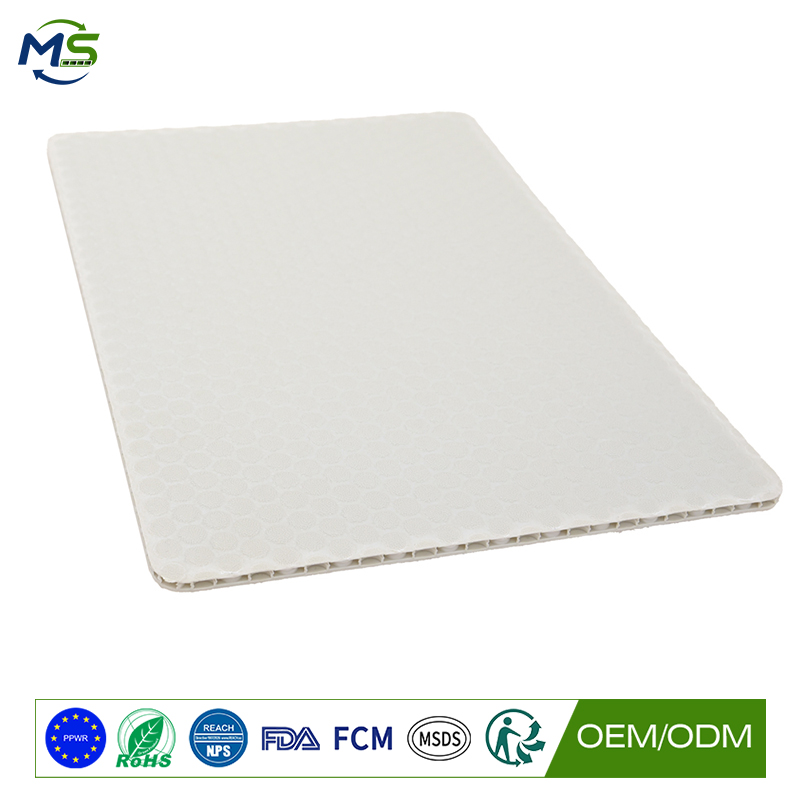
Where standing loads and moving loads differ significantly, specify for the standing load and handle the moving load with a spreader rather than with a heavier board.
A common site pattern is a light trolley route with occasional standing loads at one point. Choosing a board thick enough for the standing load would push the weight and cost of every panel on the route, most of which never need that capacity.
A better arrangement is to use a standard grade along the route and place a spreader plate or a thicker offcut under the standing point. The spreader distributes the load over enough cells to keep the working deflection within the limit, and it is a five-minute fix rather than a specification change.
This approach also keeps the stock list short. Two grades on a site are easy to manage, whereas a different panel in every area is not, and mixed grades on the same route make it impossible to know what is underfoot.
A panel that cannot be carried to the place it is needed is not a solution, and on many projects the access route decides the specification more than the load does.
Protection is valuable only where it is laid. If the route to the work area involves a staircase, a narrow doorway or a lift with a fixed capacity, the panel has to pass through it, and a board chosen for load capacity may be impossible to move.
Weight per square metre should be compared against what two people can safely carry on a stair, which is a much lower practical figure than most people assume for awkward, flat, slightly flexible items. Panels that are light but large are harder to handle than panels that are heavier but smaller.
Options that keep the capacity and solve the access problem include smaller panel formats, folded or rolled formats that reduce the cross-section for transport, and splitting the coverage into more panels of lower weight. It is worth raising access with the supplier before ordering, not after the delivery is on site.
For terminology and test-method context see ISO standards catalogue. The guidance on this page is practical site guidance, not a test report or a certificate.
A load rating is only useful if the test behind it matches the way the panel will be used, and there are three checks that expose a weak rating quickly.
First, check the deflection limit. A rating quoted at 7 mm tells you what the panel carries when it is allowed to move 7 mm, which is far more than most floor finishes will tolerate. A rating at 2 mm with the same capacity is the more useful number.
Second, check the test configuration. Many ratings are measured on a large panel with supported edges, which is close to a fully supported floor. A panel supported on two edges across a wide span deflects far more for the same load, and the published figure will not cover that case.
Third, check whether the figure is quoted per square metre of panel at a stated load, or as a capacity for a specific panel size. A single panel standing on its own edge carries more load than the same panel as part of a continuous laid area, and suppliers sometimes quote the isolated figure without saying so.
| Specification question | Short answer | Evidence to request | In this guide |
|---|---|---|---|
| What should be checked about choosing thickness when several loads are … | Where standing loads and moving loads differ significantly, specify for the standing load and handle the … | A common site pattern is a light trolley route with occasional standing loads at one … | Section 1 |
| What should be checked about the access constraint that decides the … | A panel that cannot be carried to the place it is needed is not a solution … | Protection is valuable only where it is laid. If the route to the work area … | Section 2 |
| How to check a load rating before relying on it? | A load rating is only useful if the test behind it matches the way the panel … | First, check the deflection limit. A rating quoted at 7 mm tells you what the … | Section 3 |
| What should be checked about specifying for repeat use rather than … | If a board will be lifted and moved more than a handful of times, the specification … | A board used once can be a low-cost disposable item. A board used eight or … | Section 4 |
If a board will be lifted and moved more than a handful of times, the specification should prioritise handling and cleanability over the lowest purchase price.
A board used once can be a low-cost disposable item. A board used eight or ten times is a tool, and a tool has different requirements: it must survive being dragged, washed, stacked and dropped, and it must still be recognisable as fit for purpose after all of that.
Edges are usually the first thing to fail on a board that is moved repeatedly. An edge protection strip or a board with a closed edge profile will outlast an open-cell edge by a wide margin in a reuse programme.
It also helps to plan the reuse programme before ordering. Decide the number of movement cycles expected, the cleaning method available on site, and where panels are stored between phases, then specify a grade and a format that will survive that cycle with the face intact.
Match the facing to the sensitivity of the substrate and to the conditions, rather than choosing a standard facing and hoping it is adequate.
The decision is straightforward for sensitive finishes. Hardwood, polished stone, marble, high-gloss epoxy and specialist coatings need a soft, non-abrasive facing, because even a trapped particle of grit under a hard film will scratch when traffic passes over it.
For ordinary screed or concrete that will be covered later, a smooth film facing is usually sufficient and is easier to clean. For a board used as a temporary working platform in a wet area, a facing that can be washed and dried is more useful than one chosen for grip.
Where the board sits directly on a finished floor and is likely to stay there for months, the facing decision matters most because it is the only layer between the traffic and the substrate. A felt facing in that position is a small cost relative to a damaged floor.
Pre-cut panels reduce labour on site to the point of laying, and they are worth specifying wherever the layout repeats.
The labour saving is the reason pre-cutting is specified. A panel cut on site takes a few minutes per unit, and on a large floor that becomes a significant number of hours including the clean-up, and the saving is multiplied by the number of trades that need to move the protection around.
Pre-cutting also improves fit. A factory cut is square and repeatable, so a run of panels butts cleanly and the seams line up, which matters visually on a finished floor that clients will look at.
The information needed is a dimensioned drawing with the panel layout, the openings, the floor area, the perimeter clearance for movement, and the delivery sequence by area so that the panels can be installed in the order the trades work.
Where standing loads and moving loads differ significantly, specify for the standing load and handle the moving load with a spreader rather than with a heavier board. A common site pattern is a light trolley route with occasional standing loads at one point. Choosing a board thick enough for …
A panel that cannot be carried to the place it is needed is not a solution, and on many projects the access route decides the specification more than the load does. Protection is valuable only where it is laid. If the route to the work area involves a staircase, a narrow doorway or …
If a board will be lifted and moved more than a handful of times, the specification should prioritise handling and cleanability over the lowest purchase price. A board used once can be a low-cost disposable item. A board used eight or ten times is a tool, and a …
Pre-cut panels reduce labour on site to the point of laying, and they are worth specifying wherever the layout repeats. The labour saving is the reason pre-cutting is specified. A panel cut on site takes a few minutes per unit, and on …
References checked by publisher and title on 2026-11-06. Standards and regulations are cited by name only; no performance values are attributed to them. General material-property figures in the text are indicative reference values for polypropylene and should be verified against your supplier’s current data sheet. Confirm applicability and current versions for your own project before relying on any of them.
For a quotation, a sample panel or help matching a thickness and facing to your site conditions, contact service@mingplastics.com or WhatsApp +86 189 3887 1524. Include the surface type, floor area, the trades working overhead and the expected duration so the recommended specification can be confirmed before you order.
For protection board thickness, Put the load case, the access limit and the required evidence on one page before asking for prices. Pre-cut panels reduce labour on site to the point of laying, and they are worth specifying wherever the layout repeats.


