Address
Building 1, No. 22, Shexi Yongping Road,
Dongguan, Guangdong, China
Work Hours
Monday to Friday: 7AM - 7PM
Weekend: 10AM - 5PM
Address
Building 1, No. 22, Shexi Yongping Road,
Dongguan, Guangdong, China
Work Hours
Monday to Friday: 7AM - 7PM
Weekend: 10AM - 5PM
A honeycomb core creates stiffness by separating two thin skins with vertical cell walls, which increases the panel's second ... Ask Mingskye for a sample.
A honeycomb core creates stiffness by separating two thin skins with vertical cell walls, which increases the panel’s second moment of area without adding much material. Load applied to the top skin is transferred through the cell walls to the bottom skin. This is why a light panel can resist a person’s foot or a trolley wheel while a solid sheet of the same weight would bend.
This page covers honeycomb core stiffness in six sections: Twin-wall and twin-cell cores explained; Load distribution and why point loads matter more; Impact behaviour and the difference between denting and; Bending stiffness and why panels that deflect are; What panel thickness tolerates in terms of load; Thickness, density and weight: how the three relate. Each section answers one practical question and can be read on its own.
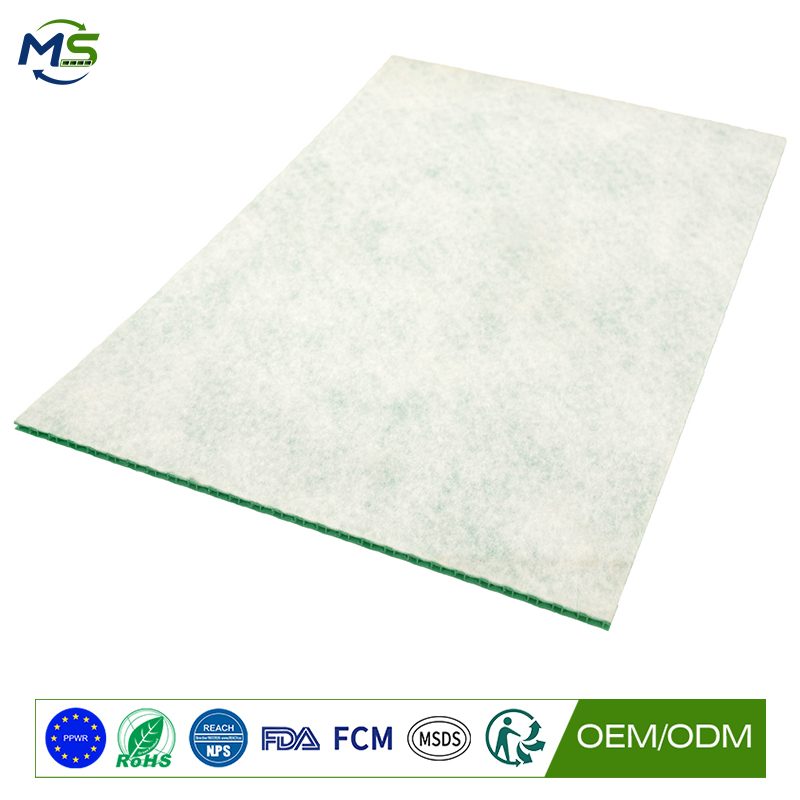
Twin-wall and twin-cell cores describe how the polypropylene extrusions are assembled, and the difference shows up in edge strength and in how the board behaves when it is cut.
A twin-wall core is extruded as a hollow rectangular tube with a rib running down the centre. Two flat skins are bonded to the outer faces, and the core is cut and turned ninety degrees to fill the panel. The centre rib doubles the number of load-bearing walls in any given cross-section, which raises compressive strength for the same core height.
A twin-cell core is built from flat strips folded into a zig-zag between the skins. It is simpler to produce and uses less material, so it is usually chosen where cost matters more than edge performance.
The difference becomes practical at the edge of a panel. A twin-wall core exposes a visible cellular section that is stiffer and less prone to damage during handling, while a twin-cell edge shows a folded wall profile that can crush if the panel is dropped on its corner. For panels that will be moved repeatedly, edge profile is worth asking about.
Protection boards are usually specified against a uniform load, yet on a construction site the loads that actually cause damage are concentrated at a point.
A trolley wheel, a scaffold base plate, a tool case and a ladder foot all deliver their load through a small contact area. The same total weight spread evenly across a square metre does far less damage, because the core walls share the load instead of one cell taking it all.
This is why the internal load capacity of a board is a better number to work with than the compressive strength of the material. Internal load capacity is measured in kilograms per square metre at a given deflection, and it describes what the structure can carry across its face without crushing.
Practical guidance follows from this. Where point loads will occur, either use a thicker board, place a spreader plate under the load, or route the traffic away from the protected area. No board of any thickness will handle a concentrated load indefinitely without some deflection.
For terminology and test-method context see ISO standards catalogue. The guidance on this page is practical site guidance, not a test report or a certificate.
A polypropylene panel deforms before it fails, so a dropped tool leaves a dent rather than a fragment, and that is the property that protects the floor underneath.
Brittle protection products such as plasterboard or fibreboard fracture into pieces under a point impact, and the fragments themselves cut or gouge the finished surface. A ductile polymer panel instead absorbs the energy by bending, which spreads the load and leaves a repairable depression.
This does not make the panel indestructible. Repeated impacts at the same spot will eventually tear the face sheet and collapse the core underneath, at which point the board has lost its protective function and should be removed.
A useful site check is to flex the panel gently by hand. It should feel stiff in the middle and slightly springy at the edges, with no cracking sound and no permanent fold. A panel that feels floppy or creaks under a light hand is not holding its geometry.
| Question | Short answer | What to check on site | In this guide |
|---|---|---|---|
| What should be checked about twin-wall and twin-cell cores explained? | Twin-wall and twin-cell cores describe how the polypropylene extrusions are assembled, and the difference shows up … | A twin-wall core is extruded as a hollow rectangular tube with a rib running down … | Section 1 |
| What should be checked about load distribution and why point loads … | Protection boards are usually specified against a uniform load, yet on a construction site the loads … | A trolley wheel, a scaffold base plate, a tool case and a ladder foot all … | Section 2 |
| What should be checked about impact behaviour and the difference between … | A polypropylene panel deforms before it fails, so a dropped tool leaves a dent rather than … | Brittle protection products such as plasterboard or fibreboard fracture into pieces under a point impact … | Section 3 |
| What should be checked about bending stiffness and why panels that … | A board that deflects under load may still be strong enough, but it is transmitting movement … | Stiffness in a panel is governed by the face sheets, because they sit furthest from … | Section 4 |
A board that deflects under load may still be strong enough, but it is transmitting movement into the floor finish, and that movement is what actually causes visible damage.
Stiffness in a panel is governed by the face sheets, because they sit furthest from the neutral axis and therefore do most of the bending work. Core height matters mainly for compression, while face sheet thickness and material govern deflection under load.
The problem with a deflecting panel is rarely that it breaks. It is that it works the floor finish underneath it. A resilient floor such as a floating timber floor or a resilient tile can crack or lift under repeated small movement, and a stone or tile floor can develop hollow-sounding areas and lifted corners.
Checking deflection at the specification stage is inexpensive. Specify a maximum working deflection, usually a few millimetres at the design load, and ask the supplier to state the figure at that load rather than a generic load rating.
Panel thickness sets how much load the core can carry before it crushes, and because the relationship is roughly linear, the useful move is to work in internal load capacity rather than thickness labels.
Increasing core height increases the section modulus of the core wall, so the compressive strength available at the face rises faster than the thickness figure suggests. A thicker board is meaningfully stronger, but the relationship is not a simple doubling of strength for a doubling of thickness.
Published internal load capacity for honeycomb panels is normally given in kilograms per square metre at a defined deflection, and the deflection limit is part of the number. A figure quoted without its deflection is not comparable with another figure, which is a frequent source of confusion in specifications.
The practical method is to establish the heaviest repeated load on the site, convert it to an equivalent uniformly distributed load, and compare that against the capacity of the chosen board at the deflection limit that the floor finish can tolerate. The tolerance of the finish is often the binding constraint, not the strength of the board.
For a honeycomb panel the nominal thickness, the core height and the finished weight move together, so specifying all three removes most of the ambiguity in a quote.
Nominal thickness is the overall panel depth including both face skins. Core height is that depth less the two skins, and the remaining material is what the honeycomb is folded into. Two panels of the same nominal thickness can have very different core heights depending on how the skins are sized, and that is what determines the load capacity.
Weight follows from the geometry. A thicker core adds wall height without adding much material, so weight increases gradually with thickness rather than in proportion to it. This is the reason a 10 mm honeycomb board can weigh less than a 6 mm solid sheet of the same material.
When requesting a quotation it is worth asking for the three figures together: nominal thickness in millimetres, core height in millimetres, and weight in kilograms per square metre. A supplier who can supply all three without checking is working from a real spec sheet rather than a catalogue thickness.
Twin-wall and twin-cell cores describe how the polypropylene extrusions are assembled, and the difference shows up in edge strength and in how the board behaves when it is cut. A twin-wall core is extruded as a hollow rectangular tube with a rib running down the centre. Two flat skins are bonded …
Protection boards are usually specified against a uniform load, yet on a construction site the loads that actually cause damage are concentrated at a point. A trolley wheel, a scaffold base plate, a tool case and a ladder foot all deliver their load through a small contact …
A board that deflects under load may still be strong enough, but it is transmitting movement into the floor finish, and that movement is what actually causes visible damage. Stiffness in a panel is governed by the face sheets, because they sit furthest from the neutral axis and therefore do most …
For a honeycomb panel the nominal thickness, the core height and the finished weight move together, so specifying all three removes most of the ambiguity in a quote. Nominal thickness is the overall panel depth including both face skins. Core height is that depth less the two skins, and the …
References checked by publisher and title on 2026-11-06. Standards and regulations are cited by name only; no performance values are attributed to them. General material-property figures in the text are indicative reference values for polypropylene and should be verified against your supplier’s current data sheet. Confirm applicability and current versions for your own project before relying on any of them.
For a quotation, a sample panel or help matching a thickness and facing to your site conditions, contact service@mingplastics.com or WhatsApp +86 189 3887 1524. Include the surface type, floor area, the trades working overhead and the expected duration so the recommended specification can be confirmed before you order.
For honeycomb core stiffness, Confirm the core construction, facing and test method in writing before comparing any two panels. For a honeycomb panel the nominal thickness, the core height and the finished weight move together, so specifying all three removes most of the ambiguity in a quote.


