Address
Building 1, No. 22, Shexi Yongping Road,
Dongguan, Guangdong, China
Work Hours
Monday to Friday: 7AM - 7PM
Weekend: 10AM - 5PM
Address
Building 1, No. 22, Shexi Yongping Road,
Dongguan, Guangdong, China
Work Hours
Monday to Friday: 7AM - 7PM
Weekend: 10AM - 5PM
A useful request for quotation states the surface being protected, the area, the heaviest traffic, the duration, the number of ... Ask Mingskye for a sample.
A useful request for quotation states the surface being protected, the area, the heaviest traffic, the duration, the number of reuse cycles expected and the documents required at delivery. It also asks for the test method behind any strength claim and for a sample before a full order. Without those inputs a supplier can only quote a generic panel, and the offers will not be comparable.
This page covers protection board RFQ in six sections: What to put in a request for quotation; What a good specification looks like on one; A structured checklist for comparing supplier offers; Sampling before a full order; Quality management and what a certification actually covers; Pricing factors that explain a wide spread between. Each section answers one practical question and can be read on its own.
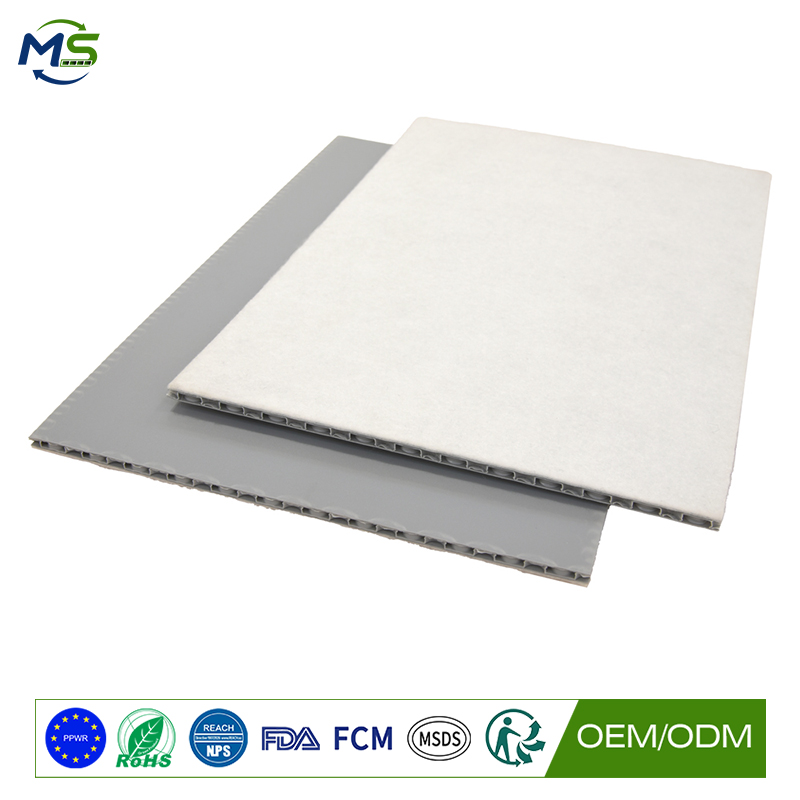
A complete enquiry contains the substrate, the loads, the area, the duration, the access route and the disposal route, and it gets a usable answer in one round rather than five.
Start with the substrate: the floor build-up and the finish, whether the floor is rigid or spanning, and what the finish can tolerate in terms of working deflection. Add the heaviest standing load and the heaviest moving load, and say whether they are the same.
Then the logistics: the area, the number of separate areas, the expected duration in weeks, the access route including stairs and lift dimensions, and whether the boards will be reused or single-use. Finish with the delivery destination and the disposal or return route.
Include the facing requirement and any fire or environmental constraint, and ask for the figures you need to compare offers: nominal thickness, core height, weight per square metre, internal load capacity at a stated deflection, and the tolerances. An enquiry that asks for specific figures produces comparable offers, which is the point of asking for them.
A one-page specification that a site supervisor can read is worth more than a twelve-page document that nobody consults on the day.
The page should open with the substrate and the finish, then the loads with their footprints, then the panel: thickness, core height, facing, internal load capacity at a stated deflection, and tolerances.
It then needs the installation rules in a form that can be followed: preparation of the substrate, maximum panel size, permitted span without support, joint treatment, edge treatment, and the maximum duration before a panel must be inspected.
It closes with the commercial and compliance items: certification, test report references, delivery and packaging, the disposal route, and who to call with a technical question. The value of the document is that it settles questions on the site instead of generating them.
For terminology and test-method context see ISO standards catalogue. The guidance on this page is practical site guidance, not a test report or a certificate.
Compare offers on the figures that determine performance and delivery, and treat everything else as commercial detail to be settled after selection.
The performance column is short: nominal thickness, core height, face sheet material, internal load capacity with deflection and test method, weight per square metre, and dimensional tolerances. If two offers cannot be compared on these, they are not offers of the same product.
The compliance column covers the manufacturing certification, the product test reports, the declaration of conformity and the material safety data. A supplier that supplies these as standard will normally supply them quickly; one that does not usually has to go back to a factory or a third party.
The commercial column covers price per square metre, the minimum order quantity, the lead time, the packaging format, the delivery terms and the payment terms. Agreeing the technical specification first and the commercial terms second is faster, because the technical specification is what determines whether the offers are even comparable.
| Specification question | Short answer | Evidence to request | In this guide |
|---|---|---|---|
| What to put in a request for quotation? | A complete enquiry contains the substrate, the loads, the area, the duration, the access route and … | Start with the substrate: the floor build-up and the finish, whether the floor is rigid … | Section 1 |
| What a good specification looks like on one page? | A one-page specification that a site supervisor can read is worth more than a twelve-page document … | The page should open with the substrate and the finish, then the loads with their … | Section 2 |
| What should be checked about a structured checklist for comparing supplier … | Compare offers on the figures that determine performance and delivery, and treat everything else as commercial … | The performance column is short: nominal thickness, core height, face sheet material, internal load capacity … | Section 3 |
| What should be checked about sampling before a full order? | A sample panel should be tested for the things that will actually fail on the site … | The most valuable sample test is simply to lay the panel on the actual floor … | Section 4 |
A sample panel should be tested for the things that will actually fail on the site, and a general product sample rarely tests any of them.
The most valuable sample test is simply to lay the panel on the actual floor and walk on it the way the site will. That reveals grip, movement under traffic, whether the surface marks, and how the seams behave, none of which appear in a datasheet.
A second test is the point-load test: put a loaded tool case or a scaffold base plate on the panel for an hour and measure the indentation and the residual deformation. A small even indentation is acceptable, a sharp permanent impression is not.
A third test is the wet test in a corner: wet the panel and check whether the facing holds and whether the core absorbs water at the edges. This is quick and it is where failures tend to originate later on.
A quality management certification covers the process that produces the board, not the performance of an individual panel, and the distinction matters when a project demands evidence.
A supplier operating under a certified quality management system has documented procedures for incoming material, production, inspection and non-conformance. That is a meaningful assurance about consistency between batches, which is what matters when a floor is protected across several deliveries.
It does not mean each panel has been individually tested to the published load figures. Testing is normally carried out on samples at defined frequencies, and the certificate describes the system rather than the individual board.
For project documentation, the useful set of evidence is the product declaration, the test reports for the specific grade, the certification of the manufacturing system, and a declaration of conformity for the market the product is being supplied into. A supplier who provides this set unprompted is saving weeks of procurement administration.
Two offers for panels of the same nominal thickness can differ by a factor of two, and the difference is almost always in the specification rather than in the margin.
The core height is the first factor. Two panels of the same overall thickness with different core heights have very different stiffness and load capacity, and the one with the smaller core is much cheaper because it uses less material.
The second is the facing. A felt or non-woven facing is materially more expensive than a film facing, and a flame-retardant grade carries an additive cost across the whole panel.
The third is the bond method and the quality control. Welded bonding with a documented process and batch testing is a more expensive product than an adhesive-bonded one, and it should be, because it performs differently. The fourth is the order quantity and the format, with a pre-cut programme costing more per square metre than a standard panel supply.
A complete enquiry contains the substrate, the loads, the area, the duration, the access route and the disposal route, and it gets a usable answer in one round rather than five. Start with the substrate: the floor build-up and the finish, whether the floor is rigid or spanning, and what the finish can …
A one-page specification that a site supervisor can read is worth more than a twelve-page document that nobody consults on the day. The page should open with the substrate and the finish, then the loads with their footprints, then the panel: thickness, core height …
A sample panel should be tested for the things that will actually fail on the site, and a general product sample rarely tests any of them. The most valuable sample test is simply to lay the panel on the actual floor and walk on it the way the …
Two offers for panels of the same nominal thickness can differ by a factor of two, and the difference is almost always in the specification rather than in the margin. The core height is the first factor. Two panels of the same overall thickness with different core heights have very different stiffness …
References checked by publisher and title on 2026-11-06. Standards and regulations are cited by name only; no performance values are attributed to them. General material-property figures in the text are indicative reference values for polypropylene and should be verified against your supplier’s current data sheet. Confirm applicability and current versions for your own project before relying on any of them.
For a quotation, a sample panel or help matching a thickness and facing to your site conditions, contact service@mingplastics.com or WhatsApp +86 189 3887 1524. Include the surface type, floor area, the trades working overhead and the expected duration so the recommended specification can be confirmed before you order.
For protection board RFQ, Put the load case, the access limit and the required evidence on one page before asking for prices. Two offers for panels of the same nominal thickness can differ by a factor of two, and the difference is almost always in the specification rather than in …


