Address
Building 1, No. 22, Shexi Yongping Road,
Dongguan, Guangdong, China
Work Hours
Monday to Friday: 7AM - 7PM
Weekend: 10AM - 5PM
Address
Building 1, No. 22, Shexi Yongping Road,
Dongguan, Guangdong, China
Work Hours
Monday to Friday: 7AM - 7PM
Weekend: 10AM - 5PM
Ask how the panel behaves on a spanning floor, what facing they would put against polished stone, how many cycles their figure ... Ask Mingskye for a sample.
Ask how the panel behaves on a spanning floor, what facing they would put against polished stone, how many cycles their figure assumes, what tape they recommend for a finished surface and how they would handle a crushed corner on arrival. Specific answers tied to your site conditions indicate application knowledge; generic claims about strength and quality do not.
This page covers protection supplier questions in six sections: Questions that reveal whether a supplier understands the; Red flags in a supplier’s claims; Why the substrate condition matters more than the; How to specify the facing for the floor; Break-even reuse: how many cycles justify a reusable; Removing protection without taking the floor with it. Each section answers one practical question and can be read on its own.
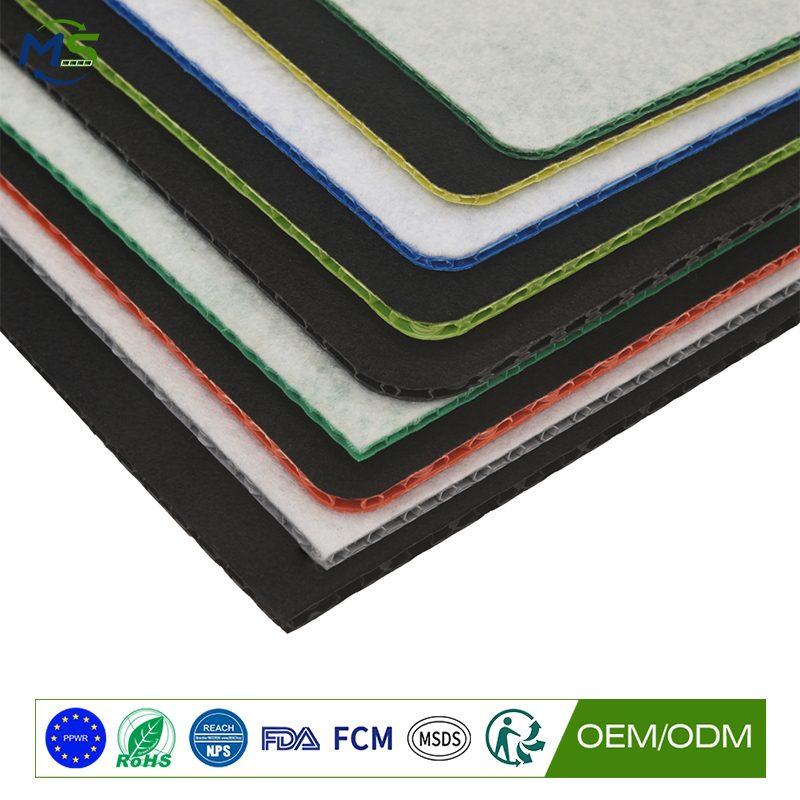
A few questions in the right order tell you more about a supplier than any amount of product literature.
Ask what deflection limit applies and what the capacity is at that limit. A supplier who answers in terms of compressive strength and then rephrases has understood the question; one who answers with a single number has not.
Ask what happens at the edge of a cut panel and whether the product is intended to be trimmed on site. The answer reveals whether they expect their panels to be handled by site labour and whether the grade suits it.
Ask how many cycles the product has actually achieved on comparable projects, and ask to speak to a reference. The honest answer is a range rather than a figure, and the honest supplier will say so.
Finally, ask what they would change if the heaviest load turned out to be higher than expected. A supplier with a solution mindset will talk about spreading the load and about a second grade; one with a fixed catalogue will talk about their standard range.
A small number of claims appear in almost every weak specification and are worth challenging directly.
An unquantified load claim is the most common. Phrases such as heavy duty, industrial grade or heavy duty construction describe a category rather than a number, and they cannot be checked against anything.
The second is a durability claim without a cycle count. Statements such as designed for repeated use or long lasting appear in almost any brochure and mean nothing without a number of cycles or an equivalent test.
The third is an environmental claim without a route. Recyclable is meaningless if the product has a bonded facing that prevents recovery, and it is worth asking which stream it goes into and under whose authority.
The fourth is a fire claim without a classification. Fire rated or fire resistant without the standard and the class cannot be verified and should not be accepted on a site where fire performance is governed by a temporary works risk assessment.
For terminology and test-method context see ISO standards catalogue. The guidance on this page is practical site guidance, not a test report or a certificate.
A panel laid on an uneven, dusty or damp floor will behave differently from the same panel laid on a prepared one, and no amount of panel specification fixes the substrate.
Dust and debris under a panel are the most common cause of scratching. A single particle of grit trapped between the board and a hardwood floor is enough to produce a visible scratch when a trolley crosses it, and the damage cannot be undone without resanding or refinishing.
An uneven floor introduces high spots that concentrate the load onto individual core cells, which is precisely the failure mode the panel was chosen to avoid. Sharp edges in a screed can also cut into the facing and puncture the board.
A damp floor is a separate issue, because a sealed panel traps the moisture and can cause the screed or the adhesive beneath to deteriorate. Preparing the substrate means sweeping, checking for sharp edges, confirming dryness and, where the panel needs to sit for a long period, laying a breathable separation layer.
| Supplier question | Short answer | Evidence to request | In this guide |
|---|---|---|---|
| What should be checked about questions that reveal whether a supplier … | A few questions in the right order tell you more about a supplier than any amount … | Ask what deflection limit applies and what the capacity is at that limit. A supplier … | Section 1 |
| What should be checked about red flags in a supplier’s claims? | A small number of claims appear in almost every weak specification and are worth challenging directly. | An unquantified load claim is the most common. Phrases such as heavy duty, industrial grade … | Section 2 |
| Why the substrate condition matters more than the panel? | A panel laid on an uneven, dusty or damp floor will behave differently from the same … | Dust and debris under a panel are the most common cause of scratching. A single … | Section 3 |
| How to specify the facing for the floor underneath? | Match the facing to the sensitivity of the substrate and to the conditions, rather than choosing … | The decision is straightforward for sensitive finishes. Hardwood, polished stone, marble, high-gloss epoxy and specialist … | Section 4 |
Match the facing to the sensitivity of the substrate and to the conditions, rather than choosing a standard facing and hoping it is adequate.
The decision is straightforward for sensitive finishes. Hardwood, polished stone, marble, high-gloss epoxy and specialist coatings need a soft, non-abrasive facing, because even a trapped particle of grit under a hard film will scratch when traffic passes over it.
For ordinary screed or concrete that will be covered later, a smooth film facing is usually sufficient and is easier to clean. For a board used as a temporary working platform in a wet area, a facing that can be washed and dried is more useful than one chosen for grip.
Where the board sits directly on a finished floor and is likely to stay there for months, the facing decision matters most because it is the only layer between the traffic and the substrate. A felt facing in that position is a small cost relative to a damaged floor.
A reusable board beats a disposable one once it has survived enough cycles to absorb the price difference, and the price difference is usually smaller than people assume.
The calculation compares the purchase price of the reusable board with the disposable board plus the cost of disposal, the waste handling and the labour to clear it. Where the reusable board costs twice as much per square metre but disposal and handling add 40 per cent to the disposable option, the break-even sits around three cycles.
Add the labour saving and the reusable board is ahead from the first cycle on many projects, because a reusable board is laid and lifted repeatedly rather than disposed of and replaced.
The counter-case is a short, single-phase project with no reuse opportunity and no collection discipline, where the disposable option wins. Deciding honestly which kind of project it is saves buying the wrong product and then managing the consequences.
Removal is where good protection is often damaged, because the panel is pulled while it is still partly stuck down.
Adhesive tape should be removed while it is still workable, not left to harden for weeks. Heat can be used on some tapes, but the safest method is a low-tack tape that is removed on the schedule it was applied, and a written removal schedule in the method statement prevents the problem entirely.
Panels should be lifted rather than dragged, and lifted from a corner rather than pulled along the surface. Any grit that has accumulated under the panel should be removed before it is lifted, and a vacuum at the joint is the fastest way to do it.
Finally, the floor should be inspected and cleaned at the point of removal, and the count of panels returned should be recorded on the same visit. Doing the inspection while the protection is still down avoids a second walk-over and finds the areas that need attention before the trades return.
A few questions in the right order tell you more about a supplier than any amount of product literature. Ask what deflection limit applies and what the capacity is at that limit. A supplier who answers in terms of compressive strength …
A small number of claims appear in almost every weak specification and are worth challenging directly. An unquantified load claim is the most common. Phrases such as heavy duty, industrial grade or heavy duty construction describe a category …
Match the facing to the sensitivity of the substrate and to the conditions, rather than choosing a standard facing and hoping it is adequate. The decision is straightforward for sensitive finishes. Hardwood, polished stone, marble, high-gloss epoxy and specialist coatings need a soft, non-abrasive facing, because …
Removal is where good protection is often damaged, because the panel is pulled while it is still partly stuck down. Adhesive tape should be removed while it is still workable, not left to harden for weeks. Heat can be used on some …
References checked by publisher and title on 2026-11-06. Standards and regulations are cited by name only; no performance values are attributed to them. General material-property figures in the text are indicative reference values for polypropylene and should be verified against your supplier’s current data sheet. Confirm applicability and current versions for your own project before relying on any of them.
For a quotation, a sample panel or help matching a thickness and facing to your site conditions, contact service@mingplastics.com or WhatsApp +86 189 3887 1524. Include the surface type, floor area, the trades working overhead and the expected duration so the recommended specification can be confirmed before you order.
For protection supplier questions, Ask for the evidence behind each claim and a production-batch sample before committing. Removal is where good protection is often damaged, because the panel is pulled while it is still partly stuck down.


