Address
Building 1, No. 22, Shexi Yongping Road,
Dongguan, Guangdong, China
Work Hours
Monday to Friday: 7AM - 7PM
Weekend: 10AM - 5PM
Address
Building 1, No. 22, Shexi Yongping Road,
Dongguan, Guangdong, China
Work Hours
Monday to Friday: 7AM - 7PM
Weekend: 10AM - 5PM
Rubber matting is chosen for grip, cushioning and sound damping in a small, fixed area, and it is heavy and expensive to cover a ... Ask Mingskye for a sample.
Rubber matting is chosen for grip, cushioning and sound damping in a small, fixed area, and it is heavy and expensive to cover a whole floor. A honeycomb protection board is chosen for area coverage and stiffness at low weight. On a large fit-out the usual answer is a board for the general run and matting only at thresholds, ramps and other places where slip resistance is the deciding factor.
This page covers rubber matting vs honeycomb board in six sections: PP honeycomb board against rubber matting; PP honeycomb board against carpet offcuts and ram; Slip resistance and the difference between a walking; Load distribution and why point loads matter more; Protecting an existing floor during a refurbishment; The cost of delay caused by missing protection. Each section answers one practical question and can be read on its own.
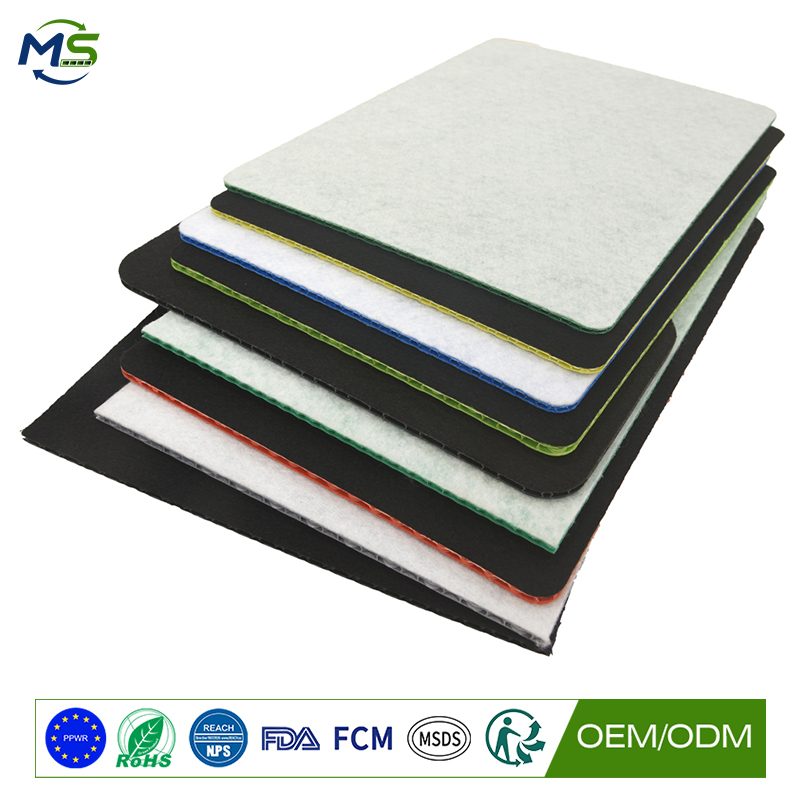
Rubber matting is for grip and for vibration isolation, and a protection board is for carrying load, so the two are chosen for different reasons.
Rubber matting is thick, heavy and soft. It excels at reducing slip on a wet or oily surface, at isolating vibration and at providing comfort under a standing workstation. It performs poorly as a general protection board because it is expensive per square metre, heavy to move and traps grit underneath it.
A polypropylene panel is stiff, light and cleanable, and it carries a distributed load effectively. It is also slippery when wet, which is why it should not be specified as a walkway.
The combination is sometimes the right answer: a rubber mat laid over a honeycomb panel gives the grip that the panel lacks, and the panel below handles the load. The order matters, because the panel has to be the load-bearing layer.
Offcut carpet and fibreboard are cheap and are often used wastefully, because the material is designed for a single short job and is then thrown away.
Carpet offcut has real virtues: it will not scratch anything, it grips well and it absorbs water. Its limitation is that it is a waste material with an unpredictable thickness and a backing that is not designed for repeated wetting.
Ram board and similar fibreboard products are a stronger single-use option and are a reasonable choice for a short project where a panel is only needed once. They are not reusable in any meaningful sense, they are heavy relative to their performance, and they cannot be recycled as a single material.
The argument for the polymer panel is not that the alternative is bad, it is that the cost of the alternative is paid every time. A fleet of reusable panels spreads one purchase over many jobs, and it also gives the site a consistent, visible, professional appearance in front of a client.
For terminology and test-method context see ISO standards catalogue. The guidance on this page is practical site guidance, not a test report or a certificate.
A protection board is not a walkway, and treating it as one is the most common cause of panels being replaced early.
The walking surface on a construction site is normally a purpose-made walkway with a defined slip rating, because a walking surface has to perform in the wet and be clearly identifiable. A protection board is a covering, and its job is to keep the substrate clean and undamaged while other traffic passes over or around it.
Even with a felt facing, a wet panel surface has a lower friction value than a rated walkway product. Barriers and signage are what keep traffic off the protected area in the first place, and they are far cheaper than replacing panels because someone slipped on them.
If the protected area has to be walked on regularly, the correct answer is to lay a rated walkway over the protection rather than to choose a heavier board. That keeps the protection intact and removes the slip risk from the equation.
| Comparison question | Short answer | What decides the choice | In this guide |
|---|---|---|---|
| What should be checked about pP honeycomb board against rubber matting? | Rubber matting is for grip and for vibration isolation, and a protection board is for carrying … | Rubber matting is thick, heavy and soft. It excels at reducing slip on a wet … | Section 1 |
| What should be checked about pP honeycomb board against carpet offcuts … | Offcut carpet and fibreboard are cheap and are often used wastefully, because the material is designed … | Carpet offcut has real virtues: it will not scratch anything, it grips well and it … | Section 2 |
| What should be checked about slip resistance and the difference between … | A protection board is not a walkway, and treating it as one is the most common … | The walking surface on a construction site is normally a purpose-made walkway with a defined … | Section 3 |
| What should be checked about load distribution and why point loads … | Protection boards are usually specified against a uniform load, yet on a construction site the loads … | A trolley wheel, a scaffold base plate, a tool case and a ladder foot all … | Section 4 |
Protection boards are usually specified against a uniform load, yet on a construction site the loads that actually cause damage are concentrated at a point.
A trolley wheel, a scaffold base plate, a tool case and a ladder foot all deliver their load through a small contact area. The same total weight spread evenly across a square metre does far less damage, because the core walls share the load instead of one cell taking it all.
This is why the internal load capacity of a board is a better number to work with than the compressive strength of the material. Internal load capacity is measured in kilograms per square metre at a given deflection, and it describes what the structure can carry across its face without crushing.
Practical guidance follows from this. Where point loads will occur, either use a thicker board, place a spreader plate under the load, or route the traffic away from the protected area. No board of any thickness will handle a concentrated load indefinitely without some deflection.
In a live refurbishment, protection serves two masters at once, the client who wants the floor kept and the contractor who needs access.
The first requirement is usually the highest-value finish on the site. On a hotel or an office refurbishment, the client cares about a marble lobby or a timber floor that will be visible on handover, and those areas get the highest grade of protection.
The second requirement is productivity, which means the protection has to be moveable. A panel that cannot be lifted by two people and carried down a corridor will stay where it was put and the work behind it will not happen.
A practical compromise used on live sites is to use a heavier board in the high-visibility areas and a lighter reusable sheet in circulation routes, with a rigid barrier between the two so that the heavier panels are not walked on.
The most expensive protection failure is a trade that cannot start, and it never appears in a protection budget.
On a programme, protection that is not available when a trade is ready to work stops that trade, and the delay propagates through the sequence. Two or three trades waiting behind one missing protection area can put a day into a programme.
The site usually absorbs this cost invisibly, because the trade that waits is paid anyway and the programme is recovered by working elsewhere. It becomes visible when the programme cannot be recovered and the completion date moves.
This is the strongest argument for provisioning protection early and holding a small buffer of panels rather than ordering exactly to the area. A buffer of panels available on site is cheap insurance against a delay that costs orders of magnitude more.
Rubber matting is for grip and for vibration isolation, and a protection board is for carrying load, so the two are chosen for different reasons. Rubber matting is thick, heavy and soft. It excels at reducing slip on a wet or oily surface, at isolating vibration and …
Offcut carpet and fibreboard are cheap and are often used wastefully, because the material is designed for a single short job and is then thrown away. Carpet offcut has real virtues: it will not scratch anything, it grips well and it absorbs water. Its limitation is that it …
Protection boards are usually specified against a uniform load, yet on a construction site the loads that actually cause damage are concentrated at a point. A trolley wheel, a scaffold base plate, a tool case and a ladder foot all deliver their load through a small contact …
The most expensive protection failure is a trade that cannot start, and it never appears in a protection budget. On a programme, protection that is not available when a trade is ready to work stops that trade, and the delay propagates …
References checked by publisher and title on 2026-11-06. Standards and regulations are cited by name only; no performance values are attributed to them. General material-property figures in the text are indicative reference values for polypropylene and should be verified against your supplier’s current data sheet. Confirm applicability and current versions for your own project before relying on any of them.
For a quotation, a sample panel or help matching a thickness and facing to your site conditions, contact service@mingplastics.com or WhatsApp +86 189 3887 1524. Include the surface type, floor area, the trades working overhead and the expected duration so the recommended specification can be confirmed before you order.
For rubber matting vs honeycomb board, Rank the alternatives on the one property that actually decides your case, then check the price. The most expensive protection failure is a trade that cannot start, and it never appears in a protection budget.


