Address
Building 1, No. 22, Shexi Yongping Road,
Dongguan, Guangdong, China
Work Hours
Monday to Friday: 7AM - 7PM
Weekend: 10AM - 5PM
Address
Building 1, No. 22, Shexi Yongping Road,
Dongguan, Guangdong, China
Work Hours
Monday to Friday: 7AM - 7PM
Weekend: 10AM - 5PM
Builders film, bubble wrap and foam are barriers or cushions, not structures. They keep dust, paint and light spills off a ... Ask Mingskye for a sample.
Builders film, bubble wrap and foam are barriers or cushions, not structures. They keep dust, paint and light spills off a surface and absorb very light contact, but they have almost no bending stiffness, so a boot heel or a trolley wheel presses straight through them onto the floor. Use them as a layer under or over a stiff panel, never as the only protection where people or equipment will cross.
This page covers builders film vs load protection in six sections: PP honeycomb board against polyethylene sheeting; PP honeycomb board against foam and bubble wrap; PP honeycomb board against peelable protective coatings; Load distribution and why point loads matter more; Bending stiffness and why panels that deflect are; Puncture and the point where the floor becomes. Each section answers one practical question and can be read on its own.
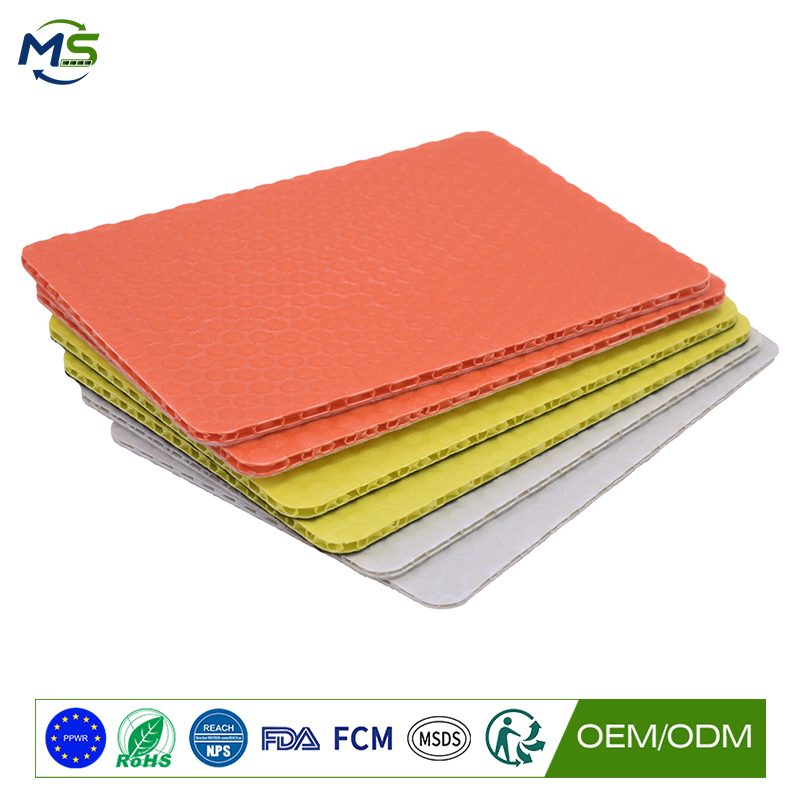
Polyethylene sheeting is a dust and spill barrier rather than a load protection, and it is worth being clear about which problem it solves.
A polythene sheet on a floor stops dust, tracks and spill from reaching the substrate, and it costs very little. What it does not do is carry any load at all, and a sheet creased by traffic will tear and bunch.
A honeycomb panel does the opposite: it carries load and it protects against impact and abrasion, but it is not a dust sheet, and a panel does not stop fine dust from settling on the floor beneath it.
The practical conclusion is that these are complements rather than alternatives. A polythene sheet under a honeycomb panel gives a dust barrier under a load-bearing protection, and this combination is standard on a clean floor where both dust and traffic are concerns.
Foam products are for cushioning a fragile object in transit, not for carrying traffic across a floor, and the difference shows up in the first week of use.
Foam and bubble wrap distribute load very gently and will not scratch anything, which is exactly what is needed for a glazed panel or a finished instrument. They have almost no compressive strength, so a foot or a trolley wheel compresses them to nothing.
They also degrade quickly in the conditions of a construction site. Polyethylene bubble wrap becomes brittle in cold conditions, foam absorbs water and holds it against the floor, and both shred under a sharp edge.
The correct use of each is clear: cushioning materials protect a product, and a load-bearing panel protects a floor. Putting a foam sheet under a trolley on a client floor produces a floor that looks marked even though no hard object ever touched it.
For terminology and test-method context see ISO standards catalogue. The guidance on this page is practical site guidance, not a test report or a certificate.
A peelable coating is a film that is applied to the floor and removed later, and it competes with a board on labour rather than on performance.
A peelable coating is excellent where the floor is porous and difficult to clean, such as an unfinished screed or a blockwork surface. It costs very little per square metre and it protects against dust, paint and light contamination.
It does not carry any load, it is easily punctured, and it cannot be repaired once torn. It also has a limited life and it is normally removed with a pressure wash, which generates a waste stream and needs somewhere to discharge the water.
The two products address different parts of the problem. Where the floor is porous and the traffic is light, a coating may be all that is needed. Where there is real traffic and the floor is valuable, a board provides the load protection that the coating cannot.
| Comparison question | Short answer | What decides the choice | In this guide |
|---|---|---|---|
| What should be checked about pP honeycomb board against polyethylene sheeting? | Polyethylene sheeting is a dust and spill barrier rather than a load protection, and it is … | A polythene sheet on a floor stops dust, tracks and spill from reaching the substrate … | Section 1 |
| What should be checked about pP honeycomb board against foam and … | Foam products are for cushioning a fragile object in transit, not for carrying traffic across a … | Foam and bubble wrap distribute load very gently and will not scratch anything, which is … | Section 2 |
| What should be checked about pP honeycomb board against peelable protective … | A peelable coating is a film that is applied to the floor and removed later, and … | A peelable coating is excellent where the floor is porous and difficult to clean, such … | Section 3 |
| What should be checked about load distribution and why point loads … | Protection boards are usually specified against a uniform load, yet on a construction site the loads … | A trolley wheel, a scaffold base plate, a tool case and a ladder foot all … | Section 4 |
Protection boards are usually specified against a uniform load, yet on a construction site the loads that actually cause damage are concentrated at a point.
A trolley wheel, a scaffold base plate, a tool case and a ladder foot all deliver their load through a small contact area. The same total weight spread evenly across a square metre does far less damage, because the core walls share the load instead of one cell taking it all.
This is why the internal load capacity of a board is a better number to work with than the compressive strength of the material. Internal load capacity is measured in kilograms per square metre at a given deflection, and it describes what the structure can carry across its face without crushing.
Practical guidance follows from this. Where point loads will occur, either use a thicker board, place a spreader plate under the load, or route the traffic away from the protected area. No board of any thickness will handle a concentrated load indefinitely without some deflection.
A board that deflects under load may still be strong enough, but it is transmitting movement into the floor finish, and that movement is what actually causes visible damage.
Stiffness in a panel is governed by the face sheets, because they sit furthest from the neutral axis and therefore do most of the bending work. Core height matters mainly for compression, while face sheet thickness and material govern deflection under load.
The problem with a deflecting panel is rarely that it breaks. It is that it works the floor finish underneath it. A resilient floor such as a floating timber floor or a resilient tile can crack or lift under repeated small movement, and a stone or tile floor can develop hollow-sounding areas and lifted corners.
Checking deflection at the specification stage is inexpensive. Specify a maximum working deflection, usually a few millimetres at the design load, and ask the supplier to state the figure at that load rather than a generic load rating.
A puncture is the most consequential failure of a protection board because it is the moment the substrate below becomes exposed to the traffic.
Punctures come from sharp points, not from weight. A protruding screw, a splinter of timber, a nail in a pallet foot or a chip of masonry will go through a facing in a way that a heavy load never would.
The repair is immediate and temporary. A patch of compatible material taped over the hole, with the edges sealed, is enough to restore the barrier while the damaged panel is replaced at the next changeover.
The investigation is more valuable than the repair. A cluster of punctures in one area usually means something in the workflow is dropping a sharp object, and the site will keep producing punctures until the workflow changes.
Polyethylene sheeting is a dust and spill barrier rather than a load protection, and it is worth being clear about which problem it solves. A polythene sheet on a floor stops dust, tracks and spill from reaching the substrate, and it costs very little. What it …
Foam products are for cushioning a fragile object in transit, not for carrying traffic across a floor, and the difference shows up in the first week of use. Foam and bubble wrap distribute load very gently and will not scratch anything, which is exactly what is needed for a glazed …
Protection boards are usually specified against a uniform load, yet on a construction site the loads that actually cause damage are concentrated at a point. A trolley wheel, a scaffold base plate, a tool case and a ladder foot all deliver their load through a small contact …
A puncture is the most consequential failure of a protection board because it is the moment the substrate below becomes exposed to the traffic. Punctures come from sharp points, not from weight. A protruding screw, a splinter of timber, a nail in a pallet foot or …
References checked by publisher and title on 2026-11-06. Standards and regulations are cited by name only; no performance values are attributed to them. General material-property figures in the text are indicative reference values for polypropylene and should be verified against your supplier’s current data sheet. Confirm applicability and current versions for your own project before relying on any of them.
For a quotation, a sample panel or help matching a thickness and facing to your site conditions, contact service@mingplastics.com or WhatsApp +86 189 3887 1524. Include the surface type, floor area, the trades working overhead and the expected duration so the recommended specification can be confirmed before you order.
For builders film vs load protection, Rank the alternatives on the one property that actually decides your case, then check the price. A puncture is the most consequential failure of a protection board because it is the moment the substrate below becomes exposed to the traffic.


