Address
Building 1, No. 22, Shexi Yongping Road,
Dongguan, Guangdong, China
Work Hours
Monday to Friday: 7AM - 7PM
Weekend: 10AM - 5PM
Address
Building 1, No. 22, Shexi Yongping Road,
Dongguan, Guangdong, China
Work Hours
Monday to Friday: 7AM - 7PM
Weekend: 10AM - 5PM
Corrugated cardboard is cheap, easy to cut and fine for short, dry, light-duty work. It loses stiffness when wet, crushes under ... Ask Mingskye for a sample.
Corrugated cardboard is cheap, easy to cut and fine for short, dry, light-duty work. It loses stiffness when wet, crushes under repeated trolley traffic and is usually discarded after one phase. A PP honeycomb board costs more per sheet but resists water, survives repeated handling and can be reused, so it wins on expensive finishes, wet work and programmes with several phases.
This page covers honeycomb board vs corrugated cardboard in six sections: PP honeycomb board against corrugated cardboard; Moisture behaviour in wet and humid conditions; Cost per square metre per use: the only; Break-even reuse: how many cycles justify a reusable; Trapped moisture under the panel; Why single-use alternatives are sometimes the right answer. Each section answers one practical question and can be read on its own.
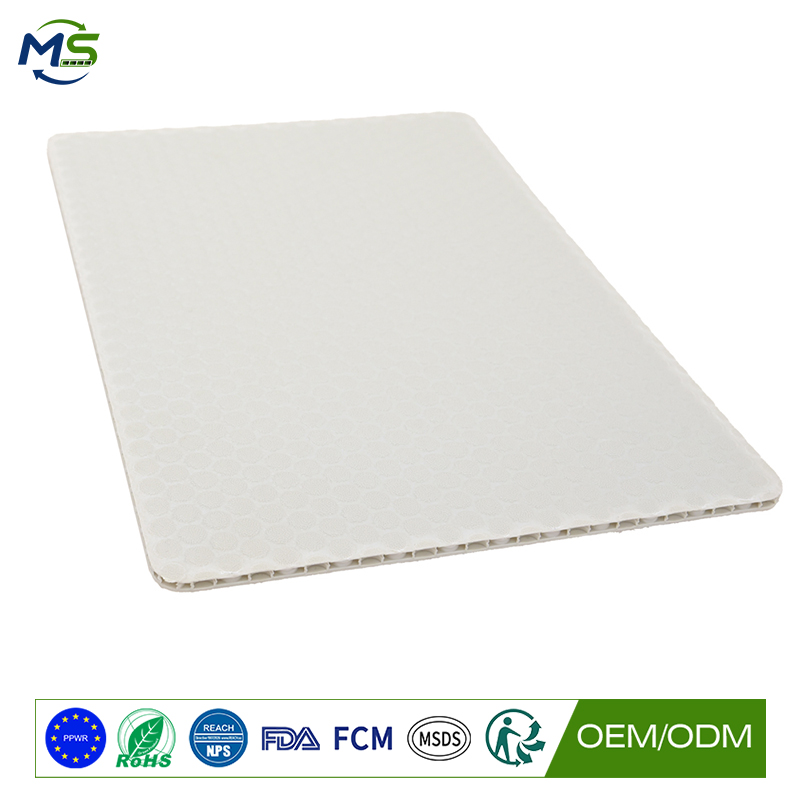
Corrugated cardboard wins on first cost and loses on everything that happens after the first job, because it tears, absorbs water and cannot be cleaned.
Corrugated board is a genuinely good product for protecting a floor for a few days during a single delivery or a short trades package. It is cheap, available everywhere and does not need to be returned.
It stops being economical when it is used repeatedly or in damp conditions. Once the flutes take up moisture the board loses almost all of its compressive strength, and it cannot be wiped clean, so it becomes a carrier for dirt rather than a barrier.
The practical comparison is a single-use board against a reusable one over a programme with more than one cycle, and it should be made on cost per cycle and on labour rather than on unit price. A honeycomb board that survives eight cycles against a cardboard sheet used once is a different product category, not a better version of the same thing.
Polypropylene absorbs very little water, which makes it a good choice for wet-area protection, but the core can still trap water and the facing choice decides whether that water stays or drains.
The water absorption of polypropylene is typically well under 1% by mass, so the polymer itself does not swell or lose strength in the way that wood-based boards do. A polypropylene panel left in a wet slab overnight will still be usable the next morning.
Water problems come from the core, not the material. If a panel is stood on edge with the cellular section exposed, or laid on a surface with a void beneath, water can sit inside the cells with no way to drain. That water cannot dry out from inside the core.
Mitigation is straightforward. Lay panels flat so the cells are compressed, keep gaps between boards so moisture can escape, and choose a facing that tolerates being wet if the area will be washed down. Never store panels on edge in an unfinished building over a long period.
For terminology and test-method context see ISO standards catalogue. The guidance on this page is practical site guidance, not a test report or a certificate.
Comparing two protection offers by price per square metre is meaningless unless the number is divided by the number of times the panel will actually be used.
The calculation is simple. Take the total cost of the panels including delivery, the protection consumables and the labour to lay and lift them, divide by the area protected, and then divide by the number of cycles the panels will survive in service.
This changes the ranking of offers. A disposable board that costs a third of a reusable one can be more expensive per cycle if the reusable board gets used five times and the disposable one is used once and thrown away, particularly once the disposal cost and the labour to clear the waste are included.
The number of cycles is the part that needs evidence rather than assumption. Ask how many times the panel has been used on comparable projects, whether the figure assumes any repair, and how the panel will be inspected between cycles. A cycle count that assumes zero damage is not a cycle count.
| Comparison question | Short answer | What decides the choice | In this guide |
|---|---|---|---|
| What should be checked about pP honeycomb board against corrugated cardboard? | Corrugated cardboard wins on first cost and loses on everything that happens after the first job … | Corrugated board is a genuinely good product for protecting a floor for a few days … | Section 1 |
| What should be checked about moisture behaviour in wet and humid … | Polypropylene absorbs very little water, which makes it a good choice for wet-area protection, but the … | The water absorption of polypropylene is typically well under 1% by mass, so the polymer … | Section 2 |
| What should be checked about cost per square metre per use … | Comparing two protection offers by price per square metre is meaningless unless the number is divided … | The calculation is simple. Take the total cost of the panels including delivery, the protection … | Section 3 |
| What should be checked about break-even reuse: how many cycles justify … | A reusable board beats a disposable one once it has survived enough cycles to absorb the … | The calculation compares the purchase price of the reusable board with the disposable board plus … | Section 4 |
A reusable board beats a disposable one once it has survived enough cycles to absorb the price difference, and the price difference is usually smaller than people assume.
The calculation compares the purchase price of the reusable board with the disposable board plus the cost of disposal, the waste handling and the labour to clear it. Where the reusable board costs twice as much per square metre but disposal and handling add 40 per cent to the disposable option, the break-even sits around three cycles.
Add the labour saving and the reusable board is ahead from the first cycle on many projects, because a reusable board is laid and lifted repeatedly rather than disposed of and replaced.
The counter-case is a short, single-phase project with no reuse opportunity and no collection discipline, where the disposable option wins. Deciding honestly which kind of project it is saves buying the wrong product and then managing the consequences.
Water trapped beneath a protection panel can damage the floor more seriously than the traffic the panel was protecting against.
The mechanism is that the floor cannot dry downward or sideways, and the vapour pressure builds under the panel. On a screed this can prevent the screed from achieving its design strength and can cause the surface to delaminate later.
Signs of the problem are visible on the underside of a lifted panel as a white or grey deposit, and on the floor as a darkened area with a distinct edge matching the panel footprint.
Prevention is procedural rather than material-based. Never lay an impermeable panel on a damp floor, keep a drainage path, leave the area open until the screed is dry, and inspect the underside of panels at every lift.
A single-use product is right when the job is genuinely single-use, the floor is not valuable and no collection system exists.
There is a category of work where reuse is impossible. A one-off concrete pour with a short protection window, a demolition site where the floor will be removed anyway, or a project where the panels will be contaminated beyond cleaning. Buying a reusable panel for these cases adds the cost of collection and return for no benefit.
The second case is a very short project in a remote location with no transport infrastructure for the return, where the collection cost exceeds the value of the panel.
The third case is a floor with no value to protect, where the real requirement is to keep a trade working for two days. In all three cases the single-use product is the correct economic answer, and a supplier who insists on the reusable option is selling the wrong thing.
Corrugated cardboard wins on first cost and loses on everything that happens after the first job, because it tears, absorbs water and cannot be cleaned. Corrugated board is a genuinely good product for protecting a floor for a few days during a single delivery or a short …
Polypropylene absorbs very little water, which makes it a good choice for wet-area protection, but the core can still trap water and the facing choice decides whether that water stays or drains. The water absorption of polypropylene is typically well under 1% by mass, so the polymer itself does not swell or lose strength …
A reusable board beats a disposable one once it has survived enough cycles to absorb the price difference, and the price difference is usually smaller than people assume. The calculation compares the purchase price of the reusable board with the disposable board plus the cost of disposal, the waste handling …
A single-use product is right when the job is genuinely single-use, the floor is not valuable and no collection system exists. There is a category of work where reuse is impossible. A one-off concrete pour with a short protection window, a demolition site …
References checked by publisher and title on 2026-11-06. Standards and regulations are cited by name only; no performance values are attributed to them. General material-property figures in the text are indicative reference values for polypropylene and should be verified against your supplier’s current data sheet. Confirm applicability and current versions for your own project before relying on any of them.
For a quotation, a sample panel or help matching a thickness and facing to your site conditions, contact service@mingplastics.com or WhatsApp +86 189 3887 1524. Include the surface type, floor area, the trades working overhead and the expected duration so the recommended specification can be confirmed before you order.
For honeycomb board vs corrugated cardboard, Rank the alternatives on the one property that actually decides your case, then check the price. A single-use product is right when the job is genuinely single-use, the floor is not valuable and no collection system exists.


