Address
Building 1, No. 22, Shexi Yongping Road,
Dongguan, Guangdong, China
Work Hours
Monday to Friday: 7AM - 7PM
Weekend: 10AM - 5PM
Address
Building 1, No. 22, Shexi Yongping Road,
Dongguan, Guangdong, China
Work Hours
Monday to Friday: 7AM - 7PM
Weekend: 10AM - 5PM
Lead time is the sum of sampling and approval, production, export packing, inland transport, the sailing or flight, clearance and ... Ask Mingskye for a sample.
Lead time is the sum of sampling and approval, production, export packing, inland transport, the sailing or flight, clearance and delivery to site. The delay usually sits at the approvals and the handover points, not in the press. Fix the sample sign-off date and the document deadlines in the order, then plan the delivery window around the trade programme rather than the earliest possible ship date.
This page covers protection panel lead time in six sections: Lead time and where the delay actually sits; Sampling and the trial order; Planning a shipment into a live site; Choosing the right delivery term; Working capital and how payment terms affect the; Minimum order quantities and when it is worth. Each section answers one practical question and can be read on its own.
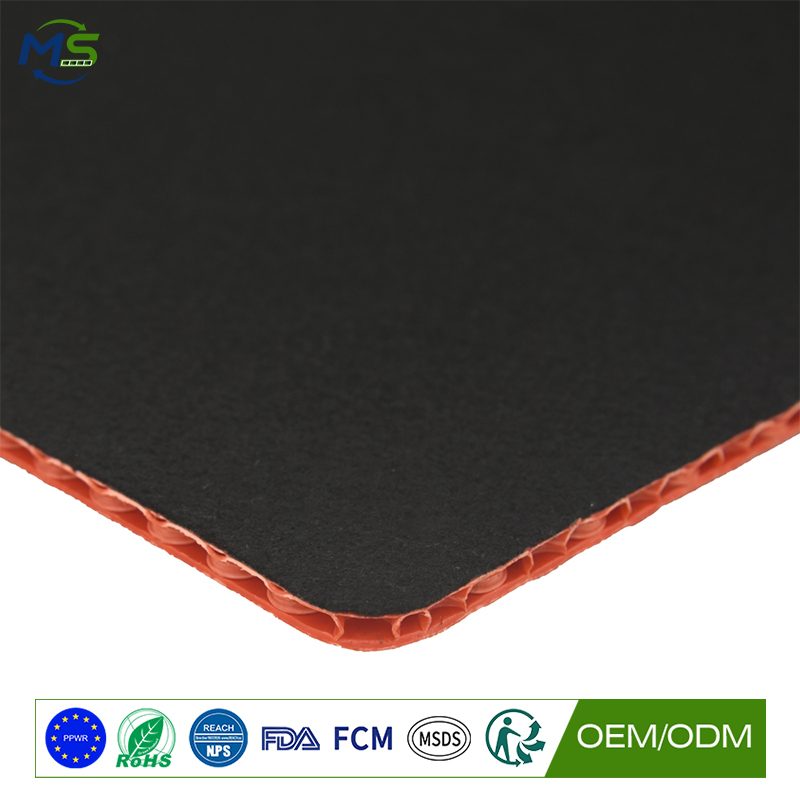
The quoted lead time is normally the production time, and the transport and clearance time are added on top and are often larger.
A custom panel programme adds the time to produce the tooling or the cutting pattern, to approve a sample and to make the first article. The sample approval step is the one that most often extends a date, and it is the one that can be shortened by agreeing the specification in writing before the sample is made.
Sea freight adds several weeks that are frequently not visible in the production schedule, and port congestion and customs clearance add more that nobody controls. A schedule built on production time alone will be optimistic by a wide margin.
The practical response is to ask for the lead time broken into its parts: sample approval, production, loading, transit, clearance and delivery. Once the parts are visible, the date that can be compressed can be identified, and it is usually sample approval rather than the factory.
A trial order of a few hundred square metres is the cheapest insurance available on a new supply relationship.
It should be the same grade, the same facing and the same production batch as the full order, so that it tests the actual product rather than a sample. A sample cut in the development lab is not the same thing.
The trial should be run on a real area with real traffic, and it should include at least one wet area, one handling cycle and one removal, because those are the three situations that generate the returns. The purpose is to generate information, so it should be measured rather than simply used.
The output should be a short report: the panels used, the cycles achieved, the damage observed, the labour time to lay and lift, and the site reaction from the crews using it. That report is the basis for the final specification and it is worth far more than a discount.
For terminology and test-method context see International Chamber of Commerce. The guidance on this page is practical site guidance, not a test report or a certificate.
A delivery to a refurbishment site has to be scheduled against the site’s logistics plan, and the constraint is usually unloading space rather than the vehicle.
The delivery note should state the vehicle type, the number of pallets, the total weight and the dimensions, because a site with a single goods lift needs to know whether a pallet will fit in it and how long it will occupy the loading bay.
Deliveries should be booked against the construction programme rather than the production schedule, and a large consignment should be split into area deliveries that match the work sequence. Delivering everything at once to a site that cannot offload it simply moves the problem.
Where the site has a strict delivery window, the supplier should be asked to confirm the driver will call ahead, and the route should be checked for the vehicle’s clearance. A delivery refused at the gate because the lorry will not fit through the entrance costs a whole day.
| Trade question | Short answer | Document to request | In this guide |
|---|---|---|---|
| What should be checked about lead time and where the delay … | The quoted lead time is normally the production time, and the transport and clearance time are … | A custom panel programme adds the time to produce the tooling or the cutting pattern … | Section 1 |
| What should be checked about sampling and the trial order? | A trial order of a few hundred square metres is the cheapest insurance available on a … | It should be the same grade, the same facing and the same production batch as … | Section 2 |
| What should be checked about planning a shipment into a live … | A delivery to a refurbishment site has to be scheduled against the site’s logistics plan, and … | The delivery note should state the vehicle type, the number of pallets, the total weight … | Section 3 |
| What should be checked about choosing the right delivery term? | The delivery term determines who carries the risk and who arranges the import, and for a … | Ex works places the risk with the buyer from the moment the goods leave the … | Section 4 |
The delivery term determines who carries the risk and who arranges the import, and for a bulky, light product the choice affects the cost more than the price.
Ex works places the risk with the buyer from the moment the goods leave the factory, which means the buyer arranges the collection and the export clearance and carries the risk across a long journey in containers.
Fob and cif move the risk at the port, and cif includes the freight and the insurance to the destination port only. The buyer is then responsible for the inland leg and for the import clearance, which is a substantial amount of work that is easily underestimated.
Delivered duties paid is usually the simplest for a first purchase and for a project in a country where the buyer does not have a customs agent. On a large project with an established importer, the saving from arranging the freight directly is often larger than the difference between the delivery terms.
Payment terms change the cost of a purchase even when nothing about the product changes, and on a large order the difference is worth calculating.
A deposit plus a balance on delivery means the buyer funds the production. An open account with payment at 30 or 60 days means the supplier funds it, and that difference has a real cost that is reflected in the price.
For a project with a slow payment cycle from the client, the working capital cost of buying the panels falls on the contractor, and it can exceed the difference between two competing quotations. This is the calculation that decides the commercial terms on a large order.
Bank instruments such as a letter of credit or a documentary collection protect the buyer and the seller in different ways and at different costs. It is worth deciding which risk actually matters in the transaction rather than defaulting to the same arrangement for every order.
Minimum order quantities protect the manufacturer from the cost of a short production run, and they can usually be negotiated when the total value of the relationship justifies it.
A short run is disproportionately expensive because the setup cost is spread over very few panels. Setting up a cutting programme, changing the face material and packing a partial pallet all carry fixed costs that do not scale down.
The negotiation is straightforward when the buyer can offer something in return: a forecast of the total requirement across several projects, a commitment to a trial order at the standard minimum, or payment terms on a larger order.
For a first purchase, a sample or a trial order at the standard minimum quantity is usually the cheapest way to test a supplier, and it is much better than placing a full order and discovering the issue after the container has arrived.
The quoted lead time is normally the production time, and the transport and clearance time are added on top and are often larger. A custom panel programme adds the time to produce the tooling or the cutting pattern, to approve a sample and to make …
A trial order of a few hundred square metres is the cheapest insurance available on a new supply relationship. It should be the same grade, the same facing and the same production batch as the full order, so that it tests …
The delivery term determines who carries the risk and who arranges the import, and for a bulky, light product the choice affects the cost more than the price. Ex works places the risk with the buyer from the moment the goods leave the factory, which means the buyer arranges the …
Minimum order quantities protect the manufacturer from the cost of a short production run, and they can usually be negotiated when the total value of the relationship justifies it. A short run is disproportionately expensive because the setup cost is spread over very few panels. Setting up a cutting programme, changing …
References checked by publisher and title on 2026-11-06. Standards and regulations are cited by name only; no performance values are attributed to them. General material-property figures in the text are indicative reference values for polypropylene and should be verified against your supplier’s current data sheet. Confirm applicability and current versions for your own project before relying on any of them.
For a quotation, a sample panel or help matching a thickness and facing to your site conditions, contact service@mingplastics.com or WhatsApp +86 189 3887 1524. Include the surface type, floor area, the trades working overhead and the expected duration so the recommended specification can be confirmed before you order.
For protection panel lead time, Fix the document pack, the milestones and the landed unit cost in the purchase order. Minimum order quantities protect the manufacturer from the cost of a short production run, and they can usually be negotiated when the total value of the relationship justifies …


