Address
Building 1, No. 22, Shexi Yongping Road,
Dongguan, Guangdong, China
Work Hours
Monday to Friday: 7AM - 7PM
Weekend: 10AM - 5PM
Address
Building 1, No. 22, Shexi Yongping Road,
Dongguan, Guangdong, China
Work Hours
Monday to Friday: 7AM - 7PM
Weekend: 10AM - 5PM
Temporary protection purchased for a construction project normally sits in purchased goods and services and in waste generated in ... Ask Mingskye for a sample.
Temporary protection purchased for a construction project normally sits in purchased goods and services and in waste generated in operations, both of which are Scope 3 categories for the reporting company. The quantities that matter are the mass purchased, the mass disposed of, the number of reuse cycles and the waste transfer records. Collect them while the work is happening rather than reconstructing them at reporting time.
This page covers Scope 3 temporary protection in six sections: Scope 3 and where protection actually sits in; The carbon footprint of polypropylene and what drives; How single-polymer construction simplifies end of life; Reporting protection waste to a client; Measuring what the site actually consumed; The environmental case for reusable versus disposable. Each section answers one practical question and can be read on its own.
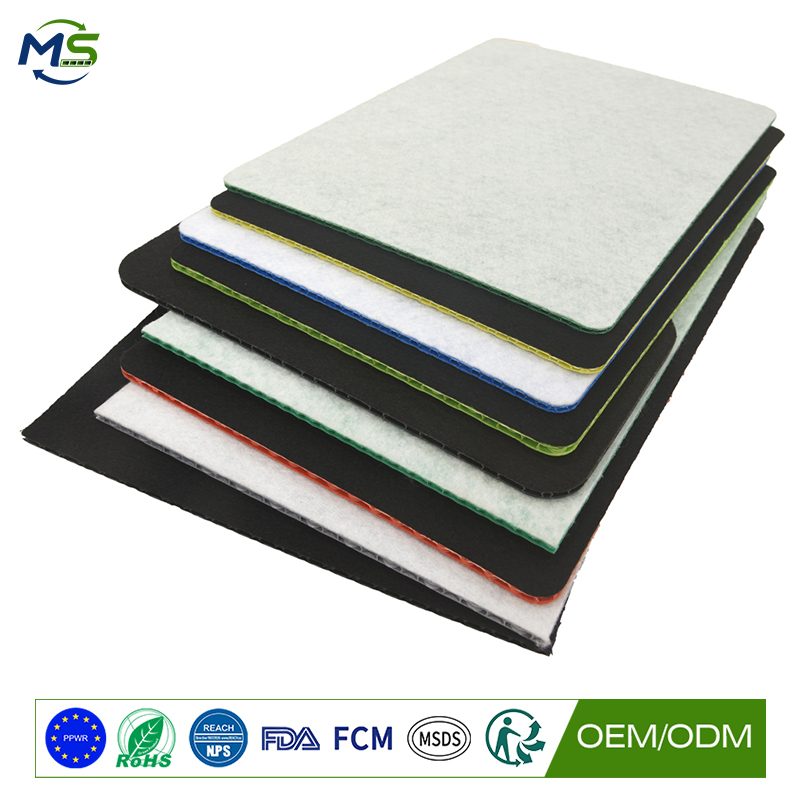
Protection boards are usually a purchased good rather than a directly controlled emission, so they enter a buyer’s Scope 3 inventory under purchased goods and services.
For a business reporting on value chain emissions, a reusable panel can be an unusually favourable line because the same asset can be counted once rather than counted again for every project or every cycle. A panel used eight times has one embodied carbon figure rather than eight.
The accounting has to be stated honestly, though. Whether the embodied carbon is counted once for the fleet or spread across the use cycles is a methodological decision, and the basis should be declared in the report so that the figure can be compared with other suppliers.
The end-of-life route matters for the figure as much as the reuse count. A single-polymer panel that goes back into a polypropylene recycling stream retains its material value, whereas a laminated board with a paper or aluminium facing has no practical route and is counted as waste.
The carbon footprint of a polypropylene board is dominated by the polymer itself, so the meaningful reduction comes from using less material and using it longer.
Polypropylene is made from fossil feedstock, and the carbon intensity of the resin is the largest single contributor to the footprint of a panel. The core geometry is what makes a low footprint possible: a honeycomb uses far less polymer than a solid sheet of the same strength.
The second contribution is the facing and any additive, particularly a flame retardant, which adds both material and processing. A grade chosen for its performance rather than for a specification nobody needs will carry less additive load.
The third is the service life. Extending the life of a panel from three cycles to eight reduces the embodied carbon per use by more than half, which is a larger reduction than any material substitution available in this product family.
For terminology and test-method context see GHG Protocol Corporate Value Chain (Scope 3) Accounting and Reporting Standard. The guidance on this page is practical site guidance, not a test report or a certificate.
A panel made from one polymer can be recycled as one material, while a laminated panel has to be separated before it can be recycled at all.
The practical test is whether the panel can go into an existing collection without anyone having to take it apart. A polypropylene panel passes that test. A board with a bonded paper facing, an aluminium layer and a plastic core does not, and in most regions it is incinerated or landfilled.
This is a design decision made years before the panel is used, and it is the reason the material specification is worth reviewing before the order rather than after the disposal problem appears.
On site, the contamination rules are simple. Panels should be free of mortar, adhesive tape residue, metal fixings and mesh reinforcement, because contamination is what forces a plastic stream down to a lower grade or to disposal. A rinse and a visual check at the collection point is enough.
| Cost question | Short answer | Figure to record | In this guide |
|---|---|---|---|
| What should be checked about scope 3 and where protection actually … | Protection boards are usually a purchased good rather than a directly controlled emission, so they enter … | For a business reporting on value chain emissions, a reusable panel can be an unusually … | Section 1 |
| What should be checked about the carbon footprint of polypropylene and … | The carbon footprint of a polypropylene board is dominated by the polymer itself, so the meaningful … | Polypropylene is made from fossil feedstock, and the carbon intensity of the resin is the … | Section 2 |
| How single-polymer construction simplifies end of life? | A panel made from one polymer can be recycled as one material, while a laminated panel … | The practical test is whether the panel can go into an existing collection without anyone … | Section 3 |
| What should be checked about reporting protection waste to a client? | Clients with environmental reporting obligations will ask for protection waste data, and the answer should be … | The measurable quantities are the number of panels issued, the number returned to the fleet … | Section 4 |
Clients with environmental reporting obligations will ask for protection waste data, and the answer should be a measured number rather than an estimate.
The measurable quantities are the number of panels issued, the number returned to the fleet, the number damaged beyond repair, the number sent for recycling and the weight of consumables such as tape and offcuts. These are all counts that can be recorded at the collection point.
Recycling rates are usually reported as a mass percentage of the total protection material handled, and they are only credible if the collection point is operated properly and contamination is controlled. A figure produced from estimated weights rather than counted panels is not defensible in an assurance process.
The most useful additional item is the cycle count. A client assessing a reusable protection programme wants to know that the panels were actually reused rather than quietly replaced, and the return count against the issue count is the evidence for that.
Four simple measurements give a project a credible sustainability record, and all four are counts rather than estimates.
Count the panels issued to the site. Count the panels returned at each phase and at the end. The difference gives the number damaged beyond repair and, with it, a direct measure of the protection performance achieved.
Weigh the offcuts and consumables that leave site. Offcuts are the most commonly overlooked waste stream in protection work, because they are bulky and go straight onto the skip rather than being counted.
Record the number of reuse cycles achieved across the whole project and the mass of material sent for recycling. Together these four figures give a waste diversion rate and a cycle count, which are the two numbers a client with reporting obligations actually needs.
Reusable wins on waste volume almost by definition, because the number of items entering the waste stream falls with every reuse cycle.
A disposable protection sheet used once per project generates one sheet of waste per protected square metre. A reusable panel used eight times generates one-eighth of a panel of waste per protected square metre, which is the arithmetic of the entire argument.
It is worth being careful about the counter-case. If a reusable panel is used once and then discarded, it has performed worse than a disposable sheet because more material was involved to achieve the same outcome. Reuse has to actually happen, which is why the collection and inspection regime is not an optional extra.
The related point is the weight. A disposable sheet is light and easy to move, and the labour saved on a single-phase project can outweigh the environmental benefit. The honest position is that reuse pays off on projects with real cycles, and single-use projects should use a single-use product.
Protection boards are usually a purchased good rather than a directly controlled emission, so they enter a buyer’s Scope 3 inventory under purchased goods and services. For a business reporting on value chain emissions, a reusable panel can be an unusually favourable line because the same asset can …
The carbon footprint of a polypropylene board is dominated by the polymer itself, so the meaningful reduction comes from using less material and using it longer. Polypropylene is made from fossil feedstock, and the carbon intensity of the resin is the largest single contributor to the footprint of …
Clients with environmental reporting obligations will ask for protection waste data, and the answer should be a measured number rather than an estimate. The measurable quantities are the number of panels issued, the number returned to the fleet, the number damaged beyond repair, the number …
Reusable wins on waste volume almost by definition, because the number of items entering the waste stream falls with every reuse cycle. A disposable protection sheet used once per project generates one sheet of waste per protected square metre. A reusable panel used eight …
References checked by publisher and title on 2026-11-06. Standards and regulations are cited by name only; no performance values are attributed to them. General material-property figures in the text are indicative reference values for polypropylene and should be verified against your supplier’s current data sheet. Confirm applicability and current versions for your own project before relying on any of them.
For a quotation, a sample panel or help matching a thickness and facing to your site conditions, contact service@mingplastics.com or WhatsApp +86 189 3887 1524. Include the surface type, floor area, the trades working overhead and the expected duration so the recommended specification can be confirmed before you order.
For Scope 3 temporary protection, Record cycles, labour and waste while the work is live, not when the report is due. Reusable wins on waste volume almost by definition, because the number of items entering the waste stream falls with every reuse cycle.


