Address
Building 1, No. 22, Shexi Yongping Road,
Dongguan, Guangdong, China
Work Hours
Monday to Friday: 7AM - 7PM
Weekend: 10AM - 5PM
Address
Building 1, No. 22, Shexi Yongping Road,
Dongguan, Guangdong, China
Work Hours
Monday to Friday: 7AM - 7PM
Weekend: 10AM - 5PM
Polypropylene is used for reusable floor protection because it resists water, most site chemicals and repeated flexing without ... Ask Mingskye for a sample.
Polypropylene is used for reusable floor protection because it resists water, most site chemicals and repeated flexing without absorbing moisture or rotting. It is a single polymer, so a worn panel can be recycled rather than separated into layers. Its low density keeps panels light enough for one person to carry, which is what makes reuse practical on a working site.
This page covers polypropylene floor protection in six sections: Why manufacturers choose polypropylene rather than another plastic; Recycled content and why single-polymer construction matters; Moisture behaviour in wet and humid conditions; UV stability and how long a panel can; Fire performance and what a reaction-to-fire rating does; How to read a panel specification sheet. Each section answers one practical question and can be read on its own.
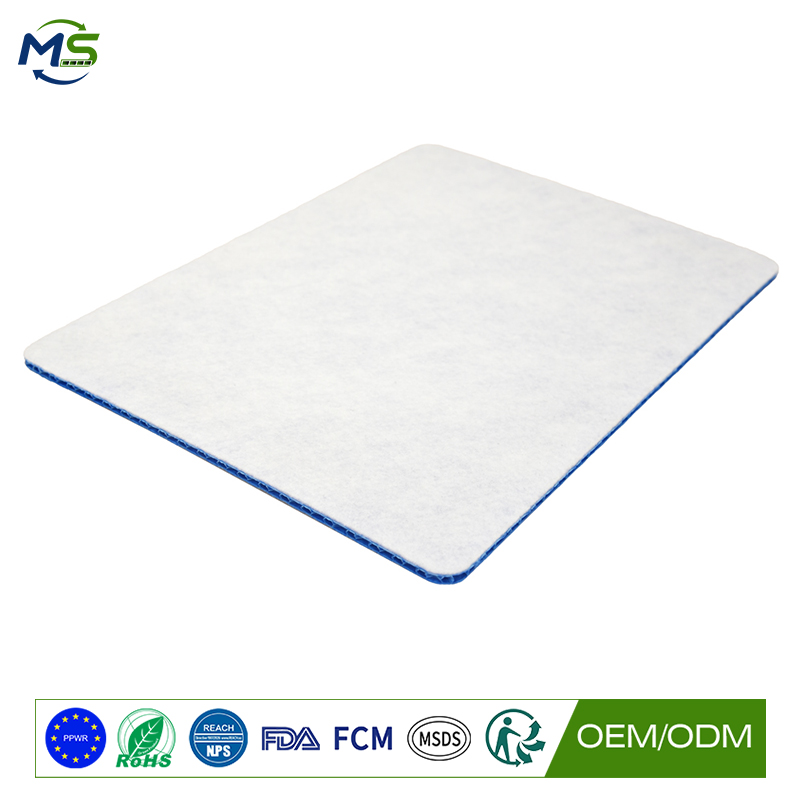
Polypropylene is used because it combines low density, high toughness and chemical resistance at a price that works for disposable and reusable protection.
Polypropylene has a density of roughly 0.90 to 0.92 g/cm³, which places it among the lightest of the common structural plastics. In a sandwich panel the face sheets carry the bending load, so the core material mainly needs to resist crushing, and polypropylene does that well even in thin walls.
The polymer also has a high ductility compared with materials such as polystyrene. It bends and deforms before it fractures, so an impact tends to leave a dent rather than a brittle crack. On a finished floor that difference is important, because a brittle shard can damage the substrate in a way a dent cannot.
Chemically, polypropylene resists dilute acids, alkalis, detergents, oils and many common construction contaminants. It is not resistant to strong oxidising acids, aromatic solvents or chlorinated solvents, so chemical exposure still needs to be checked case by case rather than assumed.
A panel made entirely from polypropylene can be recycled as a single stream, which is a materially different proposition from a laminated board with a facing that must be separated first.
Mixed-material panels create a practical barrier to recycling. A board with a paper facing, an aluminium layer and a plastic core cannot enter a standard recycling stream, and in most regions it is treated as general waste or as a contaminated product.
Single-polymer construction removes that barrier. Polypropylene has a recognised recycling route and a steady market, and a board that goes back into the same process keeps its value. The practical instruction for a site is simply that the board must be free of contamination, so mortar, adhesive tape and metal fixings should be removed before it leaves the site.
Where recycled content is claimed, ask for the percentage and the source. Post-industrial recycled material is relatively easy to verify, while post-consumer material with an unknown origin is harder. A supplier that can document the stream is more credible than one quoting a percentage without qualification.
For terminology and test-method context see ISO standards catalogue. The guidance on this page is practical site guidance, not a test report or a certificate.
Polypropylene absorbs very little water, which makes it a good choice for wet-area protection, but the core can still trap water and the facing choice decides whether that water stays or drains.
The water absorption of polypropylene is typically well under 1% by mass, so the polymer itself does not swell or lose strength in the way that wood-based boards do. A polypropylene panel left in a wet slab overnight will still be usable the next morning.
Water problems come from the core, not the material. If a panel is stood on edge with the cellular section exposed, or laid on a surface with a void beneath, water can sit inside the cells with no way to drain. That water cannot dry out from inside the core.
Mitigation is straightforward. Lay panels flat so the cells are compressed, keep gaps between boards so moisture can escape, and choose a facing that tolerates being wet if the area will be washed down. Never store panels on edge in an unfinished building over a long period.
| Question | Short answer | What to check on site | In this guide |
|---|---|---|---|
| Why manufacturers choose polypropylene rather than another plastic? | Polypropylene is used because it combines low density, high toughness and chemical resistance at a price … | Polypropylene has a density of roughly 0.90 to 0.92 g/cm³, which places it among the … | Section 1 |
| What should be checked about recycled content and why single-polymer construction … | A panel made entirely from polypropylene can be recycled as a single stream, which is a … | Mixed-material panels create a practical barrier to recycling. A board with a paper facing, an … | Section 2 |
| What should be checked about moisture behaviour in wet and humid … | Polypropylene absorbs very little water, which makes it a good choice for wet-area protection, but the … | The water absorption of polypropylene is typically well under 1% by mass, so the polymer … | Section 3 |
| What should be checked about uV stability and how long a … | Polypropylene degrades under ultraviolet radiation, and while the change is gradual it is not reversible, so … | The mechanism is chain scission in the polymer, which shows up as surface chalking, a … | Section 4 |
Polypropylene degrades under ultraviolet radiation, and while the change is gradual it is not reversible, so outdoor service life has to be planned rather than assumed.
The mechanism is chain scission in the polymer, which shows up as surface chalking, a loss of colour saturation and eventually a loss of toughness. The face sheet is the part that takes the exposure, because it is the surface that sees the light.
Unprotected panels used as external covers, temporary dust sheets or scaffold sheeting typically show visible chalking within a single season, and can become brittle enough to crack after a second. Panels formulated with stabilisers and pigments fare considerably better, but the specification should still carry a stated exposure limit.
The sensible approach for external use is to treat the facing as a consumable layer. Replace the face or the whole panel on a defined cycle rather than waiting for failure, and store panels away from direct sunlight when they are not in use.
A reaction-to-fire classification describes how a material responds to a small flame and heat source, and it says nothing about how the material behaves in a fully developed fire.
The European classification system EN 13501-1 rates reaction to fire from A1 (non-combustible) down through B, C, D and E, with a separate smoke production class and a droplet class. A polypropylene board with no flame retardant will normally sit in the lower part of that scale.
Flame-retardant grades are produced by adding a halogenated or non-halogenated retardant into the polymer, which slows ignition and reduces the rate of burning. The grade needs to be stated with the classification, and it applies to the specific product, not to polypropylene in general.
Reaction to fire is not the same as fire resistance, which is the ability of an element to resist fire for a stated period. When a building project requires fire performance, the correct place for the panel is usually in the fire strategy for the temporary works, agreed with the fire engineer or the temporary works coordinator rather than selected on a supplier datasheet.
A usable specification sheet states the core geometry, the load capacity at a stated deflection, the facing, the tolerances and the test method for each figure.
Start with the structure: nominal thickness, core height, face sheet thickness and whether the core is twin-wall or twin-cell. These determine the geometry and therefore most of the performance.
Next read the performance figures with their test methods attached. Internal load capacity, flexural stiffness and the deflection limit belong together; a capacity figure quoted without a deflection and a test method cannot be compared with anything else. The same applies to a compressive strength figure quoted as a plain kilopascal value.
Finally check the commercial detail: dimensional tolerances, the standard the product is manufactured under, whether it is certified to a quality management system, and what happens if a batch fails on arrival. A sheet that supplies all of this is a specification; a sheet that supplies only thickness and a photograph is a brochure.
Polypropylene is used because it combines low density, high toughness and chemical resistance at a price that works for disposable and reusable protection. Polypropylene has a density of roughly 0.90 to 0.92 g/cm³, which places it among the lightest of the common structural plastics. In …
A panel made entirely from polypropylene can be recycled as a single stream, which is a materially different proposition from a laminated board with a facing that must be separated first. Mixed-material panels create a practical barrier to recycling. A board with a paper facing, an aluminium layer and a plastic core cannot …
Polypropylene degrades under ultraviolet radiation, and while the change is gradual it is not reversible, so outdoor service life has to be planned rather than assumed. The mechanism is chain scission in the polymer, which shows up as surface chalking, a loss of colour saturation and eventually a …
A usable specification sheet states the core geometry, the load capacity at a stated deflection, the facing, the tolerances and the test method for each figure. Start with the structure: nominal thickness, core height, face sheet thickness and whether the core is twin-wall or twin-cell. These determine the …
References checked by publisher and title on 2026-11-06. Standards and regulations are cited by name only; no performance values are attributed to them. General material-property figures in the text are indicative reference values for polypropylene and should be verified against your supplier’s current data sheet. Confirm applicability and current versions for your own project before relying on any of them.
For a quotation, a sample panel or help matching a thickness and facing to your site conditions, contact service@mingplastics.com or WhatsApp +86 189 3887 1524. Include the surface type, floor area, the trades working overhead and the expected duration so the recommended specification can be confirmed before you order.
For polypropylene floor protection, Confirm the core construction, facing and test method in writing before comparing any two panels. A usable specification sheet states the core geometry, the load capacity at a stated deflection, the facing, the tolerances and the test method for each figure.


