Address
Building 1, No. 22, Shexi Yongping Road,
Dongguan, Guangdong, China
Work Hours
Monday to Friday: 7AM - 7PM
Weekend: 10AM - 5PM
Address
Building 1, No. 22, Shexi Yongping Road,
Dongguan, Guangdong, China
Work Hours
Monday to Friday: 7AM - 7PM
Weekend: 10AM - 5PM
School corridors need flat, trip-safe protection under heavy footfall. This guide covers thickness from 2 mm to 12 mm, daily inspection, storage and a school trial plan.
School projects run in short windows: half terms, summers and occasionally during term, when hundreds of pupils use the same corridors. Protection has to survive heavy footfall, be safe underfoot and be removable at short notice. This article looks at protecting school floors and walls during term-time works. The focus is safety underfoot, corridor traffic and fast removal.
A corridor used by hundreds of pupils between lessons is a different problem from a construction route. Protection must not create trip edges, must stay flat under running footfall and must be removable quickly if the space is needed.
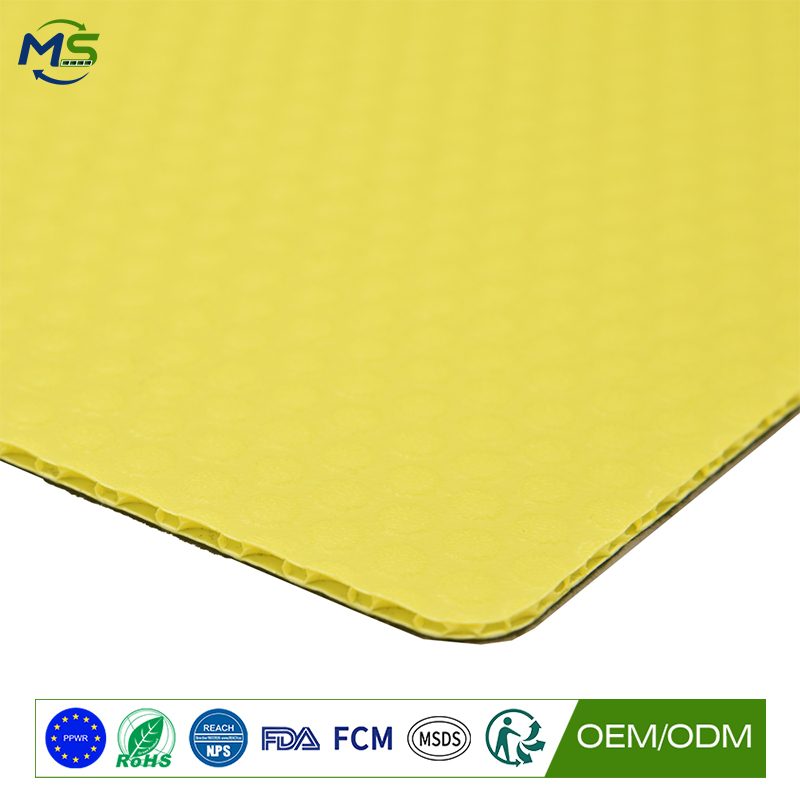
A rigid PP honeycomb protection board lies flat and stays in place, which is the property that matters most in a school corridor. A film or roll that curls is a trip hazard within minutes of being laid.
Because the boards are re-usable, a school that runs projects every holiday can store and re-use them rather than buying new protection each time.
School corridors carry foot traffic and occasionally trolleys and deliveries, so the middle of the 2 mm to 12 mm range is usually right.
For classroom floors during decorating, a mid-thin board is enough. Where deliveries, furniture moves or maintenance equipment cross the floor, thicker boards prevent the crushed edges that appear at door thresholds.
| Board group | Typical thickness | Where it earns its place | Watch-outs |
|---|---|---|---|
| Light-duty panel | 2-3 mm | Classroom floors during decorating, no trolleys | Curls under heavy footfall if unsecured |
| General corridor panel | 4-6 mm | School corridors under daily pupil footfall | Edges must be finished; inspect daily |
| Heavy-duty panel | 8-10 mm | Deliveries, furniture moves, maintenance equipment | Heavier for caretakers to move; plan storage |
| Maximum protection | 12 mm | Long programmes with repeated heavy moves | More than holiday decorating needs |
Finish every edge and seam so there is nothing to catch a foot or a bag. Inspect at the start and end of each school day, because a panel that has shifted overnight is a hazard before anyone notices.
Keep routes as wide as the corridor allows and sign any narrowing. On stairs, pay particular attention to nosings, which are the highest-risk detail for pupils.
Store lifted panels flat and out of circulation areas, since stacked boards in a corridor become an obstruction and a climbing risk.
Paper and film are cheap but curl, tear and slide under heavy footfall, which is unsafe in a corridor full of pupils, and they need replacing constantly.
Plywood protects but is heavy, awkward to store in a school and creates its own manual-handling issues for site staff and caretakers.
A PP honeycomb board is light enough for caretakers to move, rigid enough to stay flat, and re-usable every holiday, which suits a school’s budget cycle better than a consumable.
Protect one corridor and leave a comparable one on the current method. Inspect both daily and photograph the same points so wear and edge condition are comparable.
Run a footfall test over a set period, then lift and check the floor for scuffing and the panels for edge lift.
Record how quickly the protection could be removed when the space was needed, because in a school that speed is often the deciding factor.
State the floor type, the corridor widths, the pupil numbers and whether work is term-time or holiday. Ask for the recommended thickness, facing and panel size, plus fire performance for escape corridors.
Ask for guidance on edge finishing and trip-risk, on storage between holiday windows, and about custom sizes for standard corridor widths.
For a quotation or sample panel, contact service@mingplastics.com or WhatsApp +86 189 3887 1524. Include the surface type, floor area, trades on site and expected duration so the recommended thickness, facing and fire performance can be confirmed before you order.
In schools, protection is a safety item: it must lie flat, have finished edges and be inspected daily. Choose a mid thickness for corridors and reuse it every holiday.


