Address
Building 1, No. 22, Shexi Yongping Road,
Dongguan, Guangdong, China
Work Hours
Monday to Friday: 7AM - 7PM
Weekend: 10AM - 5PM
Address
Building 1, No. 22, Shexi Yongping Road,
Dongguan, Guangdong, China
Work Hours
Monday to Friday: 7AM - 7PM
Weekend: 10AM - 5PM
Navigating the complex matrix of global logistics, rising environmental taxes, and freight costs is a daily operational challenge. Today, the strategic adoption of circular, reusable plastic packaging represents a proven, high-ROI method to shield corporate EBITDA against regulatory fees while ensuring zero-damage cargo delivery. Understanding the core science and economics of **A Complete TCO Analysis: Wooden Pallet Crates versus Reusable Heavy Duty Honeycomb Box Systems** represents a critical milestone for supply chain leaders looking to secure assets, bypass border delays, and optimize total cost of ownership (TCO). MingPlastics’ engineered transit assets are designed to bridge the gap between high physical load limits and absolute regulatory compliance, delivering a future-proof logistics strategy.
Heavy industrial parts require packaging that matches the rigid mechanical support of traditional steel racks while offering the lightweight benefits of polymers. Our technical boards boast an exceptional flexural modulus, absorbing high-frequency transit vibrations and preventing energy transfer to fragile cargo. For extreme stacking load limits, we specialize in integrating hidden, high-tensile steel reinforcements inside the vertical honeycomb flutes, boosting stacking strength by over 100%.
International freight lanes expose packaging to extreme conditions, including salty marine humidity, tropical rains, and dynamic road vibrations. Traditional waxed fiberboard and timber disintegrate or lose compression strength under these conditions. Our engineered polypropylene panels are completely water-proof, preserving 100% of their structural load-bearing capacity even during prolonged open-yard staging and cross-border rail transit.
While the initial CAPEX for high-strength reusable plastic packaging is higher than single-use timber or cardboard, the long-term TCO (Total Cost of Ownership) is dramatically lower. Over a 10-year lifespan, a reusable plastic box completes over 100 trips, slashing the cost-per-trip by up to 70%.
| Cost Parameter | Traditional Plywood Crates | MingPlastics Reusable Bins |
|---|---|---|
| Lifespan / Trips | 1 to 3 Trips (Disposable) | 100+ Trips (Multi-Trip Circular) |
| Customs Handling | Requires Heat Treatment (ISPM 15) | Naturally Exempt (All-Plastic) |
| Cost Per Trip (100 Trips) | \,500 (Continuous OPEX Purchases) | \,350 (CAPEX Amortized Loop) |
The global push for zero-waste packaging is driven by stringent environmental laws. In Europe, environmental frameworks like Germany’s LUCID Packaging Act and France’s ADEME place heavy financial penalties on single-use waste. By transitioning to our certified reusable packaging loops, exporters avoid these waste taxes. Polypropylene transit assets are designed to support corporate Scope 3 decarbonization, directly reducing greenhouse gases associated with disposable waste disposal.
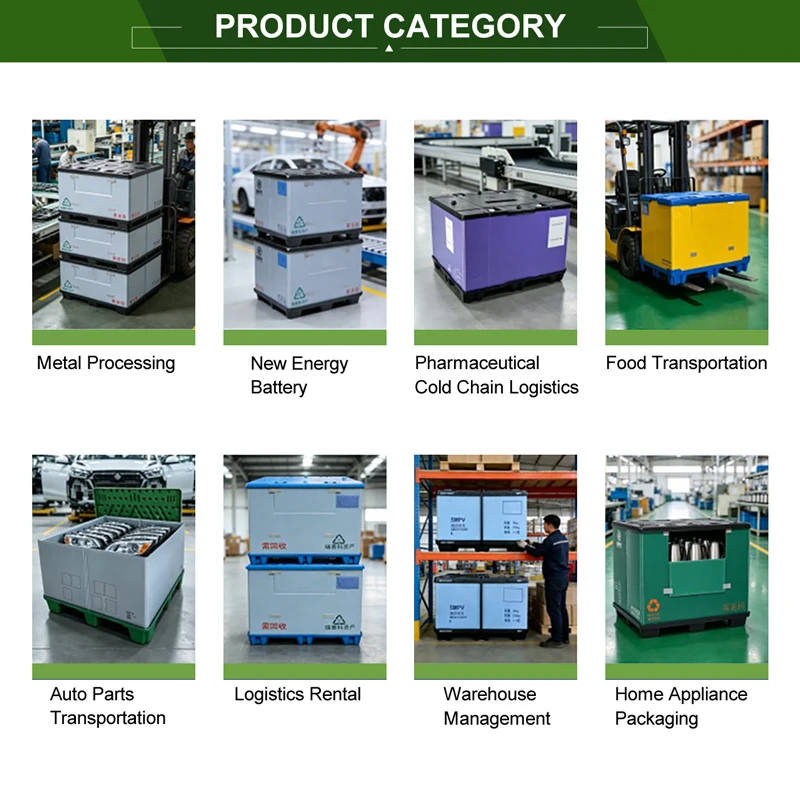
Different industrial sectors demand unique packaging characteristics. In the automotive and EV sectors, transporting heavy engine blocks or fragile high-voltage battery modules requires extreme physical strength and safety. We specialize in custom engineering pallet sleeve containers with customized internal dunnage, anti-scratch textile laminations, and permanent ESD anti-static dissipation (^6 – 10^9 \Omega$) to protect sensitive PCB modules from static ignition.
Q: Why is PP honeycomb stronger than traditional fluted plastic?
A: Honeycomb structures provide isotropic strength, distributing weight uniformly in all directions, whereas fluted boards only offer strength in one direction, preventing bowing under high-pressure stacking.
Q: Are these boxes exempt from wood quarantine rules?
A: Yes, because they are made entirely of advanced polymers, they are naturally ISPM 15 exempt, meaning they fly through international customs without fumigation delays.
Future-proof your global industrial logistics today. For technical drawings, certified UN test reports, and direct factory wholesale quotes, contact our engineering department at Email ([email protected]) or reach our technical team via WhatsApp (+86 18098231505).
MingPlastics: Your direct factory source for advanced, steel-reinforced, and RFID-ready PP honeycomb box systems. Certified compliant with FDA, EU FCM, ROHS, and REACH standards.
📞 WhatsApp/WeChat: +86 18098231505
📧 Direct Email Enquiry: [email protected]
💬 Project Consultation: Consult with our Engineers on WhatsApp