Address
Building 1, No. 22, Shexi Yongping Road,
Dongguan, Guangdong, China
Work Hours
Monday to Friday: 7AM - 7PM
Weekend: 10AM - 5PM
Address
Building 1, No. 22, Shexi Yongping Road,
Dongguan, Guangdong, China
Work Hours
Monday to Friday: 7AM - 7PM
Weekend: 10AM - 5PM
Curling and buckling come from movement that has nowhere to go. A long run laid tight against a wall with no expansion gap will ... Ask Mingskye for a sample.
Curling and buckling come from movement that has nowhere to go. A long run laid tight against a wall with no expansion gap will lift at the corners as temperature changes, and panels on uneven support will rock and buckle under traffic. Leave a small gap at fixed edges, avoid forcing joints, and check that the substrate is flat before the run starts.
This page covers protection board curling and buckling in six sections: Curling and why the corners lift first; Movement and buckling on long runs; Warping from uneven support; Impact cracking at low temperature; Thermal expansion and movement over a long installation; Working around services, penetrations and uneven edges. Each section answers one practical question and can be read on its own.
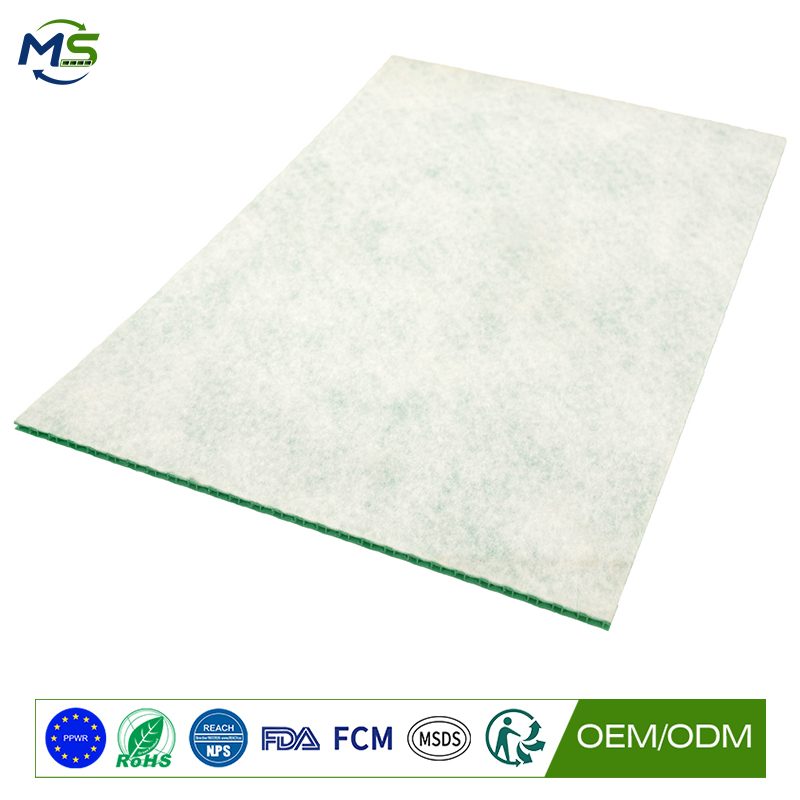
Panels curl at the corners when one face is exposed to a different condition from the other, and the corners are where that difference has the least material to resist it.
Differential drying is the usual cause. A panel with a breathable facing over a damp floor, or a panel half in a wet zone and half in a dry one, loses and gains moisture unevenly across its width, and the panel takes a curve.
Curl shows up first at the corners because the core provides almost no resistance to bending in that direction, and because the edges are the first part of the panel to dry. It also appears after a panel has been stored with one face against a damp surface for a period.
A curled panel cannot be laid flat, and a partially curled panel lifts at the corner and becomes a trip edge. The fix is to remove the cause of the differential condition and to lay the panels with the drier face against the wet side, rather than to fight the curl with weight.
A long run of panels with no gap and no joint can buckle as the material expands, and the buckle appears as a ripple across the floor.
Polypropylene expands by about 0.02 cm per metre for each 10 °C. Over a 20 m run and a 20 °C change that is roughly 8 mm of growth, and a rigidly taped, tightly butted line has nowhere to go.
The visible result is a raised ripple in the middle of the run, which becomes a trip hazard and which concentrates load on a short section of panel as traffic crosses the bump.
The remedy is a deliberate movement gap at the end of each run and at intervals along it, with the gap covered by a transition strip if a trip hazard is a concern. Alternatively the joints can be left untaped so that each panel is free to move, with a flexible joint filler used only where a sealed surface is needed.
For terminology and test-method context see ISO standards catalogue. The guidance on this page is practical site guidance, not a test report or a certificate.
A panel laid on an uneven floor takes up the shape of that floor, and a warped panel will not sit flat when the floor condition is corrected.
The usual sequence is that the screed has high spots, the panel bridges them and rests on the high points only, and the panel develops a set in that shape. Later the high spots are ground down or the screed is levelled, and the panel no longer sits flat because it has memorised the earlier profile.
Warping is also caused by storage. A stack that is not supported along its whole length will bow, and a panel that has been stored with a gap in the middle of the stack will not lie flat when it is used.
Preventing it is a matter of supporting panels properly in storage and checking the flatness of the floor before laying. A straightedge across the floor reveals high spots in a few seconds and is cheaper than replacing warped panels.
| Failure question | Short answer | What to inspect | In this guide |
|---|---|---|---|
| What should be checked about curling and why the corners lift … | Panels curl at the corners when one face is exposed to a different condition from the … | Differential drying is the usual cause. A panel with a breathable facing over a damp … | Section 1 |
| What should be checked about movement and buckling on long runs? | A long run of panels with no gap and no joint can buckle as the material … | Polypropylene expands by about 0.02 cm per metre for each 10 °C. Over a 20 … | Section 2 |
| What should be checked about warping from uneven support? | A panel laid on an uneven floor takes up the shape of that floor, and a … | The usual sequence is that the screed has high spots, the panel bridges them and … | Section 3 |
| What should be checked about impact cracking at low temperature? | Cold polypropylene loses impact toughness, and a panel that bends without cracking at room temperature may … | Polypropylene has a brittleness temperature in this region, and as the material approaches it the … | Section 4 |
Cold polypropylene loses impact toughness, and a panel that bends without cracking at room temperature may crack when it is dropped or flexed in the cold.
Polypropylene has a brittleness temperature in this region, and as the material approaches it the energy required to fracture falls sharply. A panel dropped from waist height onto a concrete floor at minus 15 °C can crack in a way the same panel would simply dent at 15 °C.
The effect is most likely in unheated winter construction and in cold stores, and in both cases the practical rule is to handle panels more gently and to avoid sharp flexing. Flexing to fit an awkward corner is a warm-weather operation.
It also affects the appearance of the damage. A brittle crack in a cold panel looks like a clean fracture line and looks like a manufacturing fault, when it is entirely a temperature effect. If panels are being returned cracked in winter, the temperature should be considered before the supplier is questioned.
Polypropylene expands by roughly 0.02 cm per metre for every 10 °C of temperature change, which is small but enough to buckle a long, tightly fitted run of panels.
The coefficient of thermal expansion for polypropylene is around 150 to 200 microstrain per kelvin. For a 10 m run that is a change of about 30 mm across a 20 °C seasonal swing, and a continuous, tightly butted line of panels has nowhere to absorb it.
The practical consequence is that expansion joints and perimeter gaps matter on long runs, particularly on floors that are heated in winter and unheated in summer, and on external ramps and balconies where the panel sees the full daily range.
Leaving a small gap at the ends of a run and avoiding a continuous line of rigidly taped seams costs almost nothing and removes a real failure mode. The gap should be wide enough for the expected movement but narrow enough that it does not become a trip hazard.
Cutting around an obstacle is where most site damage to protection occurs, because the cut edge is the weakest part of the panel.
Cut-outs should be made slightly undersize and the resulting opening covered by a facing plate or a bonded collar, so that the panel cannot move in the cut and expose the floor. A cut edge left open will lift with traffic.
Where a panel meets a wall, a riser or a fixed object, it should be cut to a close fit and held by a mechanical fixing or by a rebate, rather than simply pushed into the gap. A panel wedged into a gap will work loose when the floor moves.
Around service penetrations, the board should be cut on the line of the service so that the service itself or its escutcheon provides the closing detail, and the cut edge should be sealed with a compatible tape to keep grit out of the core.
Panels curl at the corners when one face is exposed to a different condition from the other, and the corners are where that difference has the least material to resist it. Differential drying is the usual cause. A panel with a breathable facing over a damp floor, or a panel half in a …
A long run of panels with no gap and no joint can buckle as the material expands, and the buckle appears as a ripple across the floor. Polypropylene expands by about 0.02 cm per metre for each 10 °C. Over a 20 m run and a 20 °C change …
Cold polypropylene loses impact toughness, and a panel that bends without cracking at room temperature may crack when it is dropped or flexed in the cold. Polypropylene has a brittleness temperature in this region, and as the material approaches it the energy required to fracture falls sharply. A …
Cutting around an obstacle is where most site damage to protection occurs, because the cut edge is the weakest part of the panel. Cut-outs should be made slightly undersize and the resulting opening covered by a facing plate or a bonded collar, so that the …
References checked by publisher and title on 2026-11-06. Standards and regulations are cited by name only; no performance values are attributed to them. General material-property figures in the text are indicative reference values for polypropylene and should be verified against your supplier’s current data sheet. Confirm applicability and current versions for your own project before relying on any of them.
For a quotation, a sample panel or help matching a thickness and facing to your site conditions, contact service@mingplastics.com or WhatsApp +86 189 3887 1524. Include the surface type, floor area, the trades working overhead and the expected duration so the recommended specification can be confirmed before you order.
For protection board curling and buckling, Keep a condition record and an inspection rhythm so a failure can be diagnosed rather than guessed at. Cutting around an obstacle is where most site damage to protection occurs, because the cut edge is the weakest part of the panel.


