Address
Building 1, No. 22, Shexi Yongping Road,
Dongguan, Guangdong, China
Work Hours
Monday to Friday: 7AM - 7PM
Weekend: 10AM - 5PM
Trapped wash water in folded sleeve walls appears when a unit is collapsed immediately after washing. Water held in the hollow ... Ask Mingskye for a sample.
Trapped wash water in folded sleeve walls appears when a unit is collapsed immediately after washing. Water held in the hollow core, the corner joints or the hinge line has no drainage path once the walls lie flat, and the next fill meets a stale smell. A PP honeycomb box with sealed edges still needs a defined drain orientation and a drying interval before folding. Set a drip time, fold in one consistent direction, and record an odour check at the first refill of every batch.
This page covers trapped wash water in folded sleeve walls for Post-wash folding in six sections: How trapped water is noticed on the next fill; Why folding immediately after washing traps water; Which controls belong in the wash instruction; Which box details help drainage; How to verify the drying step; Limits of a folding instruction. The buyer problem is wash water trapped in folded walls causes odour on the next fill. Each section gives one on-site check and one record to keep.
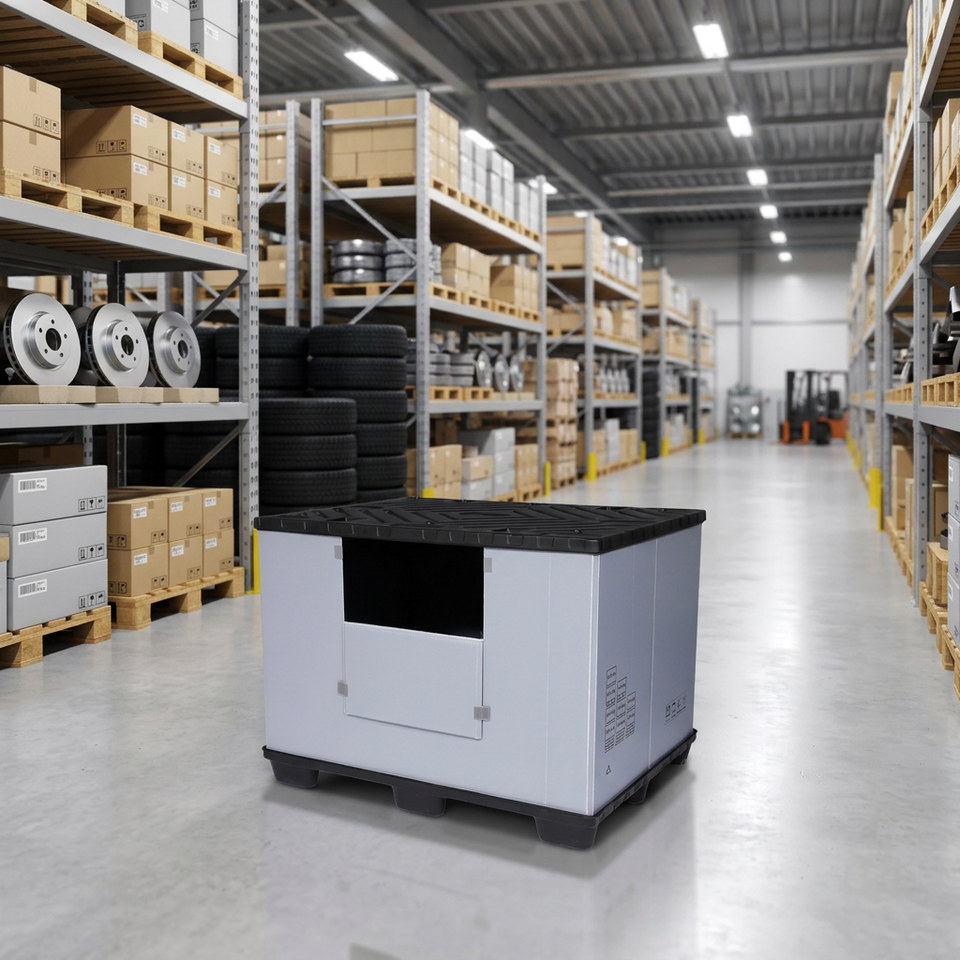
PP honeycomb pallet sleeve box used in post-wash folding – Mingskye reusable transport packaging.
A box that looked clean after washing gives off a stale smell when it is opened for the next batch.
The unit was folded flat while still wet and stacked with other flats. On the next fill the operator sees a damp line in the hinge, or hears water shift inside the hollow panel. The odour appears at the filling point, where it is too late to rewash without delaying the batch.
Sometimes there is no visible water at all. A thin film inside a corner joint is enough to produce a smell after a warm weekend in the store, and the affected units are scattered through the stack rather than grouped together.
A folded wall removes the drainage path that an upright wall had.
In the upright position, wash water runs down the face and out of the base. When the walls are collapsed straight away, the hinge line, the corner joints and any open cellular edge become horizontal pockets. Surface tension holds enough water in those pockets to keep them wet overnight.
A stack of flats makes it worse. Air cannot circulate between the folded faces, so the last unit to be folded dries slowest. The first unit filled from the stack is usually the one that has had the least drying time.
For terminology and test-method context see GS1. The guidance on this page is practical handling guidance, not a test report or a certificate.
Set a drip time, one folding direction, a drain orientation and an odour check at first refill.
State how long a unit stays upright and at what angle, and draw the direction in which it is folded so the open edge points downward. A single consistent direction makes drainage predictable; two operators folding opposite ways will produce two different outcomes from the same wash cycle.
Add a simple check at the first refill of every batch: open the unit, look at the hinge line and record an odour result against the batch identifier. It is a sensory check, not a laboratory test, but it catches the failure before product is loaded.
| Symptom on the dock | Condensation cause | Check at the scan | Record to keep |
|---|---|---|---|
| How trapped water is noticed on the next fill? | A box that looked clean after washing gives off a stale smell when it is opened … | The unit was folded flat while still wet and stacked with other flats. On the … | Section 1 |
| Why folding immediately after washing traps water? | A folded wall removes the drainage path that an upright wall had. | In the upright position, wash water runs down the face and out of the base … | Section 2 |
| Which controls belong in the wash instruction? | Set a drip time, one folding direction, a drain orientation and an odour check at first … | State how long a unit stays upright and at what angle, and draw the direction … | Section 3 |
| Which box details help drainage? | Enclosed edges, an openable hinge line and a base that drains in the folded state reduce … | A PP honeycomb sleeve with sealed cut edges stops water entering the cellular core, where … | Section 4 |
Enclosed edges, an openable hinge line and a base that drains in the folded state reduce the pockets.
A PP honeycomb sleeve with sealed cut edges stops water entering the cellular core, where it cannot be seen or drained. A hinge design that can be opened for inspection, and a base with a clear runoff path when tilted, let the wash instruction actually work. Ask the supplier to demonstrate the unit being folded wet and then opened again after the stated drip time.
Avoid a design with a horizontal internal ledge in the folded position. It will collect water regardless of how long the unit stands.
Fold one batch wet and one after the stated drip time, then compare the first-refill checks.
Use the same wash programme and stack both sets in the same store for the same period. Open the units in the same order they would be used on a production day, and record the hinge condition and odour result for each. A weight comparison before and after the drip time is a useful supporting measure if a scale is available.
If both sets fail, the problem is the wash or the store rather than the drip interval. A warm, still store can keep a flat stack damp for a full weekend.
A wash line with no drain-down space cannot follow the instruction.
If the wash area has no rack where units can stand upright, a drip time on paper will not be observed. The layout fix belongs with the site, and a different box will not create the missing space. Similarly, a store with no airflow needs a ventilation change rather than a longer instruction.
Hygiene requirements and any food-contact obligations are site-level decisions. Reference the applicable framework by name and confirm your own procedure before changing a wash programme.
A box that looked clean after washing gives off a stale smell when it is opened for the next batch. The unit was folded flat while still wet and stacked with other flats. On the next fill the operator sees a damp …
A folded wall removes the drainage path that an upright wall had. In the upright position, wash water runs down the face and out of the base. When the walls are collapsed straight away …
Enclosed edges, an openable hinge line and a base that drains in the folded state reduce the pockets. A PP honeycomb sleeve with sealed cut edges stops water entering the cellular core, where it cannot be seen or drained. A …
A wash line with no drain-down space cannot follow the instruction. If the wash area has no rack where units can stand upright, a drip time on paper will not be observed. The …
References checked by publisher and title on 2026-11-24. Standards and regulations are cited by name only; no performance values are attributed to them. General material and logistics figures in the text are indicative reference values and should be verified against your supplier’s current data sheet and your own trial. Confirm applicability and current versions for your own operation before relying on any of them.
For a quotation, a sample box or help matching a wall, closure and pack layout to your own route, contact service@mingplastics.com or WhatsApp +86 189 3887 1524. Include the part or crop, the load per layer, the destination, the dwell time and the expected cycles per year so the recommended specification can be confirmed before you order.
For trapped wash water in folded sleeve walls, Set a drip time and one folding direction in the wash instruction, then log an odour check at first refill. A wash line with no drain-down space cannot follow the instruction.
Need a specification sheet, samples or a quotation for PP honeycomb panels, sleeve boxes or cable reels? Our team replies within one business day.
Tel / WhatsApp: +86 189 3887 1524
Email: service@mingplastics.com
WhatsApp: Chat with us