Address
Building 1, No. 22, Shexi Yongping Road,
Dongguan, Guangdong, China
Work Hours
Monday to Friday: 7AM - 7PM
Weekend: 10AM - 5PM
Address
Building 1, No. 22, Shexi Yongping Road,
Dongguan, Guangdong, China
Work Hours
Monday to Friday: 7AM - 7PM
Weekend: 10AM - 5PM
Hospital refurbishment is usually phased around wards that stay open, so protection must be quiet to install, safe to walk on and ... Ask Mingskye for a sample.
Hospital refurbishment is usually phased around wards that stay open, so protection must be quiet to install, safe to walk on and easy to clean. Panels should be pre-cut to fit corridor widths, laid with flat seams that do not catch a trolley or a walking frame, and lifted section by section as each phase hands back. Infection-control cleaning agents must be checked for compatibility with the facing.
This page covers hospital floor protection refurbishment in six sections: Hospital and healthcare fit-outs; Protecting floors in an occupied building during minor; Education and school refurbishment; Routing traffic over protection without destroying it; Sequencing the protection around the trades; Chemical attack and what polypropylene will not tolerate. Each section answers one practical question and can be read on its own.
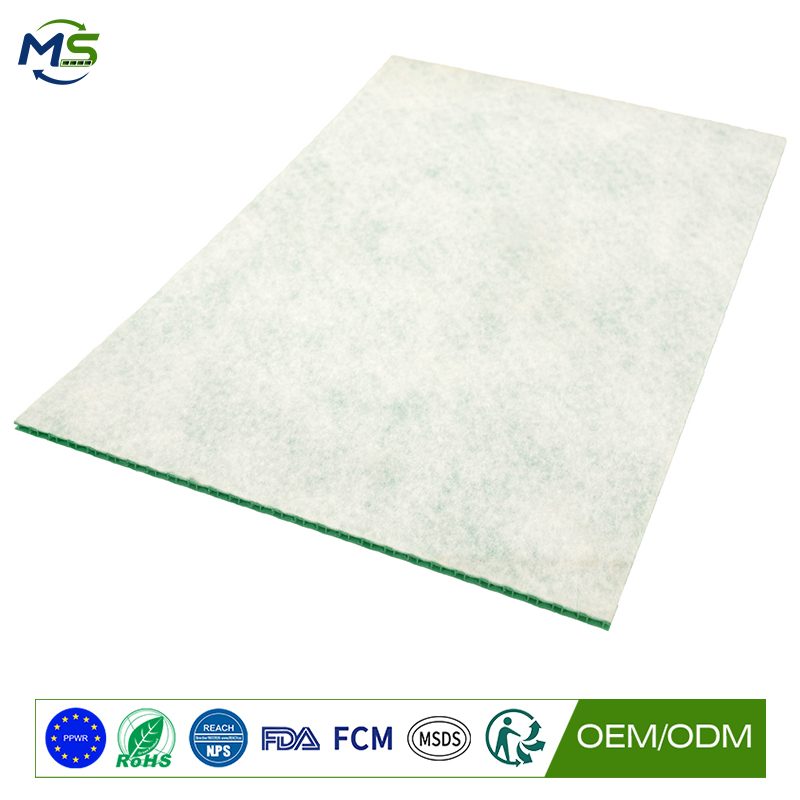
Healthcare environments add two requirements to protection: infection control and the need for the site to remain partly operational.
A cleanable facing is the first requirement. The panel has to withstand being wiped with the hospital’s own disinfectant, which is usually a quaternary ammonium compound, and it must not degrade or discolour under repeated cleaning. Film facings clean down well; felt facings trap disinfectant residue and are difficult to validate for cleanliness.
The second requirement is that the protection must not create a trip or an obstacle in an occupied building. That rules out thick panel edges in circulation routes and pushes the protection towards low-profile solutions in corridors, with barriers controlling the movement.
The third is that protection panels should not be shared with general construction areas in a hospital, because the infection control regime applies to them too. A dedicated panel fleet, cleaned to the hospital’s standard, is the normal arrangement.
Small works in an occupied building need a different approach from a full fit-out, because the protection has to be installed and removed within a single shift.
The constraint is time. A protection system that takes a team half a day to install is not viable for a two-day job in an occupied area, and the result is that the trades work without protection or rush the protection.
The solution is a small kit: a few panels of a size one person can carry, a roll of suitable tape, a small number of corner guards and a barrier tape or a small rigid barrier. This can be installed in minutes by one person and removed at the end of the shift, which is what makes it actually used.
The material choice follows from that. It should be a panel that can be cleaned and stored without a dedicated store, and it should be a facing that will not mark the floor it is protecting, because in an occupied building the floor is usually the client’s most visible asset.
For terminology and test-method context see UK Health and Safety Executive. The guidance on this page is practical site guidance, not a test report or a certificate.
School projects have a distinctive constraint: the work happens in a building that children will return to, often in phases.
The protection has to be safe for children and it has to be robust against handling, because school corridors are exactly where a panel will be moved by people who do not know how to handle it. A damaged edge or a lifted corner is a hazard, not just a defect.
Phasing makes the reuse case strong. A school refurbishment typically runs over a long period with the building partly in use, which is exactly the pattern where a reusable fleet with a collection point beats a disposable sheet.
The specification should therefore favour a panel with a protected or closed edge, a grippy facing, a light enough weight for one person to lift and a colour that makes it visible as a trip hazard so that the site keeps it out of circulation routes.
| Application question | Short answer | Constraint to confirm | In this guide |
|---|---|---|---|
| What should be checked about hospital and healthcare fit-outs? | Healthcare environments add two requirements to protection: infection control and the need for the site to … | A cleanable facing is the first requirement. The panel has to withstand being wiped with … | Section 1 |
| What should be checked about protecting floors in an occupied building … | Small works in an occupied building need a different approach from a full fit-out, because the … | The constraint is time. A protection system that takes a team half a day to … | Section 2 |
| What should be checked about education and school refurbishment? | School projects have a distinctive constraint: the work happens in a building that children will return … | The protection has to be safe for children and it has to be robust against … | Section 3 |
| What should be checked about routing traffic over protection without destroying … | Traffic management is more effective than a heavier board, because it removes the load instead of … | Wherever the load can be routed away from the protected area, do it. A temporary … | Section 4 |
Traffic management is more effective than a heavier board, because it removes the load instead of resisting it.
Wherever the load can be routed away from the protected area, do it. A temporary walkway of rated boards laid over the protection carries the traffic and can be lifted and moved as the work progresses, while the protection underneath stays flat and undisturbed.
Wheeled equipment needs a route with a defined surface. On a panel this means a track of protection laid in the line of the wheels, so the load is spread and the cells below are not loaded at a single point. It also makes it obvious where the equipment is permitted to go.
If traffic cannot be routed away, the alternative is to make the crossing point a deliberate detail: a heavier board or a spreader plate at the crossing, with the load path visible and maintained. An improvised crossing in the middle of a laid area is where the floor gets damaged.
Most protection disputes come from a sequencing error, where a floor is protected before the trades that need access to it have finished.
The sequence of trades and the sequence of protection have to be planned together. Laying protection before the screeding, painting or wet trades have finished is the most common cause of a protection layer being removed and reinstalled, and it is pure waste.
A workable plan divides the floor into zones by trade and states the order in which the protection is lifted, worked on and relaid. Zone boundaries then follow the natural work sequence, so material moves in one direction across the floor and the protected area shrinks progressively rather than randomly.
The plan should also state who removes the protection, who inspects the substrate at removal, and who confirms the area is clear before the next trade arrives. Those three responsibilities are the ones most often left undefined.
Polypropylene resists a wide range of construction chemicals but has clear limits, and exposure should be checked rather than assumed.
It performs well against dilute acids and alkalis, detergents, vegetable and mineral oils, and most cleaning products. It resists water and steam, which is why it is used so widely in food processing and wash-down areas.
It performs badly against strong oxidising acids, aromatic and chlorinated solvents, and some esters and ketones. Spills of these materials will attack the surface, leaving a dull etched area and progressively weakening the polymer.
Where a specific chemical is present in the process, the correct approach is to obtain the material’s resistance data for that chemical at the actual concentration and temperature. A panel that has been attacked chemically should be removed, because the loss of toughness is not visible until it fails under load.
Healthcare environments add two requirements to protection: infection control and the need for the site to remain partly operational. A cleanable facing is the first requirement. The panel has to withstand being wiped with the hospital’s own disinfectant, which is usually …
Small works in an occupied building need a different approach from a full fit-out, because the protection has to be installed and removed within a single shift. The constraint is time. A protection system that takes a team half a day to install is not viable for a two-day …
Traffic management is more effective than a heavier board, because it removes the load instead of resisting it. Wherever the load can be routed away from the protected area, do it. A temporary walkway of rated boards laid over the …
Polypropylene resists a wide range of construction chemicals but has clear limits, and exposure should be checked rather than assumed. It performs well against dilute acids and alkalis, detergents, vegetable and mineral oils, and most cleaning products. It resists water and steam …
References checked by publisher and title on 2026-11-06. Standards and regulations are cited by name only; no performance values are attributed to them. General material-property figures in the text are indicative reference values for polypropylene and should be verified against your supplier’s current data sheet. Confirm applicability and current versions for your own project before relying on any of them.
For a quotation, a sample panel or help matching a thickness and facing to your site conditions, contact service@mingplastics.com or WhatsApp +86 189 3887 1524. Include the surface type, floor area, the trades working overhead and the expected duration so the recommended specification can be confirmed before you order.
For hospital floor protection refurbishment, Check the site-specific constraint with the building owner before choosing a format. Polypropylene resists a wide range of construction chemicals but has clear limits, and exposure should be checked rather than assumed.


