Address
Building 1, No. 22, Shexi Yongping Road,
Dongguan, Guangdong, China
Work Hours
Monday to Friday: 7AM - 7PM
Weekend: 10AM - 5PM
Address
Building 1, No. 22, Shexi Yongping Road,
Dongguan, Guangdong, China
Work Hours
Monday to Friday: 7AM - 7PM
Weekend: 10AM - 5PM
Whether a reusable protection board falls under EU packaging rules depends on how the product is placed on the market and whether ... Ask Mingskye for a sample.
Whether a reusable protection board falls under EU packaging rules depends on how the product is placed on the market and whether it is classified as packaging or as a construction product; that classification should be confirmed with a compliance adviser before any exemption is assumed. In practice, buyers are asking for recyclability evidence, material declarations and documented reuse, so single-polymer construction and a clear end-of-life route are the useful answers.
This page covers EU packaging rules protection board in six sections: What the EU packaging rules mean for a; How single-polymer construction simplifies end of life; Reporting protection waste to a client; The environmental case for reusable versus disposable; Documents a European buyer should expect; Quality management and what a certification actually covers. Each section answers one practical question and can be read on its own.
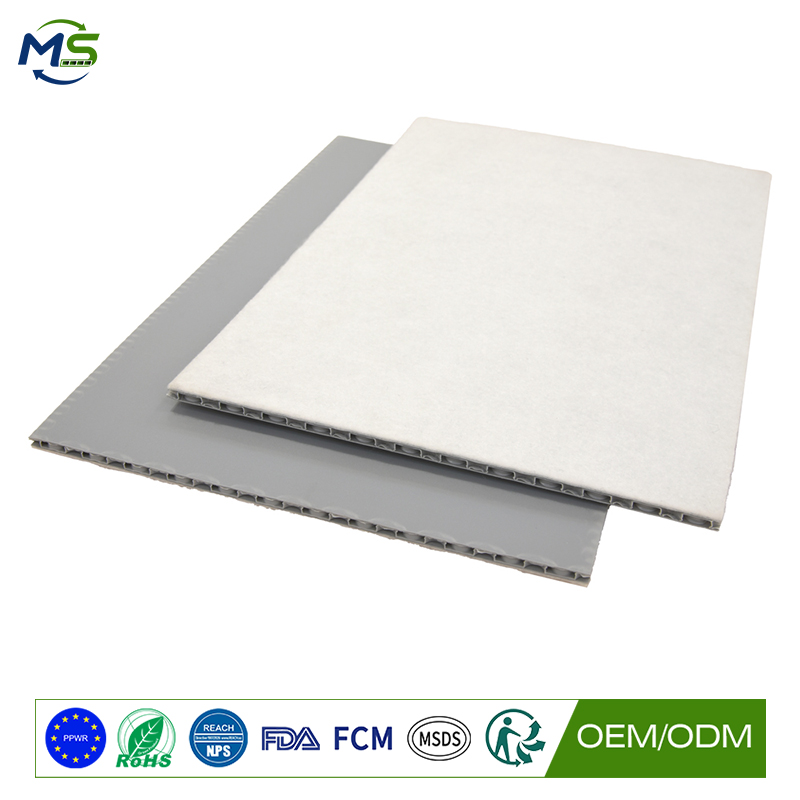
A reusable protection board is not packaging, but the packaging it arrives in and the way it is handled at the end of its life still interact with the regulation.
The EU packaging regulation, which applies from 2026, places obligations on producers to reduce packaging, to make packaging recyclable and to report the quantities placed on the market. A reusable board shipped flat in a wooden pallet with cardboard protection and plastic strapping creates a packaging stream that has to be accounted for.
A supplier that can state the packaging composition and the take-back or reuse option for its packaging is a supplier that has already done this work. That question is worth asking at the point of ordering, because it is easier to specify a returnable pallet than to retrofit one afterwards.
For the board itself, the practical point is that a product designed for reuse and for a single-material recovery route is better placed under almost any future packaging or waste policy than a disposable or composite alternative, which is a commercial argument rather than a regulatory one.
A panel made from one polymer can be recycled as one material, while a laminated panel has to be separated before it can be recycled at all.
The practical test is whether the panel can go into an existing collection without anyone having to take it apart. A polypropylene panel passes that test. A board with a bonded paper facing, an aluminium layer and a plastic core does not, and in most regions it is incinerated or landfilled.
This is a design decision made years before the panel is used, and it is the reason the material specification is worth reviewing before the order rather than after the disposal problem appears.
On site, the contamination rules are simple. Panels should be free of mortar, adhesive tape residue, metal fixings and mesh reinforcement, because contamination is what forces a plastic stream down to a lower grade or to disposal. A rinse and a visual check at the collection point is enough.
For terminology and test-method context see GHG Protocol Corporate Value Chain (Scope 3) Accounting and Reporting Standard. The guidance on this page is practical site guidance, not a test report or a certificate.
Clients with environmental reporting obligations will ask for protection waste data, and the answer should be a measured number rather than an estimate.
The measurable quantities are the number of panels issued, the number returned to the fleet, the number damaged beyond repair, the number sent for recycling and the weight of consumables such as tape and offcuts. These are all counts that can be recorded at the collection point.
Recycling rates are usually reported as a mass percentage of the total protection material handled, and they are only credible if the collection point is operated properly and contamination is controlled. A figure produced from estimated weights rather than counted panels is not defensible in an assurance process.
The most useful additional item is the cycle count. A client assessing a reusable protection programme wants to know that the panels were actually reused rather than quietly replaced, and the return count against the issue count is the evidence for that.
| Cost question | Short answer | Figure to record | In this guide |
|---|---|---|---|
| What the EU packaging rules mean for a protection board? | A reusable protection board is not packaging, but the packaging it arrives in and the way … | The EU packaging regulation, which applies from 2026, places obligations on producers to reduce packaging … | Section 1 |
| How single-polymer construction simplifies end of life? | A panel made from one polymer can be recycled as one material, while a laminated panel … | The practical test is whether the panel can go into an existing collection without anyone … | Section 2 |
| What should be checked about reporting protection waste to a client? | Clients with environmental reporting obligations will ask for protection waste data, and the answer should be … | The measurable quantities are the number of panels issued, the number returned to the fleet … | Section 3 |
| What should be checked about the environmental case for reusable versus … | Reusable wins on waste volume almost by definition, because the number of items entering the waste … | A disposable protection sheet used once per project generates one sheet of waste per protected … | Section 4 |
Reusable wins on waste volume almost by definition, because the number of items entering the waste stream falls with every reuse cycle.
A disposable protection sheet used once per project generates one sheet of waste per protected square metre. A reusable panel used eight times generates one-eighth of a panel of waste per protected square metre, which is the arithmetic of the entire argument.
It is worth being careful about the counter-case. If a reusable panel is used once and then discarded, it has performed worse than a disposable sheet because more material was involved to achieve the same outcome. Reuse has to actually happen, which is why the collection and inspection regime is not an optional extra.
The related point is the weight. A disposable sheet is light and easy to move, and the labour saved on a single-phase project can outweigh the environmental benefit. The honest position is that reuse pays off on projects with real cycles, and single-use projects should use a single-use product.
A cross-border supply of protection panels normally moves with four documents, and the fourth is the one that is most often missing.
The commercial invoice states the parties, the description, the quantity, the price and the terms, and it is the document that supports the customs declaration and the import VAT calculation.
The packing list gives the detail the invoice cannot: the number of packages, the weights, the pallet dimensions and the marks and numbers. It is what the carrier and the warehouse work from, and an accurate one prevents most delivery disputes.
The transport document covers carriage. The certificate of origin or the origin statement supports preferential tariff treatment, and where a buyer expects preferential treatment it has to be present at the point of import, not requested later.
The declaration of conformity and the product safety data sheet are the fourth pair, and they are what a buyer needs for its own file and for any site requirement. For a product sold into the European market these are not optional paperwork, and a supplier who cannot supply them is telling you something about the rest of the operation.
A quality management certification covers the process that produces the board, not the performance of an individual panel, and the distinction matters when a project demands evidence.
A supplier operating under a certified quality management system has documented procedures for incoming material, production, inspection and non-conformance. That is a meaningful assurance about consistency between batches, which is what matters when a floor is protected across several deliveries.
It does not mean each panel has been individually tested to the published load figures. Testing is normally carried out on samples at defined frequencies, and the certificate describes the system rather than the individual board.
For project documentation, the useful set of evidence is the product declaration, the test reports for the specific grade, the certification of the manufacturing system, and a declaration of conformity for the market the product is being supplied into. A supplier who provides this set unprompted is saving weeks of procurement administration.
A reusable protection board is not packaging, but the packaging it arrives in and the way it is handled at the end of its life still interact with the regulation. The EU packaging regulation, which applies from 2026, places obligations on producers to reduce packaging, to make packaging recyclable and to report …
A panel made from one polymer can be recycled as one material, while a laminated panel has to be separated before it can be recycled at all. The practical test is whether the panel can go into an existing collection without anyone having to take it apart. A polypropylene …
Reusable wins on waste volume almost by definition, because the number of items entering the waste stream falls with every reuse cycle. A disposable protection sheet used once per project generates one sheet of waste per protected square metre. A reusable panel used eight …
A quality management certification covers the process that produces the board, not the performance of an individual panel, and the distinction matters when a project demands evidence. A supplier operating under a certified quality management system has documented procedures for incoming material, production, inspection and non-conformance. That is a …
References checked by publisher and title on 2026-11-06. Standards and regulations are cited by name only; no performance values are attributed to them. General material-property figures in the text are indicative reference values for polypropylene and should be verified against your supplier’s current data sheet. Confirm applicability and current versions for your own project before relying on any of them.
For a quotation, a sample panel or help matching a thickness and facing to your site conditions, contact service@mingplastics.com or WhatsApp +86 189 3887 1524. Include the surface type, floor area, the trades working overhead and the expected duration so the recommended specification can be confirmed before you order.
For EU packaging rules protection board, Record cycles, labour and waste while the work is live, not when the report is due. A quality management certification covers the process that produces the board, not the performance of an individual panel, and the distinction matters when a project demands evidence.


