Address
Building 1, No. 22, Shexi Yongping Road,
Dongguan, Guangdong, China
Work Hours
Monday to Friday: 7AM - 7PM
Weekend: 10AM - 5PM
One-way crate disposal invoices at overseas plants are the cost that never appears in the packaging quotation. The receiving ... Ask Mingskye for a sample.
One-way crate disposal invoices at overseas plants are the cost that never appears in the packaging quotation. The receiving plant pays to segregate, store and dispose of wooden or mixed-material crates, and that charge is booked locally rather than against the purchase order. A reusable PP honeycomb pallet sleeve box changes who owns the empty, so the return route has to be agreed before the first shipment. Ask the receiving plant for its disposal rate per unit and put the figure beside the freight line in the comparison.
This page covers one-way crate disposal invoices at overseas plants for Overseas plant receiving in six sections: How disposal cost reaches the receiving plant; Why mixed-material crates create the charge; Which figures to request from the receiving site; What a returnable sleeve box changes; How to build a fair cost comparison; Limits of the returnable model. The buyer problem is one-way crates arrive as an unbudgeted disposal invoice. Each section gives one on-site check and one record to keep.
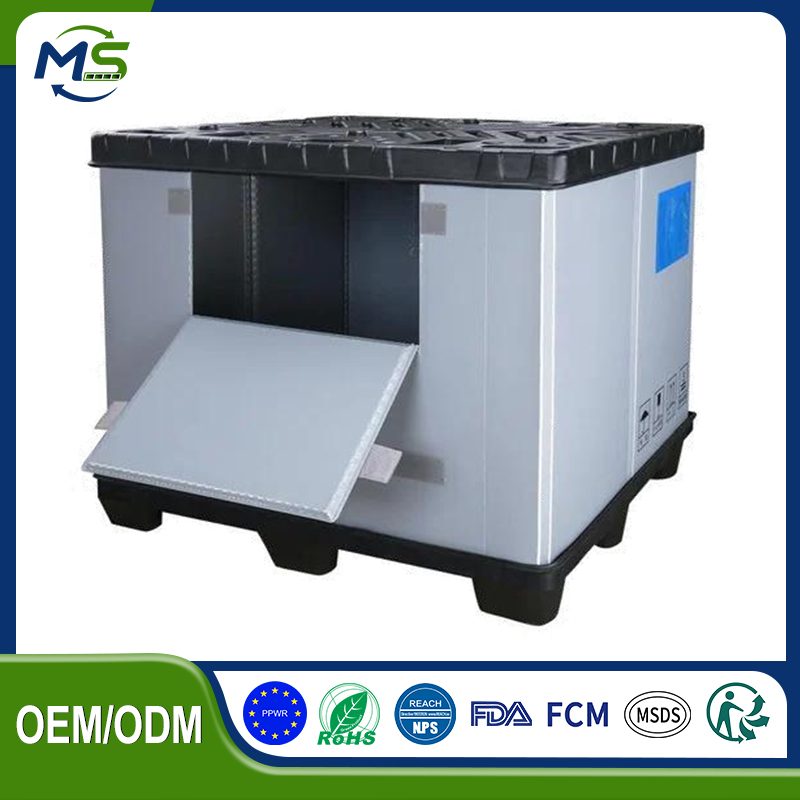
PP honeycomb pallet sleeve box used in overseas plant receiving – Mingskye reusable transport packaging.
The invoice appears at the destination as a waste charge, months after the packaging quotation was approved.
A shipment arrives in one-way wooden or mixed-material crates. The receiving plant has to segregate them, store them until a waste collection and pay a local disposal or recycling charge. That cost is booked to the receiving site budget, not to the purchase order that bought the parts.
The shipping plant sees a low unit packaging price and a clean despatch. Nobody connects the two figures, so the comparison between a disposable and a returnable option is made with one of its largest terms missing.
A crate that cannot be separated into one waste stream costs more to handle than its purchase price suggests.
Wood, metal fixings, foam and film in one assembly have to be split before they can enter a recycling stream. Where local regulation or a site contract assigns a cost per container or per tonne, the receiving plant pays for that handling on every shipment. A single-polymer transport box avoids the segregation step but creates an empty that somebody must own.
The second cause is an undefined empty. If the contract does not say who takes the returned unit and on which leg, the receiving site will treat it as waste by default, which reproduces the original charge in a different form.
For terminology and test-method context see International Chamber of Commerce. The guidance on this page is practical handling guidance, not a test report or a certificate.
Ask for the disposal rate per unit, the handling minutes per shipment and the storage space occupied.
The disposal rate turns a vague complaint into a line item that can sit beside freight in a comparison. Handling minutes capture the labour that no invoice shows. Storage space matters in a plant where waste skips occupy a loading bay that could otherwise hold a returnable stack.
Also ask who signs the waste note and on what cost centre. That identifies the budget owner who will be affected by a switch to a returnable pack, and therefore the person who should be in the trial.
| Symptom at destuffing | Carriage cause | Check at stuffing | Record to keep |
|---|---|---|---|
| How disposal cost reaches the receiving plant? | The invoice appears at the destination as a waste charge, months after the packaging quotation was … | A shipment arrives in one-way wooden or mixed-material crates. The receiving plant has to segregate … | Section 1 |
| Why mixed-material crates create the charge? | A crate that cannot be separated into one waste stream costs more to handle than its … | Wood, metal fixings, foam and film in one assembly have to be split before they … | Section 2 |
| Which figures to request from the receiving site? | Ask for the disposal rate per unit, the handling minutes per shipment and the storage space … | The disposal rate turns a vague complaint into a line item that can sit beside … | Section 3 |
| What a returnable sleeve box changes? | A reusable PP honeycomb box converts a disposal cost into a return-logistics cost and an asset … | The empty has value, so it is counted, folded and sent back on a planned … | Section 4 |
A reusable PP honeycomb box converts a disposal cost into a return-logistics cost and an asset register.
The empty has value, so it is counted, folded and sent back on a planned leg. That requires a consolidation point at the receiving plant, a folded stack that fits the available space, and a named owner for the count. Where those exist, the local waste charge falls away and the comparison can be made on freight plus return freight instead.
The box also needs to survive enough cycles to matter. Ask for a sample and run it through your own wash, fold and return steps rather than relying on a nominal cycle figure from a datasheet.
Put purchase, freight, destination handling, disposal and return freight on one sheet per shipment.
Use the same shipment volume and the same destination for both options. Add the receiving plant disposal rate from the previous section to the disposable case, and add the return leg plus an allowance for lost units to the returnable case. State the assumed cycle count and show a downside case with fewer cycles, because that is where the returnable model is most sensitive.
Include the cost of the first trial shipment separately. A pilot with an extra empty return leg will look worse than a steady-state loop, and the two should not be averaged together.
A low-volume or one-way lane may never repay the return leg.
Where shipments are infrequent, the receiving site has no consolidation space, or the empty cannot be carried on an existing backhaul, the return leg can cost more than the disposal it replaces. In that situation a lighter one-way pack or a local sourcing change is the honest answer, and the decision should be documented rather than left to the destination budget.
Regulatory frameworks on packaging waste are cited by name for context only. Applicability, current versions and local fee structures must be confirmed for your own markets.
The invoice appears at the destination as a waste charge, months after the packaging quotation was approved. A shipment arrives in one-way wooden or mixed-material crates. The receiving plant has to segregate them, store them until a waste collection …
A crate that cannot be separated into one waste stream costs more to handle than its purchase price suggests. Wood, metal fixings, foam and film in one assembly have to be split before they can enter a recycling stream. Where local …
A reusable PP honeycomb box converts a disposal cost into a return-logistics cost and an asset register. The empty has value, so it is counted, folded and sent back on a planned leg. That requires a consolidation point at …
A low-volume or one-way lane may never repay the return leg. Where shipments are infrequent, the receiving site has no consolidation space, or the empty cannot be carried on an existing backhaul, the …
References checked by publisher and title on 2026-11-24. Standards and regulations are cited by name only; no performance values are attributed to them. General material and logistics figures in the text are indicative reference values and should be verified against your supplier’s current data sheet and your own trial. Confirm applicability and current versions for your own operation before relying on any of them.
For a quotation, a sample box or help matching a wall, closure and pack layout to your own route, contact service@mingplastics.com or WhatsApp +86 189 3887 1524. Include the part or crop, the load per layer, the destination, the dwell time and the expected cycles per year so the recommended specification can be confirmed before you order.
For one-way crate disposal invoices at overseas plants, Request the local disposal rate per unit and put it next to the freight line before comparing packaging options. A low-volume or one-way lane may never repay the return leg.
Need a specification sheet, samples or a quotation for PP honeycomb panels, sleeve boxes or cable reels? Our team replies within one business day.
Tel / WhatsApp: +86 189 3887 1524
Email: service@mingplastics.com
WhatsApp: Chat with us