Address
Building 1, No. 22, Shexi Yongping Road,
Dongguan, Guangdong, China
Work Hours
Monday to Friday: 7AM - 7PM
Weekend: 10AM - 5PM
Address
Building 1, No. 22, Shexi Yongping Road,
Dongguan, Guangdong, China
Work Hours
Monday to Friday: 7AM - 7PM
Weekend: 10AM - 5PM
Corners crush first because the cell walls there have no neighbouring cells to share the load into, so a trolley wheel or a ... Ask Mingskye for a sample.
Corners crush first because the cell walls there have no neighbouring cells to share the load into, so a trolley wheel or a stacked pallet collapses a small area instead of being spread across the core. Visible local crushing is usually a handling or stacking problem rather than a whole-panel strength failure. Edge protection, flat stacking and sensible traffic routing prevent most of it.
This page covers crushed honeycomb panel corners in six sections: Crushed cores: what local crushing looks like; Edge chipping and the cost of unprotected stacking; Puncture and the point where the floor becomes; Overloading from vehicles and plant; Repairing panels instead of replacing them; Writing a defect report that gets a useful. Each section answers one practical question and can be read on its own.
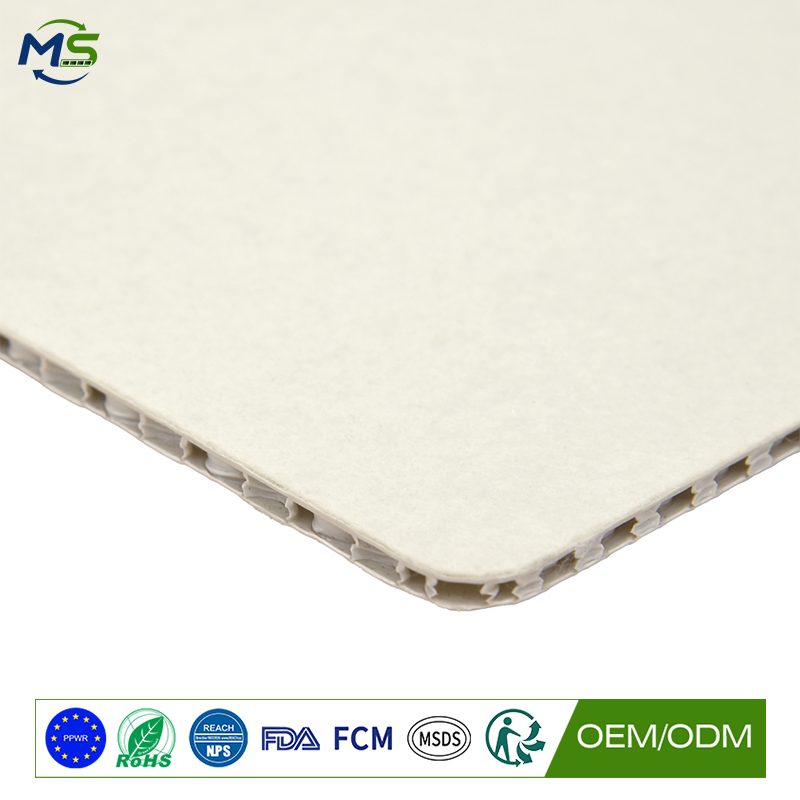
Local crushing shows up as a sharp permanent indentation under a single point, and it means the core height at that spot was never adequate for the load.
The difference between an acceptable deflection and a failure is whether the deformation is permanent. A panel that recovers to flat when the load is removed has flexed, not failed. A panel that keeps a dent has had its core walls buckle.
Buckled core walls do not recover, and the crushed region has lost most of its capacity. A panel with a crushed area should come out of service rather than be monitored, because the load path around the damage now concentrates on the adjacent cells.
The corrective action is almost always to spread the load rather than to buy a heavier panel everywhere. A spreader plate under the offending item, or a thicker board locally, resolves the problem at a fraction of the cost of upgrading the whole area.
Chipping at the edge is the most common damage to a panel in a reuse programme, and it is almost entirely caused by how panels are stored and moved.
The exposed cellular edge of a honeycomb panel is fragile. Dragging a panel across a floor, dropping one on its corner or stacking one on top of another with the edges misaligned will all chip the edge, and a chipped edge is where the panel will fail first.
Edge protection solves this directly. A capping strip, a wrapped edge or a board with a closed edge profile protects the vulnerable section and extends the working life of the panel considerably, particularly in a fleet that is handled repeatedly.
Storing panels with a consistent orientation, so that each panel rests on the same edge and the load runs down the walls rather than across them, reduces chipping without any extra cost. Mixed orientation stacking is the reason so many panels arrive with damaged corners.
For terminology and test-method context see ISO standards catalogue. The guidance on this page is practical site guidance, not a test report or a certificate.
A puncture is the most consequential failure of a protection board because it is the moment the substrate below becomes exposed to the traffic.
Punctures come from sharp points, not from weight. A protruding screw, a splinter of timber, a nail in a pallet foot or a chip of masonry will go through a facing in a way that a heavy load never would.
The repair is immediate and temporary. A patch of compatible material taped over the hole, with the edges sealed, is enough to restore the barrier while the damaged panel is replaced at the next changeover.
The investigation is more valuable than the repair. A cluster of punctures in one area usually means something in the workflow is dropping a sharp object, and the site will keep producing punctures until the workflow changes.
| Failure question | Short answer | What to inspect | In this guide |
|---|---|---|---|
| What should be checked about crushed cores: what local crushing looks … | Local crushing shows up as a sharp permanent indentation under a single point, and it means … | The difference between an acceptable deflection and a failure is whether the deformation is permanent … | Section 1 |
| What should be checked about edge chipping and the cost of … | Chipping at the edge is the most common damage to a panel in a reuse programme … | The exposed cellular edge of a honeycomb panel is fragile. Dragging a panel across a … | Section 2 |
| What should be checked about puncture and the point where the … | A puncture is the most consequential failure of a protection board because it is the moment … | Punctures come from sharp points, not from weight. A protruding screw, a splinter of timber … | Section 3 |
| What should be checked about overloading from vehicles and plant? | A protection board is not designed to carry the wheels of a forklift or a pallet … | Vehicle loads are far higher than pedestrian loads. A loaded pallet truck can put several … | Section 4 |
A protection board is not designed to carry the wheels of a forklift or a pallet truck, and vehicle traffic over panel protection fails in a predictable way.
Vehicle loads are far higher than pedestrian loads. A loaded pallet truck can put several tonnes through a small wheel footprint, which is three orders of magnitude beyond the point load the panel was chosen for.
The failure is progressive. The cells under the wheel crush, the face sheet collapses into the void, and the panel folds. It usually happens first at the leading edge where the panel is unsupported, and the damage is not visible until the panel is lifted.
Where vehicle access is unavoidable, the answer is a purpose-made roadway system rated for the load, or a temporary fill of compacted material laid directly on the ground. Using protection panels as a roadway saves money once and then costs the price of the panels and the floor beneath them.
Most damaged panels can be repaired, and in a fleet with a planned maintenance step that is usually cheaper than replacing them.
A puncture in the face is a patch job. Clean the area, dry it, and apply a compatible patch larger than the hole, sealed around the edges. The patch needs to be a material that bonds to the facing and that will not become a hard spot under traffic.
A crushed core cannot be repaired, because the internal structure has been permanently deformed. That panel can only be used on a lower duty, such as a vertical wall covering or a storage cover, and it should be marked so that it is not returned to a load-bearing role.
A cracked face with a sound core can often be recovered by trimming back to sound material and protecting the exposed edge. Recording the repair on the panel’s own history, so that a repaired panel is accounted for in the inspection regime, is what keeps the fleet trustworthy.
A defect report that names the panel, the batch, the location and the failure mode produces a replacement or a credit; a report that says the panels are faulty produces a dispute.
The first element is identification: the product name and grade, the batch or production date, the order reference, and the panel’s own mark if the fleet is numbered. Panels that are individually numbered make this trivial and are worth doing in any reuse programme.
The second element is the failure mode, described in physical terms rather than as a complaint. Saying the panel failed at a 4 mm working deflection under a 1500 kg per square metre load describes the mechanism and tells the supplier whether it is a design issue, a manufacturing issue or an application issue.
The third element is the evidence: photographs of the failed area, the panel edge in section, and the substrate beneath. A photograph of a sectioned edge is worth more than a description, because it shows the core structure and the bond line directly.
Local crushing shows up as a sharp permanent indentation under a single point, and it means the core height at that spot was never adequate for the load. The difference between an acceptable deflection and a failure is whether the deformation is permanent. A panel that recovers to flat when …
Chipping at the edge is the most common damage to a panel in a reuse programme, and it is almost entirely caused by how panels are stored and moved. The exposed cellular edge of a honeycomb panel is fragile. Dragging a panel across a floor, dropping one on its corner or …
A protection board is not designed to carry the wheels of a forklift or a pallet truck, and vehicle traffic over panel protection fails in a predictable way. Vehicle loads are far higher than pedestrian loads. A loaded pallet truck can put several tonnes through a small wheel footprint, which …
A defect report that names the panel, the batch, the location and the failure mode produces a replacement or a credit; a report that says the panels are faulty produces a dispute. The first element is identification: the product name and grade, the batch or production date, the order reference, and the panel’s own …
References checked by publisher and title on 2026-11-06. Standards and regulations are cited by name only; no performance values are attributed to them. General material-property figures in the text are indicative reference values for polypropylene and should be verified against your supplier’s current data sheet. Confirm applicability and current versions for your own project before relying on any of them.
For a quotation, a sample panel or help matching a thickness and facing to your site conditions, contact service@mingplastics.com or WhatsApp +86 189 3887 1524. Include the surface type, floor area, the trades working overhead and the expected duration so the recommended specification can be confirmed before you order.
For crushed honeycomb panel corners, Keep a condition record and an inspection rhythm so a failure can be diagnosed rather than guessed at. A defect report that names the panel, the batch, the location and the failure mode produces a replacement or a credit; a report that says the panels are …