Address
Building 1, No. 22, Shexi Yongping Road,
Dongguan, Guangdong, China
Work Hours
Monday to Friday: 7AM - 7PM
Weekend: 10AM - 5PM
Address
Building 1, No. 22, Shexi Yongping Road,
Dongguan, Guangdong, China
Work Hours
Monday to Friday: 7AM - 7PM
Weekend: 10AM - 5PM
A PP honeycomb protection board is a reusable sandwich panel made from two flat polypropylene skins bonded to a cellular ... Ask Mingskye for a sample.
A PP honeycomb protection board is a reusable sandwich panel made from two flat polypropylene skins bonded to a cellular honeycomb core. The core carries load through thin vertical walls instead of solid plastic, so the panel stays stiff at low weight. It is laid over finished floors during construction or fit-out to prevent scratches, dents and spills, then lifted, cleaned and used again.
This page covers PP honeycomb protection board in six sections: What a PP honeycomb protection board actually is; Twin-wall and twin-cell cores explained; How the face sheets and core are bonded; Thickness, density and weight: how the three relate; Why manufacturers choose polypropylene rather than another plastic; How to read a panel specification sheet. Each section answers one practical question and can be read on its own.
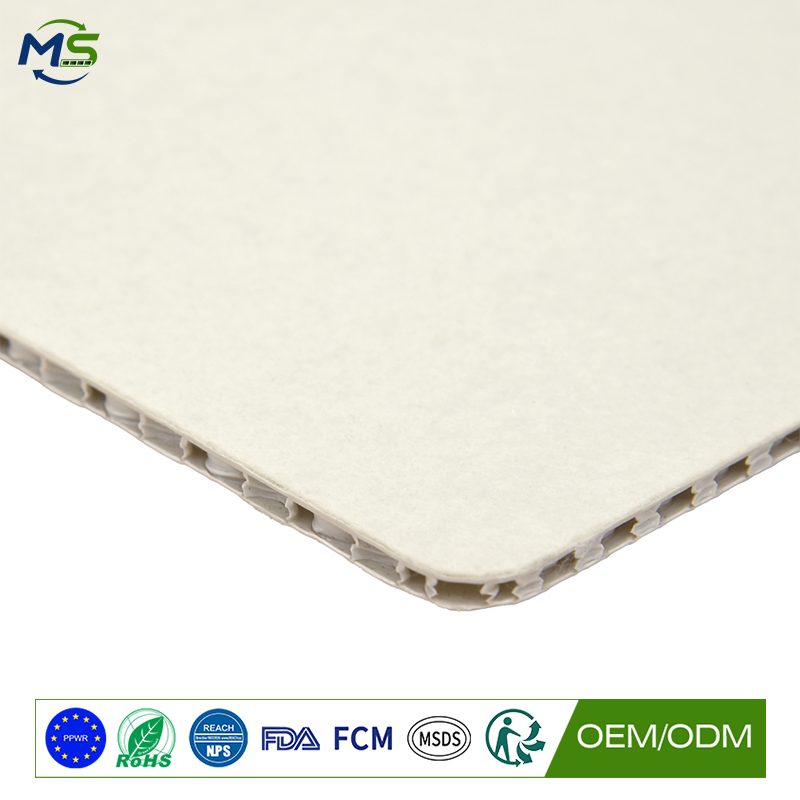
A PP honeycomb protection board is a lightweight sandwich panel made from two flat polypropylene skins bonded to a honeycomb core, and the core is what gives the board its strength-to-weight ratio.
The name describes the structure rather than the material. Polypropylene is the polymer, honeycomb describes the core geometry, and protection board describes the job. Instead of a solid slab of plastic, the material is distributed into thin walls that run perpendicular to the faces. Load applied to the surface is carried by those walls rather than by the full thickness of a solid sheet.
This matters on site because the two properties that decide whether a protection board works are weight and stiffness. A solid polypropylene sheet heavy enough to resist a point load is awkward to move, and awkward material gets left in the store. The honeycomb format reaches a useful stiffness at a fraction of the weight, which is why it can be carried by one person and still survive being stood on.
Because the core is hollow, the board is also a poor conductor of heat compared with a solid sheet of the same thickness. That is useful in cold rooms and on floors over heating systems, and it means the board can be left down through seasonal changes without acting as a thermal bridge.
Twin-wall and twin-cell cores describe how the polypropylene extrusions are assembled, and the difference shows up in edge strength and in how the board behaves when it is cut.
A twin-wall core is extruded as a hollow rectangular tube with a rib running down the centre. Two flat skins are bonded to the outer faces, and the core is cut and turned ninety degrees to fill the panel. The centre rib doubles the number of load-bearing walls in any given cross-section, which raises compressive strength for the same core height.
A twin-cell core is built from flat strips folded into a zig-zag between the skins. It is simpler to produce and uses less material, so it is usually chosen where cost matters more than edge performance.
The difference becomes practical at the edge of a panel. A twin-wall core exposes a visible cellular section that is stiffer and less prone to damage during handling, while a twin-cell edge shows a folded wall profile that can crush if the panel is dropped on its corner. For panels that will be moved repeatedly, edge profile is worth asking about.
For terminology and test-method context see ISO standards catalogue. The guidance on this page is practical site guidance, not a test report or a certificate.
The bond between the polypropylene faces and the honeycomb core determines whether a board delaminates, and most reputable manufacturers achieve it with heat and pressure rather than adhesive alone.
Because polypropylene is a thermoplastic, it can be welded. The standard process heats the extruded core and presses the face sheet against it so the two surfaces fuse. A welded bond is stronger than an adhesive bond and does not carry the same risk of the adhesive creeping under sustained heat.
The alternative route uses a polyurethane or epoxy-based adhesive and gives good results, but the bond line becomes the weakest point when the board is exposed to water, heat cycling or solvent contamination. Boards marketed for outdoor or chemical environments are worth checking for a welded bond rather than an adhesive one.
A simple way to judge bond quality without a laboratory is to look at the edge of a cut-off piece. A fused bond shows a continuous melted transition between the skin and the core wall, while an adhesive bond shows a sharp line and often a visible bead of glue.
| Question | Short answer | What to check on site | In this guide |
|---|---|---|---|
| What a PP honeycomb protection board actually is? | A PP honeycomb protection board is a lightweight sandwich panel made from two flat polypropylene skins … | The name describes the structure rather than the material. Polypropylene is the polymer, honeycomb describes … | Section 1 |
| What should be checked about twin-wall and twin-cell cores explained? | Twin-wall and twin-cell cores describe how the polypropylene extrusions are assembled, and the difference shows up … | A twin-wall core is extruded as a hollow rectangular tube with a rib running down … | Section 2 |
| How the face sheets and core are bonded? | The bond between the polypropylene faces and the honeycomb core determines whether a board delaminates, and … | Because polypropylene is a thermoplastic, it can be welded. The standard process heats the extruded … | Section 3 |
| What should be checked about thickness, density and weight: how the … | For a honeycomb panel the nominal thickness, the core height and the finished weight move together … | Nominal thickness is the overall panel depth including both face skins. Core height is that … | Section 4 |
For a honeycomb panel the nominal thickness, the core height and the finished weight move together, so specifying all three removes most of the ambiguity in a quote.
Nominal thickness is the overall panel depth including both face skins. Core height is that depth less the two skins, and the remaining material is what the honeycomb is folded into. Two panels of the same nominal thickness can have very different core heights depending on how the skins are sized, and that is what determines the load capacity.
Weight follows from the geometry. A thicker core adds wall height without adding much material, so weight increases gradually with thickness rather than in proportion to it. This is the reason a 10 mm honeycomb board can weigh less than a 6 mm solid sheet of the same material.
When requesting a quotation it is worth asking for the three figures together: nominal thickness in millimetres, core height in millimetres, and weight in kilograms per square metre. A supplier who can supply all three without checking is working from a real spec sheet rather than a catalogue thickness.
Polypropylene is used because it combines low density, high toughness and chemical resistance at a price that works for disposable and reusable protection.
Polypropylene has a density of roughly 0.90 to 0.92 g/cm³, which places it among the lightest of the common structural plastics. In a sandwich panel the face sheets carry the bending load, so the core material mainly needs to resist crushing, and polypropylene does that well even in thin walls.
The polymer also has a high ductility compared with materials such as polystyrene. It bends and deforms before it fractures, so an impact tends to leave a dent rather than a brittle crack. On a finished floor that difference is important, because a brittle shard can damage the substrate in a way a dent cannot.
Chemically, polypropylene resists dilute acids, alkalis, detergents, oils and many common construction contaminants. It is not resistant to strong oxidising acids, aromatic solvents or chlorinated solvents, so chemical exposure still needs to be checked case by case rather than assumed.
A usable specification sheet states the core geometry, the load capacity at a stated deflection, the facing, the tolerances and the test method for each figure.
Start with the structure: nominal thickness, core height, face sheet thickness and whether the core is twin-wall or twin-cell. These determine the geometry and therefore most of the performance.
Next read the performance figures with their test methods attached. Internal load capacity, flexural stiffness and the deflection limit belong together; a capacity figure quoted without a deflection and a test method cannot be compared with anything else. The same applies to a compressive strength figure quoted as a plain kilopascal value.
Finally check the commercial detail: dimensional tolerances, the standard the product is manufactured under, whether it is certified to a quality management system, and what happens if a batch fails on arrival. A sheet that supplies all of this is a specification; a sheet that supplies only thickness and a photograph is a brochure.
A PP honeycomb protection board is a lightweight sandwich panel made from two flat polypropylene skins bonded to a honeycomb core, and the core is what gives the board its strength-to-weight ratio. The name describes the structure rather than the material. Polypropylene is the polymer, honeycomb describes the core geometry, and protection board describes …
Twin-wall and twin-cell cores describe how the polypropylene extrusions are assembled, and the difference shows up in edge strength and in how the board behaves when it is cut. A twin-wall core is extruded as a hollow rectangular tube with a rib running down the centre. Two flat skins are bonded …
For a honeycomb panel the nominal thickness, the core height and the finished weight move together, so specifying all three removes most of the ambiguity in a quote. Nominal thickness is the overall panel depth including both face skins. Core height is that depth less the two skins, and the …
A usable specification sheet states the core geometry, the load capacity at a stated deflection, the facing, the tolerances and the test method for each figure. Start with the structure: nominal thickness, core height, face sheet thickness and whether the core is twin-wall or twin-cell. These determine the …
References checked by publisher and title on 2026-11-06. Standards and regulations are cited by name only; no performance values are attributed to them. General material-property figures in the text are indicative reference values for polypropylene and should be verified against your supplier’s current data sheet. Confirm applicability and current versions for your own project before relying on any of them.
For a quotation, a sample panel or help matching a thickness and facing to your site conditions, contact service@mingplastics.com or WhatsApp +86 189 3887 1524. Include the surface type, floor area, the trades working overhead and the expected duration so the recommended specification can be confirmed before you order.
For PP honeycomb protection board, Confirm the core construction, facing and test method in writing before comparing any two panels. A usable specification sheet states the core geometry, the load capacity at a stated deflection, the facing, the tolerances and the test method for each figure.


