Address
Building 1, No. 22, Shexi Yongping Road,
Dongguan, Guangdong, China
Work Hours
Monday to Friday: 7AM - 7PM
Weekend: 10AM - 5PM
Address
Building 1, No. 22, Shexi Yongping Road,
Dongguan, Guangdong, China
Work Hours
Monday to Friday: 7AM - 7PM
Weekend: 10AM - 5PM
Racking legs concentrate load onto warehouse floors. This guide covers thickness from 2 mm to 12 mm, install sequencing, set-down zones and a racking trial plan.
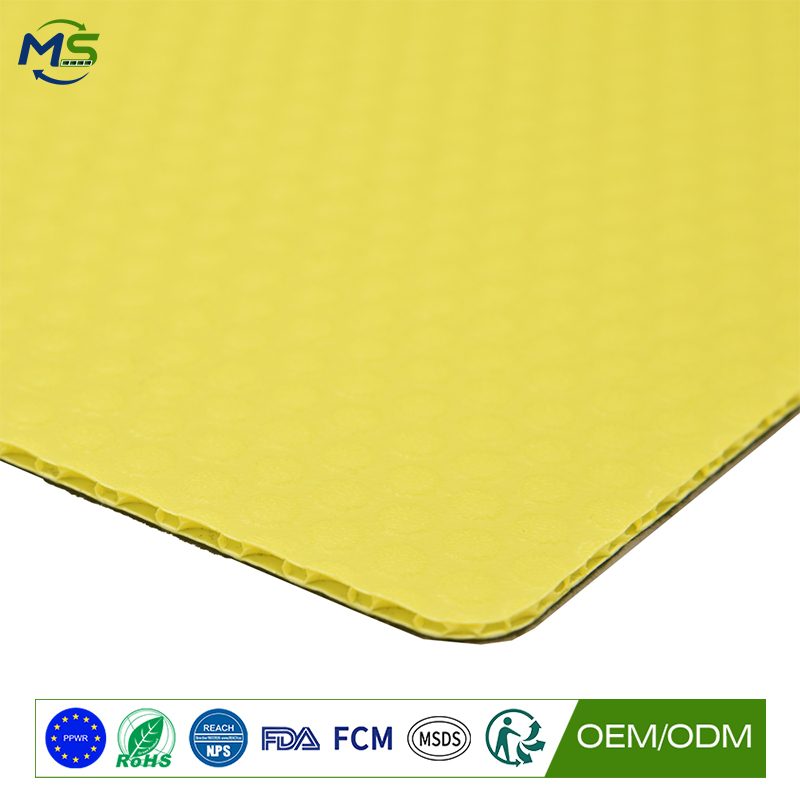
Racking installation puts steel legs, bracing and decking onto a finished warehouse floor, often while the building is being fitted out around it. The loads are concentrated and the sequence is repetitive, which means a protection mistake is repeated hundreds of times. This article looks at protecting floors during racking installation. The focus is leg loads, repetitive sequences and working around the install crew.
An upright leg transfers the rack’s load, and during installation the loaded footprint is smaller still as frames are stood and braced. That is when a slab or coating is most at risk.
A rigid PP honeycomb protection board spreads the leg load over a larger area, protecting the slab surface and any applied coating at exactly the point where damage would occur.
Because the panels are light and re-usable, they can be moved along the aisle as the installation progresses rather than being consumed row by row.
Racking installation justifies the upper part of the 2 mm to 12 mm range, because leg and component loads are high and often applied dynamically as frames are lifted into place.
For pedestrian routes alongside the works a mid thickness is enough. Under upright legs and where decking and frames are set down, thicker boards give the spreading that protects the floor.
| Board group | Typical thickness | Where it earns its place | Watch-outs |
|---|---|---|---|
| Light-duty panel | 2-3 mm | Pedestrian routes beside the installation | Unsuitable under upright legs |
| General aisle panel | 4-6 mm | Aisle traffic and light component handling | Tape seams along the direction of travel |
| Heavy-duty panel | 8-10 mm | Upright legs, bracing and set-down zones | Check coating tolerance to point loads |
| Maximum protection | 12 mm | Very heavy duty racking and mezzanine work | Confirm slab capacity for the rack design |
Agree with the install crew where protection goes and when it moves, because a board that slows the sequence will be moved aside rather than used.
Protect the set-down zones where frames and decking are staged, since that is where loads are applied repeatedly in the same place.
Tape seams along the aisle so panels do not separate under foot and wheel traffic, and inspect at the end of each day.
Plywood is the usual choice under racking legs and works, but it is heavy to move along an aisle and absorbs moisture in a warehouse environment.
Timber offcuts are inconsistent and often contaminated, and plastic sheeting offers no load spreading at all under a steel leg.
A PP honeycomb board gives consistent known performance, is light enough to move with the sequence and is reusable across the whole installation.
Protect one aisle and keep a comparable aisle on the current method. Inspect under the legs and at set-down zones at the end of each day.
Run a leg-load test by standing and bracing a frame on a sample panel, then lift and inspect the slab and coating.
Record how many rows each panel survived and how the install crew found the method, because adoption determines whether protection is used consistently.
State the slab type and coating, the rack type and leg loads, the aisle lengths and whether the building is live. Ask for the recommended thickness for concentrated leg loads.
Ask for guidance on moving protection with the install sequence, and about custom sizes to suit standard aisle widths.
For a quotation or sample panel, contact service@mingplastics.com or WhatsApp +86 189 3887 1524. Include the surface type, floor area, trades on site and expected duration so the recommended thickness, facing and fire performance can be confirmed before you order.
Protect under upright legs and set-down zones, agree the sequence with the install crew, and use the thick end of the range where concentrated steel loads land.


