Address
Building 1, No. 22, Shexi Yongping Road,
Dongguan, Guangdong, China
Work Hours
Monday to Friday: 7AM - 7PM
Weekend: 10AM - 5PM
Address
Building 1, No. 22, Shexi Yongping Road,
Dongguan, Guangdong, China
Work Hours
Monday to Friday: 7AM - 7PM
Weekend: 10AM - 5PM
Museum work needs reversible, non-shedding protection. This guide covers thickness from 2 mm to 12 mm, crate routes, conservation approval and a gallery trial plan.
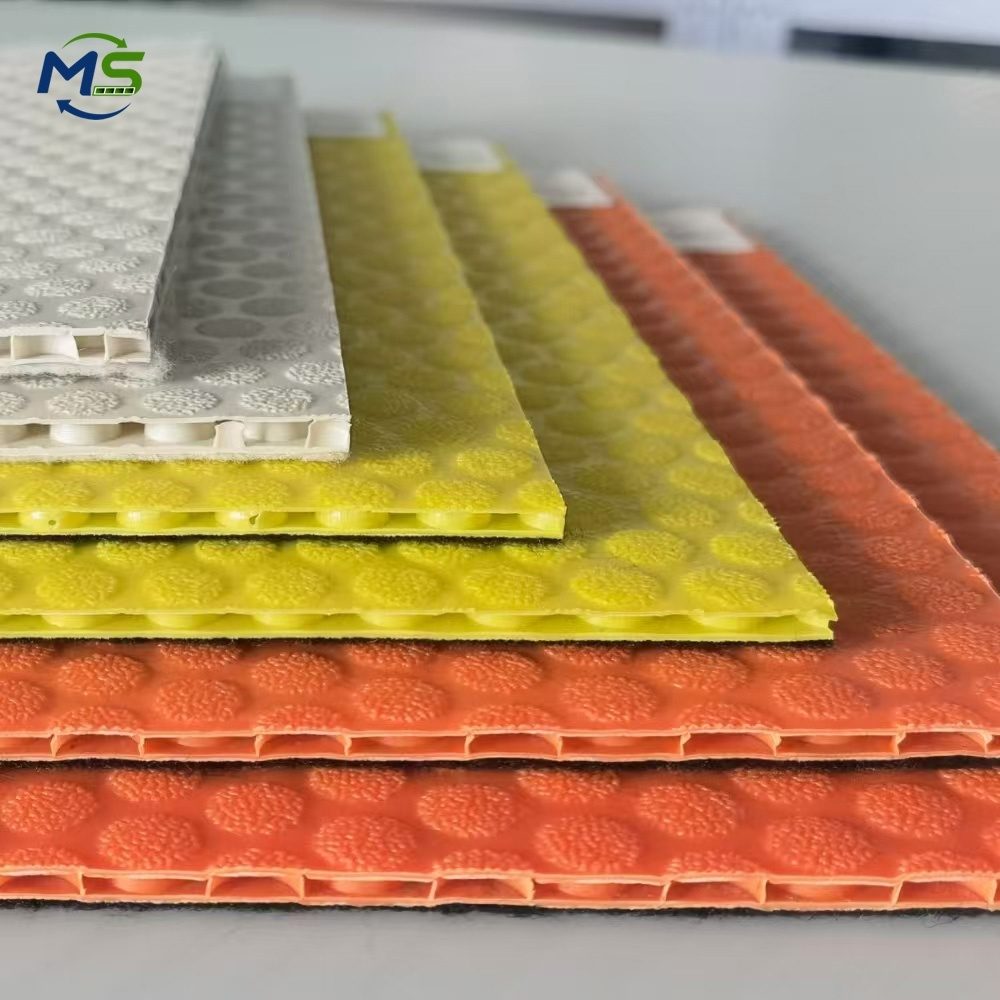
Museum and gallery work happens around objects that cannot be replaced, on floors and walls that are often historic, and under conservation constraints that govern every material brought into the space. This article looks at protecting surfaces during exhibition installation. The focus is reversible protection, handling collections and satisfying conservation requirements.
In a collection environment the first question is not cost but whether a material is permitted: reversible, non-shedding, low-odour and free of adhesives that could transfer.
A loose-laid rigid PP honeycomb protection board is reversible by nature: it is laid and lifted without bonding to the surface beneath.
The felt or fleece facing protects historic floors and wall surfaces from abrasion, which matters when the same route is used for weeks during an install.
Gallery routes carry crates, trolleys and scaffolding for lighting, so the middle to upper part of the 2 mm to 12 mm range is usually appropriate on floors.
For wall protection during hanging, thinner boards are easier to handle and fix. For crate routes and scissor lifts on historic floors, thicker boards spread the load better.
| Board group | Typical thickness | Where it earns its place | Watch-outs |
|---|---|---|---|
| Light-duty panel | 2-3 mm | Wall protection during hanging, pedestrian routes | Not for crate or trolley loads |
| General gallery panel | 4-6 mm | Gallery floors under installation traffic | Soft facing required on historic surfaces |
| Heavy-duty panel | 8-10 mm | Crate routes, scissor lifts, set-down zones | Heavier handling through historic openings |
| Maximum protection | 12 mm | Long installs with repeated heavy moves | More than hanging work needs |
Plan the crate route before anything is delivered: through the loading bay, along protected corridors and into the gallery, with no set-down point on an unprotected surface.
Protect turning and set-down zones as carefully as the straight route, because those are where concentrated loads occur and where historic floors most often fail.
Keep protection clear of cases, plinths and display fixings so that installers can work without lifting panels repeatedly.
Moving blankets are standard for objects but do nothing for floor loads, and they collect dust in a gallery environment.
Paper and cardboard absorb moisture, tear and shed, and are usually rejected by conservation teams for long programmes.
Plywood protects but is heavy to carry through historic routes and often needs fixings that are not permitted. A PP honeycomb board is lighter, reversible and non-absorbing, which is a combination conservation officers are more likely to accept.
Agree the trial with the conservation team first. Protect one route and keep a comparable route on the current method, with condition photographs taken before and after.
Run a crate-trolley test over the panels with a representative load, then lift and inspect the floor.
Record reversibility: confirm that lifting leaves no residue or mark, because that is the requirement that governs approval.
State the floor and wall types, the conservation constraints, the crate weights and the route layout. Ask for the recommended thickness, facing and panel size, plus fire performance.
Confirm in writing that the system is loose-laid and reversible, and ask about custom sizes for gallery dimensions and repeated case layouts.
For a quotation or sample panel, contact service@mingplastics.com or WhatsApp +86 189 3887 1524. Include the surface type, floor area, trades on site and expected duration so the recommended thickness, facing and fire performance can be confirmed before you order.
In collection environments, specify reversible loose-laid protection with a soft facing, protect set-down zones as carefully as routes, and confirm in writing that lifting leaves no residue.


